Lovebug
Plecia nearctica · also called love bug, love bugs, March fly and honeymoon fly · Last checked November 3, 2026.
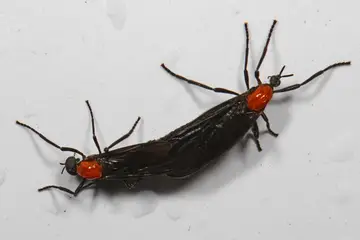

Lovebugs are small black flies with a red thorax, usually seen flying as joined pairs in huge swarms along Gulf Coast and southeastern highways. They are a nuisance rather than a danger: UF/IFAS calls them a nuisance pest, as opposed to destructive or dangerous, and Texas A&M Forest Service says they don't bite or sting. Big flights come for about four weeks in spring and again in late summer or fall. UF/IFAS Extension
On this page
Is the lovebug dangerous?
UF/IFAS: a nuisance pest, as opposed to destructive or dangerous. UF/IFAS Extension
“They are a nuisance pest, as opposed to destructive or dangerous, in areas where they accumulate in large numbers.”
Bites and stings: Texas A&M Forest Service says they don't bite or sting.
No official source we use states whether this animal is venomous. That does not mean it is harmless: do not handle it.
How to identify a lovebug
A photo or description can narrow it down, but cannot confirm what an animal is or that it is safe. Look from a distance and do not handle wild animals.
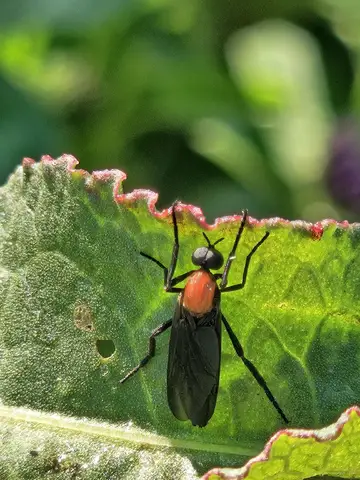
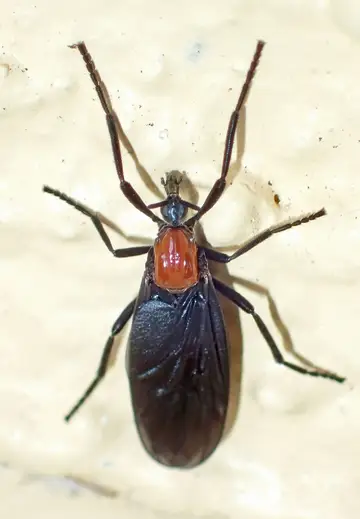
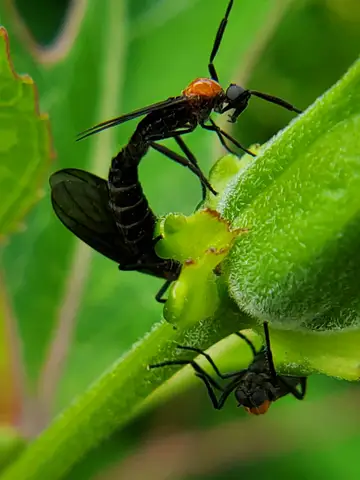
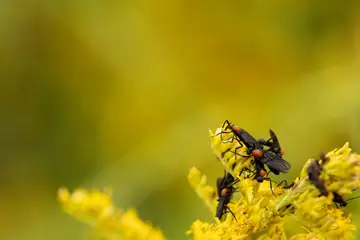
Size: Males about 1/4 inch; females about 1/4 to 1/3 inch. UF/IFAS Extension
Colors: Black with a red top of the thorax; LSU describes the thorax as bright orange. Pattern: Solid black body with a contrasting red patch behind the head.
Key features
- Fly as joined male-female pairs UF/IFAS Extension
- True flies with one pair of wings LSU AgCenter
- Males have very large eyes that occupy most of the head LSU AgCenter
Young
Larvae are slate gray, about 1/2 inch, living in groups under decaying vegetation.
Animals mistaken for the lovebug
Lovebug or Plecia americana?
Lovebug
Plecia americana Plecia americana
Thorax almost completely red, and it is a woodland species that does not seem to be a problem on highways. Fall Plecia are P. nearctica. UF/IFAS Extension
Lovebug or Dilophus sayi?
Lovebug
Dilophus sayi Dilophus sayi
Smaller, completely black, much less abundant, April to June only, and not noticeably on highways. UF/IFAS Extension
Where the lovebug lives
- Native or listed
- Nonnative or not established
- No official record in our data
- 1–9
- 10–99
- 100–999
- 1,000+
State boundaries: U.S. Census Bureau, cartographic boundary file cb_2024_us_state_20m.
When it is active
Two flights a year, each about four weeks. Florida: April-May and August-September. Texas: May and September. Louisiana: spring emergence in March or April, with a fall flight of P. nearctica. UF/IFAS Extension
US open-licence records peak in April to May and September.
Habitat and habits
Habitat: Larvae live in moist, decaying vegetation in grassy or weedy areas; adults gather on flowers and along highways. UF/IFAS Extension
Behavior: Daytime fliers drawn to vehicle exhaust exposed to sunlight, heat and light-colored surfaces; not attracted to electric lights.
Diet: Larvae eat decomposing leaves and grass; adults feed on nectar and pollen.
Young: Females lay about 350 eggs on average under decaying vegetation (UF/IFAS; Texas A&M Forest Service says 100 to 300). Adults live only days.
Questions about the lovebug
Love bug season
Two flights a year, each lasting about four weeks. UF/IFAS gives April-May and August-September for Florida, and Texas A&M Forest Service gives May and September for Texas.
Love bugs season
Generally spring and late summer or fall, about four weeks each. Timing shifts by place: Louisiana's spring flight starts in March or April, for example.
Love bug season end
Each flight lasts about four weeks. Texas A&M Forest Service says numbers rise quickly, peak at about two weeks and then decline. UF/IFAS says the species has been collected in Florida in every month of the year except November.
Love bug season florida
April-May and August-September, each lasting about four weeks. UF/IFAS adds a minor December peak in south Florida and says adults have been collected every month except November.
Love bug season texas
Texas A&M Forest Service says adults usually emerge in May and September, and each emergence lasts about four weeks. Massive outbreaks do not occur every year.
Love bug season louisiana
LSU AgCenter says adults emerge in March or April, with mating flights that may last over a month, and P. nearctica has another flight in fall.
Love bug season in Alabama, Georgia and Mississippi
No state-specific dates were found. UF/IFAS lists these states in the range, and Clemson Extension gives May and September for the southeastern US generally.
Love bug season houston
No Houston-specific dates were found. Texas A&M Forest Service gives May and September for Texas and mentions highways of southeast Texas.
Love bugs florida
Found throughout Florida. First collected in 1949 in Escambia County, and UF/IFAS says the idea that University of Florida scientists introduced them is a myth.
Love bugs texas
Yes. The species was first described from Galveston, and Texas A&M Forest Service reports two generations per year, with adults usually in May and September.
Love bugs houston
Texas A&M Forest Service describes massive emergences on the highways of southeast Texas in May or September.
Love bugs alabama
Yes. UF/IFAS lists Alabama among the states where the species is established.
Alabama love bugs
UF/IFAS lists Alabama among the states where the species is established.
Love bugs in georgia
Yes. UF/IFAS lists Georgia among the states where the species is established, and Texas A&M Forest Service mentions them along the Atlantic coast in Georgia and South Carolina.
Louisiana love bugs
Yes. LSU AgCenter says adults emerge in March or April, and that they form mating flights over open areas, especially highway corridors.
Love bugs origin
They were not created in a lab. UF/IFAS calls the University of Florida story a myth and documents the fly's spread around the Gulf Coast into Florida, with a migration map from Central America. LSU AgCenter calls the genetic-experiment story an urban legend.
Love bugs purpose
Larvae help recycle decaying plant matter into organic matter, and adults aid pollination while feeding on nectar and pollen.
Sources
- ENY-840/IN694: Living with Lovebugs. UF/IFAS Extension (EDIS). Original publication January 2007; checked November 3, 2026.
Quoted passages (6)
“They are a nuisance pest, as opposed to destructive or dangerous, in areas where they accumulate in large numbers.”
“…fly as pairs of males and females in tandem”
“An individual female deposits an average of 350 eggs under decaying vegetation in a grassy or weedy area with adequate moisture.”
“The larvae feed on decomposing leaves and grass until they pupate.”
“In nature, the adults live just long enough to mate, feed, disperse and deposit a batch of eggs, about 3–4 days”
“…than the Plecia species, completely black, and much less abundant, appearing only in April to June”
- Lovebugs. Texas A&M Forest Service. undated page; checked November 3, 2026.
Quoted passages (1)
“The flies are most active between about 9:00 a.m. and 5:00 p.m. They are not active at night and are not attracted to electric lights.”
- EENY-47/IN204: Lovebug, Plecia nearctica Hardy. UF/IFAS Extension (EDIS, Featured Creatures). Original publication August 1998; checked November 3, 2026.
Quoted passages (4)
“Males are 6–7 mm (~1/4 in), and females are 6–9 mm (~1/4 to 1/3 in) in length”
“Slate-gray larvae are often found in groups beneath decaying vegetation, where moisture is consistent.”
“Each of the two Plecia nearctica generations in Florida lasts about four weeks in April–May and August– September.”
“Plecia americana is a woodland species that does not seem to be a problem on highways.”
- Plecia spp., Lovebugs (Diptera: Bibionidae). LSU AgCenter. page timestamp 8/14/2019; checked November 3, 2026.
Quoted passages (2)
“…they are true flies with only one pair of wings”
“Males possess enormous eyes that are joined at the middle and occupy most of the top and sides of the head.”
- What is it? Wednesday: Lovebug. Clemson Cooperative Extension, Home & Garden Information Center. ©2021 Clemson Extension; checked November 3, 2026.
- Fact Or Fiction? The Truth About Those Pesky Lovebugs. UF/IFAS News. Posted May 27, 2004; checked November 3, 2026.
- GBIF.org occurrence records, human observations licensed CC0 1.0 or CC BY 4.0 only, accessed November 3, 2026. The datasets behind these counts are listed on our Sources page.
- State boundaries: U.S. Census Bureau, cartographic boundary file cb_2024_us_state_20m.