Luna moth
Actias luna · also called American moon moth · Last checked November 3, 2026.
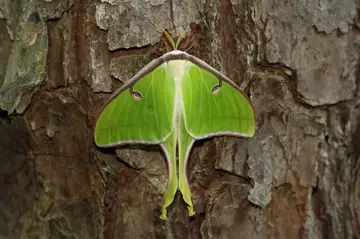
The luna moth is a large, pale or lime-green moth with a long tail on each hindwing and an eyespot on each of its four wings (wingspan about 3 to 4 1/4 inches). It lives in and near forests across the eastern United States, from Maine to Florida and west to eastern Texas and eastern North Dakota. Adults cannot eat and live only about a week. None of the official sources we checked say whether luna moths are any danger to people. Missouri Department of Conservation
On this page
Is the luna moth dangerous?
No official source we use states whether this animal is venomous. That does not mean it is harmless: do not handle it.
How to identify a luna moth
A photo or description can narrow it down, but cannot confirm what an animal is or that it is safe. Look from a distance and do not handle wild animals.
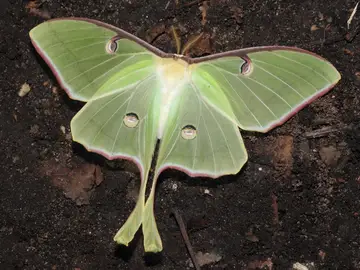
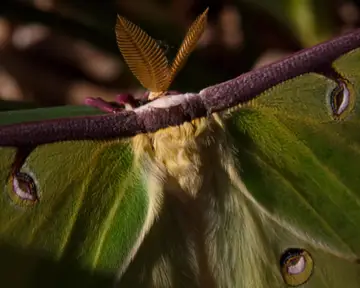
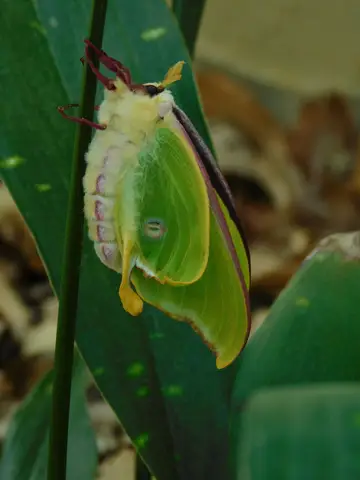
Size: Wingspan 3 to 4 1/4 inches; caterpillars up to 3 1/2 inches long. Missouri Department of Conservation
Colors: Pale or lime green, with a dark leading edge on the forewings; spring broods deeper green with reddish-purple wing margins; later broods more yellowish. Pattern: Eyespot on each of the four wings; long tapering tail on each hindwing.
Key features
- Lime-green color and long tails set it apart from all other North American moths Missouri Department of Conservation
- Feathery antennae, larger on males Missouri Department of Conservation
Young
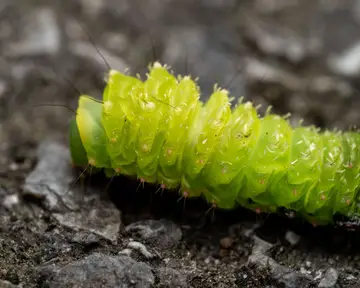
Caterpillar: bright green with narrow yellow bands at the back of each segment, a yellowish side stripe, rows of reddish tubercles and a brownish head.
Animals mistaken for the luna moth
Luna moth or Polyphemus moth (caterpillar)?
Luna moth
Polyphemus moth (caterpillar) Antheraea polyphemus
The polyphemus caterpillar's yellow bands run near the middle of each segment, across the spiracles; the luna caterpillar's bands are at the back edge of each segment. Missouri Department of Conservation
Where the luna moth lives
- Native or listed
- Nonnative or not established
- No official record in our data
- 1–9
- 10–99
- 100–999
- 1,000+
State boundaries: U.S. Census Bureau, cartographic boundary file cb_2024_us_state_20m.
When it is active
Nocturnal. One generation a year in the north, two in the Ohio Valley and three farther south; Missouri adults fly early April through August, and adults can be found in every month in Louisiana and Florida.
US open-licence records peak in May to August.
Habitat and habits
Habitat: In and near deciduous woodlands where the caterpillars' food trees grow; adults are attracted to lights at night.
Behavior: Mostly active at night. To deter predators, caterpillars click and regurgitate distasteful fluid; the adults' hindwing tails disrupt bat sonar.
Diet: Caterpillars eat leaves of walnut, hickory, pecan, persimmon, sweetgum and sumac; adults have reduced mouthparts and do not eat.
Young: Eggs hatch in 8 to 13 days; caterpillars pupate in a thin silk cocoon in leaf litter; adults live about a week, only long enough to mate and lay eggs.
Sources
- Luna Moth (Field Guide). Missouri Department of Conservation. undated page; checked November 3, 2026.
Quoted passages (7)
“Wingspan: 3–4¼ inches; larvae can grow up to 3½ inches long.”
“The luna moth’s distinctive lime-green color and long tails distinguish it from all other North American moths.”
“The antennae, particularly on males, are feathery.”
“Larvae are bright green caterpillars, the segments convex (expanded outward) with narrow yellow bands positioned at the hind part of each segment”
“Luna moth caterpillars eat the foliage of walnuts, hickories, pecan, persimmon, sweet gum, and sumacs. Adults, like other members of the giant silkworm family, have reduced mouthparts, so they don’t eat at all.”
“Eggs incubate for 8–13 days before hatching. The caterpillars feed and grow larger, then pupate in a thin, silken cocoon spun among leaf litter on the ground, and emerge as winged adults.”
“Similar species: The caterpillar of the polyphemus moth looks quite similar, but it has the yellow bands running nearly across the spiracles, about at the center of each segment, instead of at the back edge of each segment.”
- Luna Moth, Actias (=Tropaea) luna (EENY-411/IN737, Featured Creatures). University of Florida IFAS Extension (EDIS / Ask IFAS). undated page; checked November 3, 2026.
- GBIF.org occurrence records, human observations licensed CC0 1.0 or CC BY 4.0 only, accessed November 3, 2026. The datasets behind these counts are listed on our Sources page.
- State boundaries: U.S. Census Bureau, cartographic boundary file cb_2024_us_state_20m.