Mud dauber
Sphecidae and Crabronidae (two wasp families); main US species: Sceliphron caementarium, Chalybion californicum, Trypoxylon politum · also called mud dauber wasp, black and yellow mud dauber, blue mud dauber and organ pipe mud dauber · Last checked November 3, 2026.
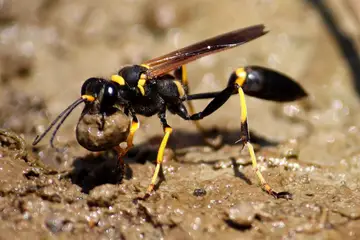

Mud daubers are solitary, thread-waisted wasps that build nests of mud on eaves, garages and barns and stock them with paralyzed spiders. Females can sting but rarely do: Missouri says they only sting if handled roughly, and UF/IFAS says stings are rare and not of medical importance. They do not defend their nests the way paper wasps and yellowjackets do. The black and yellow mud dauber is found throughout the US. Missouri Department of Conservation
This page covers a family (Sphecidae and Crabronidae (two wasp families); main US species: Sceliphron caementarium, Chalybion californicum, Trypoxylon politum), not a single species.
On this page
Is the mud dauber dangerous?
Missouri Department of Conservation: solitary, do not aggressively sting people; females can sting but only do so if mishandled. Missouri Department of Conservation
“These wasps are solitary and do not aggressively sting people. The females are capable of stinging people but only do so if mishandled.”
Bites and stings: Stings rather than bites. Females can sting; Missouri says males lack stingers.
If someone is bitten or stung, call 911 or Poison Help at 1-800-222-1222.
How to identify a mud dauber
A photo or description can narrow it down, but cannot confirm what an animal is or that it is safe. Look from a distance and do not handle wild animals.
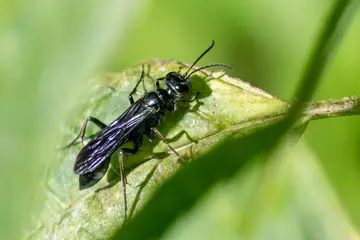
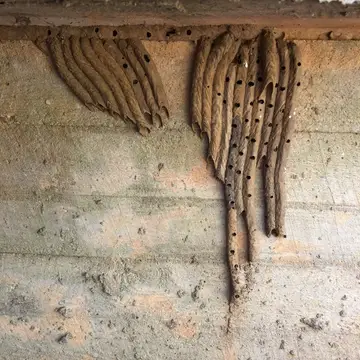
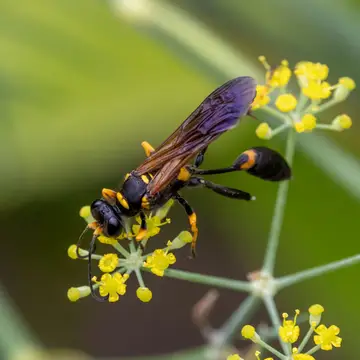
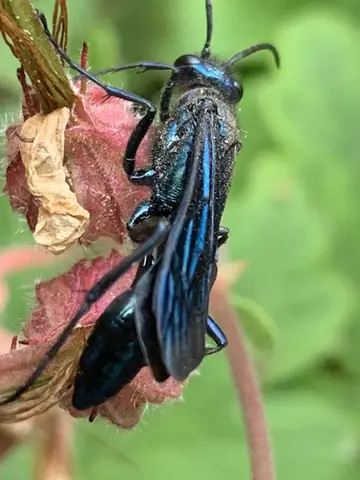
Size: 3/4 to 1 inch; UF/IFAS gives 21 to 25 mm for the black and yellow mud dauber. UF/IFAS Extension
Colors: black, yellow and metallic blue. Pattern: banded and solid.
Key features
- Narrow or threadlike waist. Missouri Department of Conservation
- Black and yellow mud dauber: lump-shaped nest about the size of a lemon or a fist. Missouri Department of Conservation
- Blue mud dauber: metallic blue; reworks old nests into lumpy shapes. Missouri Department of Conservation
- Organ pipe mud dauber: black with blue wings and white 'stockings'; nest of vertical parallel tubes. Missouri Department of Conservation
- Nests are clay or mud cells under eaves and in garages. UF/IFAS Extension
Young
Grublike larvae develop inside sealed mud cells, feeding on stored spiders.
Animals mistaken for the mud dauber
Mud dauber or Spider wasps?
Mud dauber
Spider wasps Pompilidae
Spinier legs, with extra-long hind legs that dangle in flight; often seen dragging a spider on the ground. Missouri Department of Conservation
Mud dauber or Mason and potter wasps?
Mud dauber
Mason and potter wasps
Lack a long narrow waist; mud nests look like little round pots or jugs. Missouri Department of Conservation
Mud dauber or Great golden digger wasp and great black wasp?
Mud dauber
Great golden digger wasp and great black wasp
Larger, nest in the ground, and have a less pronounced narrow waist. Missouri Department of Conservation
Mud dauber or Asiatic mud dauber?
Mud dauber
Asiatic mud dauber Sceliphron curvatum
Reddish brown, with a striped abdomen; each nest cell sits separately. UF/IFAS says it is not yet known whether it is established in the US. UF/IFAS Extension
Where the mud dauber lives
- Native or listed
- Nonnative or not established
- No official record in our data
- 1–9
- 10–99
- 100–999
- 1,000+
State boundaries: U.S. Census Bureau, cartographic boundary file cb_2024_us_state_20m.
When it is active
Minnesota: June through August. Colorado: first adults emerge in late May or early June. Missouri: pass the winter as immature wasps in the nests. University of Minnesota Extension
US open-licence records for the three main US mud daubers (Sceliphron caementarium, Chalybion californicum and Trypoxylon politum) peak in June to August.
Habitat and habits
Habitat: Natural sites include cave entrances, rock overhangs and hollow trees; people notice nests in barns, garages, house eaves and under bridges. Missouri Department of Conservation
Behavior: Solitary. Females collect mud balls at puddle edges and build cells, each taking about an hour. Do not defend nests the way colony-forming wasps do.
Diet: Adults drink nectar. Larvae eat paralyzed spiders stored in the nest; blue mud daubers use large numbers of black widows.
Young: A female lays a single egg in each provisioned cell, then seals it. One to three generations a year.
Questions about the mud dauber
Mud dauber
A solitary, thin-waisted wasp that builds mud nests on buildings and stocks them with paralyzed spiders. Females can sting but rarely do, usually only if handled roughly. If you have a serious reaction, call 911 or Poison Help at 1-800-222-1222.
Sources
- Mud Daubers. Missouri Department of Conservation. undated page; checked November 3, 2026.
Quoted passages (12)
“These wasps are solitary and do not aggressively sting people. The females are capable of stinging people but only do so if mishandled.”
“Mud daubers are familiar wasps with narrow or threadlike waists.”
“…the final product is rounded like a lump, and about the size of a lemon or a fist.”
“The common blue mud dauber (Chalybion californicum) is a pretty metallic blue; it often refurbishes the nests of other types of mud daubers.”
“…is black with blue wings, with white ‘stockings’ on the hind legs.”
“…so when the grublike wasp larvae hatch, they have fresh food to eat and fuel their growth.”
“People often notice nests in barns, garages, and the eaves of houses.”
“Common blue mud daubers use large numbers of black widow spiders.”
“The solitary species, such as mud daubers, do not defend their nests the way paper wasps, yellow jackets, and other colony-forming species do.”
“However, they have spinier legs, with extra-long hind legs that typically dangle in flight”
“…these nests typically resemble little round pots or jugs affixed to a wall or other structure.”
“The great golden digger wasp and great black wasp are larger and nest in the ground.”
- EENY-654/IN1478 Black and Yellow Mud Dauber. UF/IFAS Extension (Featured Creatures). Original May 2016; checked November 3, 2026.
Quoted passages (1)
“Sceliphron curvatum makes nests with each individual cell separate from the rest”
- ENY-215 Stinging or Venomous Insects and Related Pests. UF/IFAS Extension. Revised Feb 2022; checked November 3, 2026.
Quoted passages (3)
“Mud Daubers 3/4–1 inch (1.9–2.4 cm); black and yellow, or metallic blue, or shiny black.”
“Mud daubers build clay or mud-cell nests.”
“One to three generations can develop in a year.”
- Black and yellow mud dauber. University of Minnesota Extension. undated page; checked November 3, 2026.
Quoted passages (1)
“…found June through August.”
- GBIF.org occurrence records, human observations licensed CC0 1.0 or CC BY 4.0 only, accessed November 3, 2026. The datasets behind these counts are listed on our Sources page.
- State boundaries: U.S. Census Bureau, cartographic boundary file cb_2024_us_state_20m.