Praying mantis (mantids)
Mantidae · also called praying mantid, mantis, mantid and Carolina mantis · Last checked November 3, 2026.
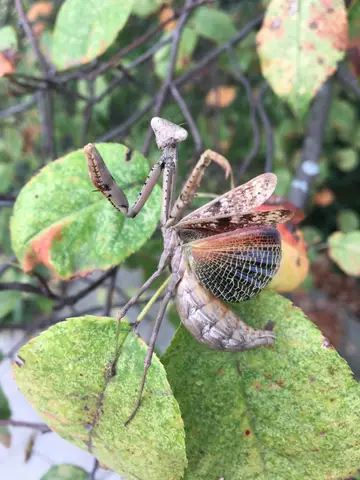
Praying mantises (mantids) are predatory insects that fold their spiny front legs in a "praying" position while they wait to grab insects. The Missouri Department of Conservation says the Chinese mantis is considered harmless to humans. Kentucky has three species, the native Carolina mantis and the introduced European and Chinese mantises, and the Chinese mantis is common statewide in Missouri. People usually see them on vegetation around houses and in grasslands, pastures and farm fields. Most live only about a year: they mate and lay eggs in late summer, die when it freezes, and the eggs overwinter in egg cases. University of Kentucky Entomology
This page covers a family (Mantidae), not a single species.
On this page
Is the praying mantis dangerous?
Missouri Department of Conservation, on the Chinese mantis: fierce predators of insects, but considered harmless to humans. Missouri Department of Conservation
“Although mantises are fierce predators to insects, this species is considered harmless to humans.”
No official source we use states whether this animal is venomous. That does not mean it is harmless: do not handle it.
How to identify a praying mantis
A photo or description can narrow it down, but cannot confirm what an animal is or that it is safe. Look from a distance and do not handle wild animals.
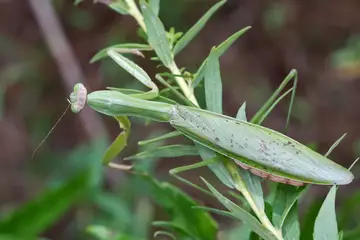
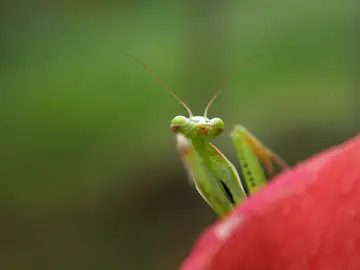

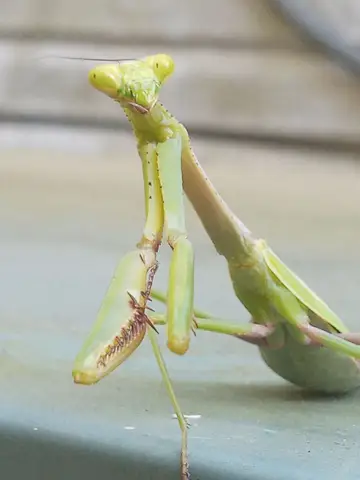
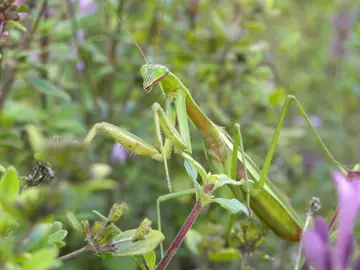
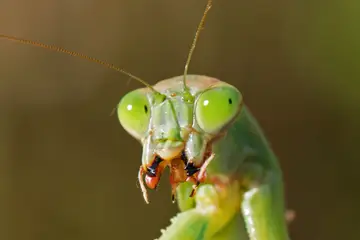
Size: Carolina mantis about 2 to 2.5 inches; European mantis about 3 inches; Chinese mantis 3 to 5 inches.
Colors: Green, tan or brown depending on species; camouflage coloring.
Key features
- Front legs are raised in a "praying" position and have long sharp spines for holding prey. University of Kentucky Entomology
- Triangular head that swivels. Missouri Department of Conservation
- Egg cases (ootheca) of the Chinese mantis: tan, fairly round, about Ping-Pong-ball size, said to resemble toasted marshmallows; usually attached to twigs of bushes and small trees. Missouri Department of Conservation
Young
Young (nymphs) look like small adults without fully developed wings; very young ones often curl the abdomen tip upward.
Animals mistaken for the praying mantis
Praying mantis (mantids) or Chinese mantis?
Praying mantis (mantids)
Chinese mantis Tenodera sinensis
Largest (up to 5 inches); fairly square facial shield with vertical stripes; usually tan with a green line along the side. Missouri Department of Conservation
MDC: considered harmless to humans (quoted in dangerous.statement)
Praying mantis (mantids) or European mantis?
Praying mantis (mantids)
European mantis Mantis religiosa
About 3 inches; tan to bright green; a round black dot (sometimes white-centered) on the underside of the base of each big foreleg. MDC notes the spot can be hard to see when the forelegs are held together. Missouri Department of Conservation
not stated
Praying mantis (mantids) or Carolina mantis?
Praying mantis (mantids)
Carolina mantis Stagmomantis carolina
Smallest (about 2.5 inches); pale green to tan or mottled gray; in adult females the wings reach only three-fourths of the way down the abdomen. Missouri Department of Conservation
not stated
Where the praying mantis lives
- Native or listed
- Nonnative or not established
- No official record in our data
- 1–9
- 10–99
- 100–999
- 1,000+
State boundaries: U.S. Census Bureau, cartographic boundary file cb_2024_us_state_20m.
When it is active
Most mantids live only about a year: they hatch in spring, grow through the growing season, mate and lay eggs in late summer and die when it freezes; eggs overwinter in egg cases. UKY: Kentucky mantids have only one generation per year.
US open-licence records for all mantises in the family Mantidae peak in August to October.
Habitat and habits
Habitat: Tall plants and other perches with a view: vegetation around houses, grasslands, pastures, farm fields and other open areas. Missouri Department of Conservation
Behavior: Lie-in-wait predators: sit still on plants and grab passing prey with the front legs. Cannibalistic; the female sometimes eats the male during mating.
Diet: All kinds of insects and spiders, including pests but also other insect predators, pollinators and butterflies. Large female Chinese mantises have occasionally been recorded eating small reptiles, amphibians and even hummingbirds; MDC says this seems relatively rare.
Young: Females lay 12 to 400 eggs in a frothy mass that hardens into a protective case; young hatch in spring.
Legal status and reporting
Invasive status: MDC calls the Chinese mantis nonnative and says nonnative mantids may be outcompeting native North American mantids; because it has been widespread for so long, its ecological impact is difficult to determine, and MDC does not settle whether it is "invasive". Louisiana lists the Chinese mantis on its 2025 SWAP Invasive Species List (Tier 3: limited or poorly known negative impacts). MDC suggests leaving the native Carolina mantis alone and says that if people want to experiment with mantids as pest control, the native Carolina mantis is the better choice.
Sources
- ENTFACT-418: Praying Mantids. University of Kentucky Entomology (Cooperative Extension). Revised: 1/26; checked November 3, 2026.
Quoted passages (2)
“When hunting mantids assume a "praying" position, folding the legs under their head. … Long sharp spines on the upper insides of these legs allow them to hold to on their prey.”
“After mating, the female will lay groups of 12-400 eggs in a frothy liquid that turns to a hard protective shell. This is how these insects survive the winter. Small mantids emerge from this case in the spring.”
- Chinese Mantis (Field Guide). Missouri Department of Conservation. undated page; checked November 3, 2026.
Quoted passages (9)
“Although mantises are fierce predators to insects, this species is considered harmless to humans.”
“The head is triangular and swivels, so the mantis can track prey without otherwise moving.”
“Egg cases resemble tan toasted marshmallows. They are fairly round, about as long as wide, Ping-Pong-ball size; usually attached to twigs of bushes and small trees.”
“Immature mantids look a lot like the adults, but without fully developed wings. Very young mantids often have the abdomen tip curled upward.”
“Mantises perch in tall plants or other areas with a view, waiting to snatch any insect that flies or crawls past. People usually see them in or near the vegetation around houses as well as in grasslands, pastures, agricultural areas, and other open areas.”
“Mantises eat all kinds of insects and spiders, and adult females of this species have been known to eat small reptiles, amphibians, and even hummingbirds. … Mantids eat many pest insects, but they also eat insects that humans tend to appreciate, such as other insect predators, pollinators, butterflies, and so on. … these seem to be relatively rare occurrences”
“Chinese mantises can reach 5 inches long and range from pale green to tan — usually tan, with a green line running down the side (the edges of the forewings). … Examine the facial shield (the part of the face in front of the antennae and between the eyes): in the Chinese mantis, it is fairly square and has vertical stripes.”
“…it grows only to about 3 inches, and its color ranges from tan to bright green. A key diagnostic feature is a round black dot on the underside of the basal joint (coxa) of the big forelegs. Sometimes this black dot has a white center. This spot can be hard to see when their ‘arms’ are held together.”
“The Carolina mantis (Stagmomantis carolina) is native to the United States; it is smaller, only reaching about 2½ inches. It is pale green to tan or mottled gray, and the wings extend only three-fourths of the way down the abdomen in adult females.”
- GBIF.org occurrence records, human observations licensed CC0 1.0 or CC BY 4.0 only, accessed November 3, 2026. The datasets behind these counts are listed on our Sources page.
- State boundaries: U.S. Census Bureau, cartographic boundary file cb_2024_us_state_20m.