Tomato Hornworm
Manduca quinquemaculata · also called five-spotted hawkmoth (adult), five-spotted hawk moth (adult), hawk moth (adult) and sphinx moth (adult) · Last checked November 3, 2026.
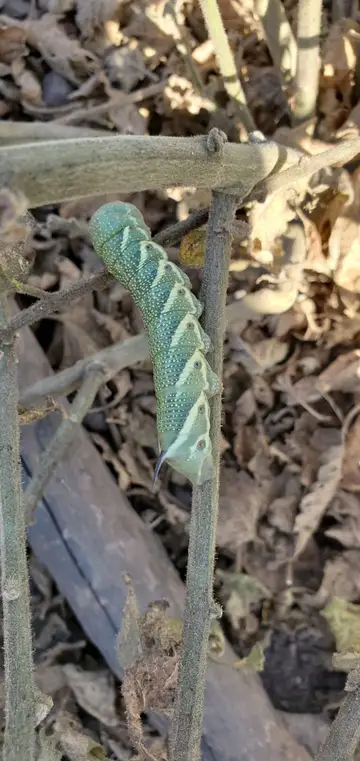
The tomato hornworm is a large green caterpillar, up to about 3 to 4 inches long, with white V-shaped markings and a dark horn at the rear. It feeds on tomato and related plants and becomes a large moth called the five-spotted hawkmoth. Official sources do not treat it as a danger to people: Texas A&M AgriLife calls it medically harmless, and the Connecticut Agricultural Experiment Station says the horn is not venomous. The UF/IFAS range is northern Mexico to southernmost Canada, unevenly; it is uncommon in the Southeast, where the look-alike tobacco hornworm takes its place. UF/IFAS Extension
On this page
Is the tomato hornworm dangerous?
Medically harmless according to Texas A&M AgriLife; the horn is not venomous according to the Connecticut Agricultural Experiment Station, which says it is ornamental and a bluff against predators. Texas A&M AgriLife Extension Service
“Caterpillars feed on certain plants, adult moths feed on nectar; medically harmless.”
How to identify a tomato hornworm
A photo or description can narrow it down, but cannot confirm what an animal is or that it is safe. Look from a distance and do not handle wild animals.
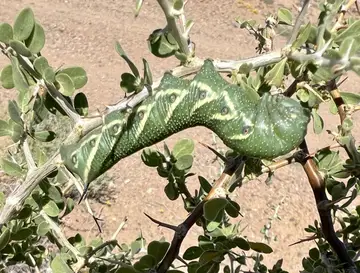
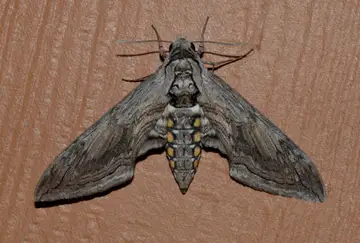
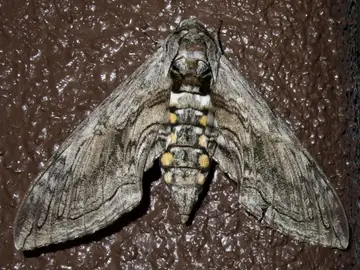
Size: Caterpillar up to 3 to 4 inches. Sources vary: 3 inches (CAES), 3 to 4 inches (AgriLife, Rutgers), up to 4 inches (Maine, Minnesota, Wisconsin). Texas A&M AgriLife Extension Service
Colors: Green body. Wisconsin describes it as blue-green. Michigan State says the tomato hornworm occasionally occurs as a "black" or dark form; horn black in most sources; Maine says blue-black, N.C. says blue, Rutgers says dark green or black. Pattern: Eight V-shaped white marks on each side.
Key features
- Horn on the last abdominal segment, usually black in this species UF/IFAS Extension
- Adult moth has five pairs of orange-yellow abdominal spots Texas A&M AgriLife Extension Service
- White rice-like cocoons on the back are wasp pupae, not hornworm eggs Connecticut Agricultural Experiment Station
Young
Small caterpillars are yellow to white with no markings (Minnesota); UF/IFAS says each stage is larger but otherwise very similar.
Animals mistaken for the tomato hornworm
Tomato Hornworm or Tobacco hornworm?
Tomato Hornworm
Tobacco hornworm Manduca sexta
Tobacco hornworm: seven white diagonal lines and a horn that is usually red. Tomato hornworm: V-shaped marks (eight on each side) and a horn that is frequently black. Adult moths: the Carolina sphinx typically has six pairs of abdominal spots, the five-spotted hawkmoth five. UF/IFAS Extension
Not stated separately; the CAES statement that the horns are not venomous covers both species.
Where the tomato hornworm lives
- Native or listed
- Nonnative or not established
- No official record in our data
- 1–9
- 10–99
- 100–999
- 1,000+
State boundaries: U.S. Census Bureau, cartographic boundary file cb_2024_us_state_20m.
When it is active
Caterpillars in summer: Wisconsin says adults emerge in late June and advises checking plants from early July through August; Texas and Minnesota say adult moths emerge in spring. Winter is spent as a pupa in the soil. University of Wisconsin-Madison Division of Extension
US open-licence records peak in July to September.
Habitat and habits
Habitat: Gardens and fields with tomato and related nightshade plants. Well camouflaged among the leaves. UF/IFAS Extension
Behavior: Larvae and adults are most active from dusk until dawn. Caterpillars generally stay on the host plant until the last stage.
Diet: Caterpillars eat leaves and sometimes green fruit of tomato, pepper, eggplant, potato and tobacco, plus weeds such as jimsonweed. Adult moths feed on nectar.
Young: Eggs are laid singly on host plants. Caterpillars feed for 3 to 4 weeks (AgriLife), then pupate in the soil.
Questions about the tomato hornworm
Tomato hornworm
A large green caterpillar with V-shaped white marks and a dark horn at the rear, feeding on tomato and related plants. It becomes the five-spotted hawkmoth. Texas A&M AgriLife calls it medically harmless, and the Connecticut Agricultural Experiment Station says the horn is not venomous.
Sources
- EENY700/IN1206: Tomato Hornworm Manduca quinquemaculata (Haworth). UF/IFAS Extension (Featured Creatures). page copyright 2022; checked November 3, 2026.
Quoted passages (5)
“…the horn, a small protrusion on the final abdominal segment of the caterpillar that gives the hornworm its name, of the tomato hornworm is black”
“Tomato hornworms are well camouflaged among the leaves of their host plants.”
“…is a common garden pest that feeds on plants in the Solanaceae (nightshade) family including tomato, peppers, eggplant, and potato.”
“…is most active from dusk until dawn”
“…tomato hornworm has V-shaped yellow-white markings on the body and the tobacco hornworm has white diagonal lines”
- Tomato Hornworm - Field Guide to Common Texas Insects. Texas A&M AgriLife Extension Service. archived copy, captured June 14, 2026; checked November 3, 2026.
Quoted passages (4)
“Caterpillars feed on certain plants, adult moths feed on nectar; medically harmless.”
“Caterpillars can reach 3 to 4 inches in length”
“The moth’s abdomen is marked with five pairs of orange-yellow spots.”
“…caterpillars develop through five stages (instars) for 3 to 4 weeks until they pupate 3 to 4 inches deep in the soil.”
- Tomato and Tobacco Hornworm (fact sheet). Connecticut Agricultural Experiment Station. undated page; checked November 3, 2026.
Quoted passages (2)
“The horns are not venomous.”
“…white rice-shaped ‘eggs.’ These are actually the pupal cocoons of the wasps.”
- Tomato hornworms in home gardens. University of Minnesota Extension. archived copy, captured May 19, 2026; checked November 3, 2026.
Quoted passages (1)
“Small tomato hornworms are yellow to white in color with no markings.”
- Hornworms (XHT1107). University of Wisconsin-Madison Division of Extension. Last Revised 05/01/2020; checked November 3, 2026.
Quoted passages (1)
“…frequently monitor tomatoes for hornworm larvae from early July through August”
- GBIF.org occurrence records, human observations licensed CC0 1.0 or CC BY 4.0 only, accessed November 3, 2026. The datasets behind these counts are listed on our Sources page.
- State boundaries: U.S. Census Bureau, cartographic boundary file cb_2024_us_state_20m.