Velvet Ant
Mutillidae (velvet ants); best-known US species Dasymutilla occidentalis (eastern or red velvet ant, "cow killer") · also called Cow killer, Cow ant, Eastern velvet ant and Red velvet ant · Last checked November 3, 2026.
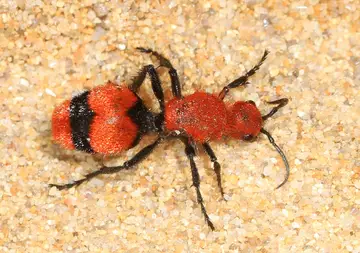
Velvet ants are not ants. They are solitary wasps: the wingless, fuzzy, brightly colored females run over bare sandy ground, and the males have wings. Females can sting, and official sources describe the sting as excruciating and extremely painful, which is where the name "cow killer" comes from. Clemson Extension says the sting is rarely dangerous. They are not aggressive and sting when picked up or stepped on barefoot. Nearly 500 species live in North America north of Mexico. The big red-and-black eastern velvet ant (Dasymutilla occidentalis) is the most common species in South Carolina, according to Clemson Extension, and the largest and most brightly colored in Missouri, according to the Missouri Department of Conservation. Missouri Department of Conservation
This page covers a family (Mutillidae (velvet ants); best-known US species Dasymutilla occidentalis (eastern or red velvet ant, "cow killer")), not a single species.
On this page
Is the velvet ant dangerous?
Missouri Department of Conservation: velvet ants are not aggressive, but they will sting if held or stepped on with bare feet. The sting is excruciating, hence the name "cow killer". MDC also says a 1996 study found their venom comparatively less toxic than that of harvester ants and honeybees. Missouri Department of Conservation
“Velvet ants are not aggressive, but they will sting if held or if stepped on with bare feet. The stinger is extraordinarily long, and the sting is excruciating, hence the popular name ‘cow killer.’”
Bites and stings: Stings, not bites. Stings usually happen to people walking barefoot where velvet ants live, or handling them carelessly (Texas AgriLife).
If someone is bitten or stung, call 911 or Poison Help at 1-800-222-1222.
How to identify a velvet ant
A photo or description can narrow it down, but cannot confirm what an animal is or that it is safe. Look from a distance and do not handle wild animals.
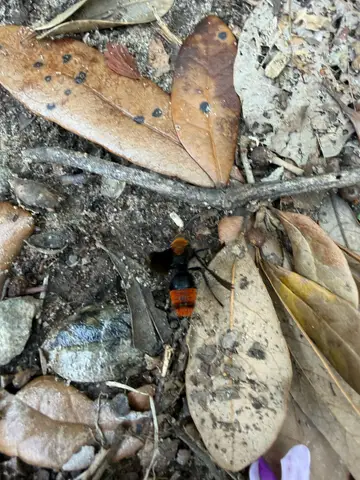
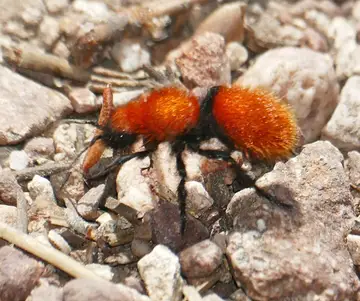

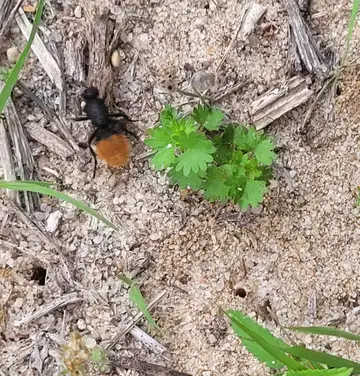
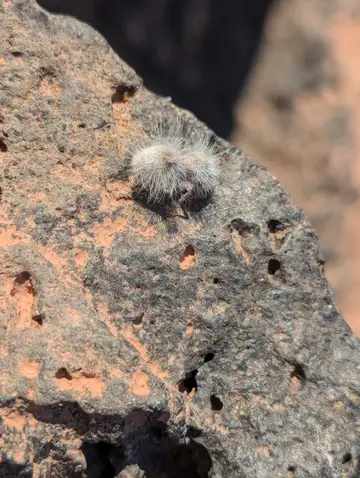
Size: About 1/2 to 1 1/4 inches long, depending on species Missouri Department of Conservation
Colors: Usually brightly colored, often in shades of red and orange, with blackish legs; most kinds black or brown, often strikingly ringed or marked with red, yellow or orange; eastern velvet ant: black and orange-red; other species: black, red, orange or white in various patterns. Pattern: Dense velvety hair in bright patterns of black with red, yellow or orange.
Key features
- Females wingless and ant-like, like large furry ants; males winged and look like ordinary wasps Missouri Department of Conservation
- Run rapidly over the ground Missouri Department of Conservation
- May squeak when disturbed, a warning sound Clemson University Cooperative Extension, Home & Garden Information Center
- Very hard body, difficult to crush Texas A&M AgriLife Extension Service
Animals mistaken for the velvet ant
Velvet Ant or Ants (true ants)?
Velvet Ant
Ants (true ants) Formicidae
True ants are social insects; velvet ants are solitary wasps that travel alone and look like large, furry, brightly colored ants. Missouri Department of Conservation
Varies by species; red imported fire ants sting (see Texas AgriLife B-6118).
Where the velvet ant lives
- Native or listed
- Nonnative or not established
- No official record in our data
- 1–9
- 10–99
- 100–999
- 1,000+
State boundaries: U.S. Census Bureau, cartographic boundary file cb_2024_us_state_20m.
When it is active
Daytime, in the warm part of the year. In South Carolina they are common from about May through September and are seen most during cooler daylight hours, especially late afternoon. Texas AgriLife says Texas velvet ants are found during summertime. Clemson University Cooperative Extension, Home & Garden Information Center
US open-licence records for all velvet ants (family Mutillidae) peak in June to September.
Habitat and habits
Habitat: Open, dry, sunny, sandy places such as sunny lawns and cemeteries, where their host bees and wasps nest Missouri Department of Conservation
Behavior: Females search the ground for host nests, break in, and lay eggs on the host larvae or pupae. The eastern velvet ant parasitizes bumble bee nests.
Diet: Adults eat nectar. Larvae develop inside the nests of ground-nesting bees and wasps and eat the host young.
Young: Usually one generation a year. Young overwinter in the host nest before becoming adults.
Questions about the velvet ant
Velvet ant sting
Only females sting. Missouri Department of Conservation calls the sting excruciating, and Texas AgriLife says it is usually much more painful than a bee sting. Clemson Extension says it is rarely dangerous. Texas AgriLife adds that a generalized rash or difficulty breathing after any insect sting means seeing a doctor immediately. In an emergency, call 911 or Poison Help at 1-800-222-1222.
Velvet ant bite
Velvet ants sting rather than bite, and only females can sting. Texas AgriLife says stings usually happen when people walk barefoot where velvet ants live or handle them carelessly.
Velvet ant stinger
Missouri Department of Conservation says the female's stinger is extraordinarily long. Texas AgriLife says the stinger (ovipositor) is very long and males cannot sting.
Velvet ant cow killer
"Cow killer" is a nickname for the eastern (red) velvet ant, Dasymutilla occidentalis, because the female's sting is so painful. Clemson Extension says there is nothing to show any cow has ever been killed by one.
Velvet ant male
Males have wings and look more like ordinary wasps. Texas AgriLife says males cannot sting. Both sexes can squeak.
Velvet ant location
Look in open, dry, sunny, sandy places such as lawns and cemeteries, where their host bees and wasps nest. Official sources confirm them in Missouri, Ohio, South Carolina and Texas, and MDC says nearly 500 species occur in North America north of Mexico.
Velvet ant texas
Yes. Texas AgriLife says velvet ants are found in Texas in summer in both urban and rural areas, including the red velvet ant ("cow killer"), the gray velvet ant and thistle down mutillids.
Sources
- Velvet Ants (Field Guide). Missouri Department of Conservation. undated page; checked November 3, 2026.
Quoted passages (8)
“Velvet ants are not aggressive, but they will sting if held or if stepped on with bare feet. The stinger is extraordinarily long, and the sting is excruciating, hence the popular name ‘cow killer.’”
“Length: about ½ to 1¼ inches, depending on species.”
“Female velvet ants are wingless throughout their lives; males are winged.”
“Velvet ants usually run on the ground quite rapidly.”
“They are most often found in open, dry, sunny, sandy areas such as sunny lawns or cemeteries.”
“Adult velvet ants, like many other wasps and bees, eat nectar.”
“The eastern velvet ant, Dasymutilla occidentalis, the largest and most brightly colored species of velvet ant in the state, parasitizes bumble bee nests.”
“True ants are social insects, while velvet ants are a group of solitary wasps.”
- Velvet Ants (HGIC 2485). Clemson University Cooperative Extension, Home & Garden Information Center. Revised: Jul 18, 2022; checked November 3, 2026.
Quoted passages (2)
“Velvet ants may also produce a squeaking sound when disturbed.”
“In South Carolina, they are common from about May through September. They are most often seen during cooler daylight hours, especially late afternoon.”
- Venomous Terrestrial Animals of Texas (B-6118). Texas Cooperative Extension (now Texas A&M AgriLife Extension). 8-04 (publication code B-6118 8-04; checked November 3, 2026.
Quoted passages (1)
“The species highlighted here are some of the best known, most commonly encountered, and most dangerous of venomous animals.”
- Velvet Ants (ENT-3004). Texas A&M AgriLife Extension Service. undated page; checked November 3, 2026.
Quoted passages (2)
“Velvet ants have very hard bodies and are difficult to crush.”
“Velvet ants spend the winter inside the nest of their hosts in a pre-adult stage. There is usually only one generation a year.”
- Bees and Wasps of Ohio Field Guide (Publication 5488). Ohio Department of Natural Resources, Division of Wildlife (text by Eric R. Eaton). PUBLICATION 5488; checked November 3, 2026.
- GBIF.org occurrence records, human observations licensed CC0 1.0 or CC BY 4.0 only, accessed November 3, 2026. The datasets behind these counts are listed on our Sources page.
- State boundaries: U.S. Census Bureau, cartographic boundary file cb_2024_us_state_20m.