Vinegaroon (giant whip scorpion)
Mastigoproctus (giant vinegaroons); UF/IFAS treats the US animal as Mastigoproctus giganteus giganteus · also called giant whip scorpion, giant whipscorpion, whip scorpion and grampus · Last checked November 3, 2026.
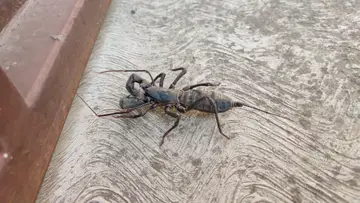
The vinegaroon, or giant whip scorpion, is a large, nearly black arachnid with heavy pincer-like pedipalps, long thin front legs and a thin whip-like tail. It is not a true scorpion and is not venomous: UF/IFAS says it has neither a venom-filled stinger nor a venomous bite, and the New Mexico Poison & Drug Information Center says it is not venomous. It can pinch if mishandled and can spray a vinegar-like acid that irritates skin, eyes and mouth. UF/IFAS lists it in Arizona, Florida, New Mexico, Oklahoma and Texas. UF/IFAS Extension, Department of Entomology and Nematology
This page covers a genus (Mastigoproctus (giant vinegaroons); UF/IFAS treats the US animal as Mastigoproctus giganteus giganteus), not a single species.
On this page
Is the vinegaroon dangerous?
Not venomous. The New Mexico Poison & Drug Information Center says that, unlike true scorpions, vinegaroons are not venomous, but their vinegar secretions can irritate the skin, eyes and mouth. New Mexico Poison & Drug Information Center
“Vinegaroons are black and nocturnal creatures. Unlike true scorpions, they are not venomous, but their vinegar secretions can cause irritation to the skin, eyes, and mouth.”
Bites and stings: No venomous bite or sting. The pedipalps (pincers) can give a noticeable pinch if it is mishandled (UF/IFAS; Texas A&M: 'they can pinch'). Its defensive acid spray can irritate skin, eyes and mouth (NM Poison & Drug Information Center).
If someone is bitten or stung, call 911 or Poison Help at 1-800-222-1222.
How to identify a vinegaroon
A photo or description can narrow it down, but cannot confirm what an animal is or that it is safe. Look from a distance and do not handle wild animals.
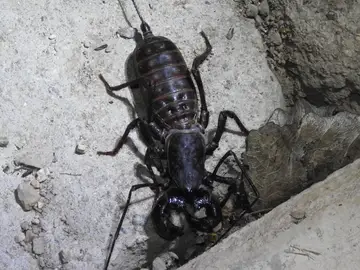

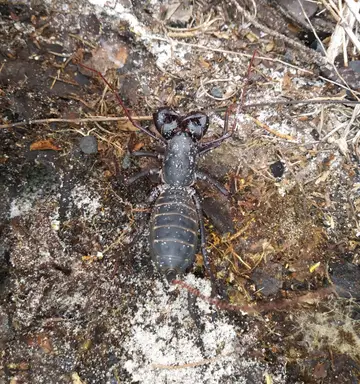

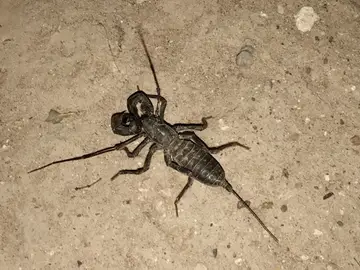
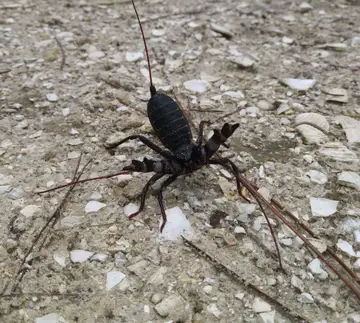

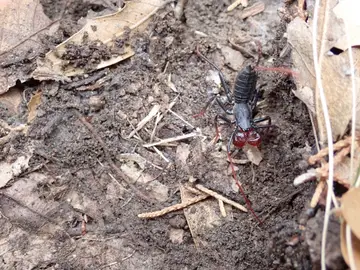
Size: Body up to about 5 cm (2 in), not counting the tail (UF/IFAS); Texas A&M gives adult bodies of 1 1/2 to 3 inches UF/IFAS Extension, Department of Entomology and Nematology
Colors: Nearly black (Texas species); black (NM Poison Center). Pattern: No pattern described in the official sources checked.
Key features
- Heavy pincer-like pedipalps; long thin first legs used like antennae; long thin whip-like tail Texas A&M AgriLife Extension Service
- Scorpion-like pincers in front but a whip tail with no stinger National Park Service
- Vinegar smell from its acetic-acid spray UF/IFAS Extension, Department of Entomology and Nematology
Young
Young are white when they hatch and ride on the mother's back for about a month; after the first molt they look like miniature adults
Animals mistaken for the vinegaroon
Vinegaroon (giant whip scorpion) or Scorpions (true scorpions, including the Arizona bark scorpion)?
Vinegaroon (giant whip scorpion)
Scorpions (true scorpions, including the Arizona bark scorpion) Scorpiones (e.g., Centruroides sculpturatus)
NPS: the vinegaroon has scorpion-like pincers in front but a whip tail in back with no stinger. The NM Poison & Drug Information Center says the Arizona bark scorpion stings with the tips of its tail. National Park Service
Venomous. NM Poison & Drug Information Center: all scorpions produce venom; the Arizona bark scorpion is the only species that causes serious illness.
Vinegaroon (giant whip scorpion) or Camel spider (sun spider, windscorpion)?
Vinegaroon (giant whip scorpion)
Camel spider (sun spider, windscorpion) Solifugae
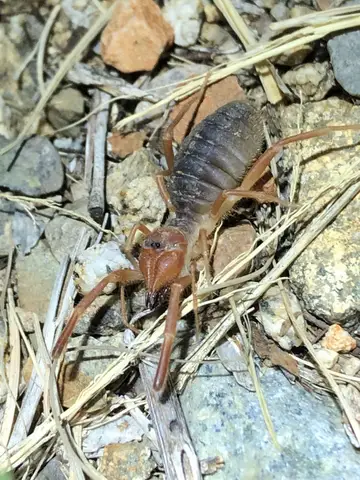
UC IPM: the windscorpion (camel spider) is 3/4 to 1-1/2 inches long and yellowish brown, with a rounded abdomen, no stinger and no scorpion-like pincers, but large pincerlike jaws. University of California Statewide IPM Program
See camel-spider page.
Vinegaroon (giant whip scorpion) or Tailless whip scorpion (whip spider)?
Vinegaroon (giant whip scorpion)
Tailless whip scorpion (whip spider) Amblypygi
University of Wyoming Extension: tailless whipscorpions are around half an inch long, with long, whip-like front legs and claws held closed in front of the body. University of Wyoming Extension
Where the vinegaroon lives
- Native or listed
- Nonnative or not established
- No official record in our data
- 1–9
- 10–99
- 100–999
- 1,000+
State boundaries: U.S. Census Bureau, cartographic boundary file cb_2024_us_state_20m.
When it is active
Nocturnal. In Florida it spends the driest periods underground and is active on the surface in the rainy season (May/June to November). NPS (Gila, NM): may be seen on nighttime walks in summer. UF/IFAS Extension, Department of Entomology and Nematology
US open-licence records for all giant vinegaroons (genus Mastigoproctus) peak in July to August.
Habitat and habits
Habitat: More common in arid areas, but also grassland, scrub, pine forests and barrier islands. By day it hides in burrows and under logs, boards, rotting wood and rocks. UF/IFAS Extension, Department of Entomology and Nematology
Behavior: When threatened it retreats to its burrow or rears up with pedipalps spread, and can spray acetic acid accurately from a few inches to about a foot
Diet: Soft-bodied insects such as termites, cockroaches and crickets, crushed in the pedipalps
Young: Mates in fall; the female lays 30-40 eggs in a fluid-filled sac held under her abdomen and stays in her burrow holding the sac for about two more months. Whip scorpions can live at least seven years.
Questions about the vinegaroon
Whip scorpion bite
Vinegaroons (whip scorpions) are not venomous. UF/IFAS says they have no venom-filled stinger and no venomous bite, but their pincer-like pedipalps can give a noticeable pinch if mishandled. Their vinegar spray can irritate skin, eyes and mouth (NM Poison & Drug Information Center). For an exposure, call Poison Help at 1-800-222-1222, or 911 in an emergency.
Whip scorpion arizona
Yes. UF/IFAS lists Arizona among the states where the giant whip scorpion occurs, along with Florida, New Mexico, Oklahoma and Texas.
Whip scorpion vs vinegaroon
They are the same animal. UF/IFAS says the giant whip scorpion is also known as the vinegaroon (or grampus), named for the vinegar-like acetic acid it sprays.
Whip scorpion location
UF/IFAS lists Arizona, Florida, New Mexico, Oklahoma, Texas and Mexico. In Texas it is found mainly in the west, especially the Trans-Pecos (Texas A&M AgriLife). It hides by day in burrows and under logs, boards and rocks.
Whip scorpion vs tailless whip scorpion
No official source checked compares the two directly.
Sources
- Giant Whip Scorpion Mastigoproctus giganteus giganteus (EENY493/IN890). UF/IFAS Extension, Department of Entomology and Nematology (University of Florida). EENY493: original publication May 2011, reviewed May 2020; checked November 3, 2026.
Quoted passages (8)
“This is a fairly large creature, up to 5 cm long, which does not include the caudal flagellum or telson.”
“This produces that tell-tale vinegar-like scent.”
“The young are white in color when they hatch from the eggs and then climb onto their mother's back for about one month. Once the first molt is complete the second instar young look like miniatures of the adults.”
“While more commonly encountered in arid areas, Mastigoproctus giganteus can also be found in grassland, scrub, pine forests and barrier islands.”
“The primary prey of Mastigoproctus giganteus are soft bodied insects like termites, cockroaches, and crickets.”
“When threatened, vinegaroons seek the refuge of their burrows or put on a bluff display of rearing up and spreading their pedipalps. They can also accurately spray acetic acid from a pore at the base of the caudal filament to a distance of a few inches to one foot.”
“They spend the driest periods underground and become active on the surface during Florida's rainy season (May/June–November).”
“Mating takes place in the fall. … She carries the eggs internally for several months and then lays 30 to 40 eggs in a fluid filled sac held under her abdomen.”
- Bites and Stings. New Mexico Poison & Drug Information Center (UNM Health Sciences; New Mexico's poison-control program). undated page; checked November 3, 2026.
Quoted passages (1)
“Vinegaroons are black and nocturnal creatures. Unlike true scorpions, they are not venomous, but their vinegar secretions can cause irritation to the skin, eyes, and mouth.”
- Vinegaroon - Field Guide to Common Texas Insects. Texas A&M AgriLife Extension Service (Department of Entomology). archived copy, captured July 14, 2026; checked November 3, 2026.
Quoted passages (1)
“Vinegaroons have heavy mouthparts (pedipalps) that are formed into pincers. The first pair of legs is long and thin and is used like antenna to feel their way around. … The tail is long and thin suggesting a whip which is where the common name, "whipscorpion," originates for the order Uropygi.”
- Insects, Spiders, Centipedes, Millipedes - Gila Cliff Dwellings National Monument. National Park Service. updated April 24, 2025; checked November 3, 2026.
Quoted passages (2)
“It has scorpion-like pinchers in the front but a non-scorpion whiptail in the back, with no stinger.”
“Visitors often mistake it for a giant scorpion. It is a whip scorpion, not a true scorpion. It has scorpion-like pinchers in the front but a non-scorpion whiptail in the back, with no stinger.”
- Windscorpion (Pest Notes, Home and Landscape). University of California Statewide IPM Program (UC Agriculture and Natural Resources). updated 05/2010; checked November 3, 2026.
Quoted passages (1)
“The windscorpion is 3/4 to 1-1/2 inches long and yellowish brown. It has a rounded abdomen and no stinger. Unlike spiders, it doesn’t have venom glands or web-spinning organs, and unlike scorpions, it doesn’t have pincers. Windscorpions have large, pincerlike jaws”
- Identify Your House Spiders! (UW Extension SpiderWeb identifying page). University of Wyoming Extension. archived copy, captured August 13, 2022; checked November 3, 2026.
Quoted passages (1)
“Size: Around 0.5" Behavior: The like to hide under rocks and bark. Appearance: They have long, whip-like front legs, and claws that are held closed in front of their bodies.”
- GBIF.org occurrence records, human observations licensed CC0 1.0 or CC BY 4.0 only, accessed November 3, 2026. The datasets behind these counts are listed on our Sources page.
- State boundaries: U.S. Census Bureau, cartographic boundary file cb_2024_us_state_20m.