Woolly bear caterpillar (banded woollybear)
Pyrrharctia isabella · also called banded woollybear, woolly worm, woolly bear and wooly bear · Last checked November 3, 2026.
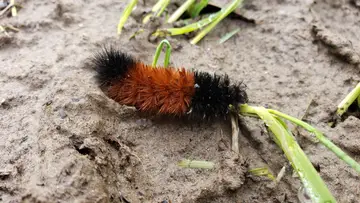
The woolly bear is the fuzzy caterpillar of the Isabella tiger moth: densely covered in stiff hairs, black at both ends and rusty red or brown in the middle, and often seen crossing roads in fall. It does not sting like some other caterpillars, but the Missouri Department of Conservation says touching the bristles can cause a rash (dermatitis) in some people. NC State Extension calls it harmless. It is found across the United States. The idea that its bands predict winter is folklore. Missouri Department of Conservation
On this page
Is the woolly bear caterpillar dangerous?
MDC says touching the bristles can cause dermatitis in some people. Most people get no rash, but some do. Since some other fuzzy caterpillars can sting, MDC advises caution with any caterpillar you can't identify. Missouri Department of Conservation
“Note that touching the bristles can cause dermatitis in some people.”
Bites and stings: Does not bite or sting people. Touching the bristles can cause dermatitis (a rash) in some people (MDC).
No official source we use states whether this animal is venomous. That does not mean it is harmless: do not handle it.
How to identify a woolly bear caterpillar
A photo or description can narrow it down, but cannot confirm what an animal is or that it is safe. Look from a distance and do not handle wild animals.
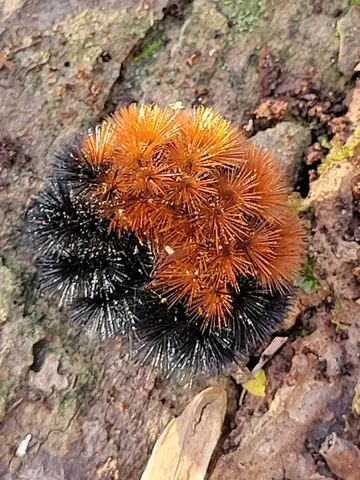
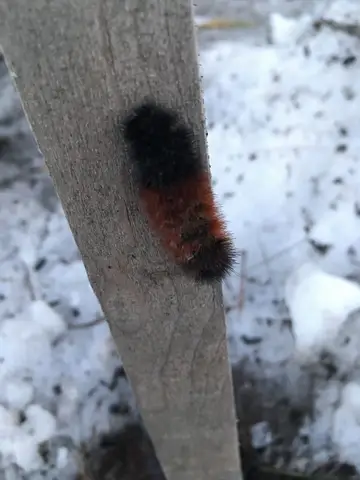
Size: Mature caterpillars a little over an inch long (NC State); NWS: about 1 1/2 inches NC State Extension
Colors: Black at both ends, rusty red or brown in the middle. Pattern: Three bands: black, rusty red, black. Band widths vary with age, moisture and genetics.
Key features
- Fuzzy with dense, stiff hairs; rolls into a ball when disturbed Missouri Department of Conservation
Young
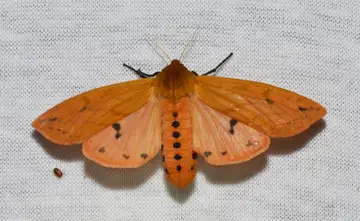
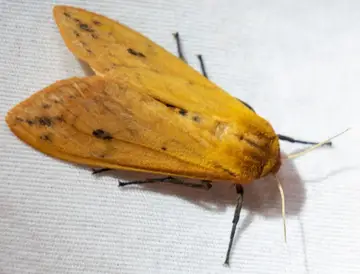
This page is about the larva. Adult: the Isabella tiger moth, with pointed yellow or tan forewings with faint lines and small dark spots; females have orange (NC State: pink) hindwings.
Animals mistaken for the woolly bear caterpillar
Woolly bear caterpillar (banded woollybear) or Puss caterpillar (southern flannel moth)?
Woolly bear caterpillar (banded woollybear)
Puss caterpillar (southern flannel moth) Megalopyge opercularis
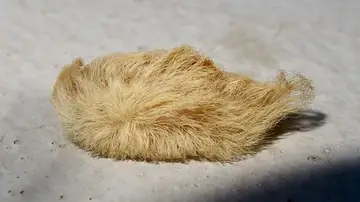
No official source checked compares the two directly. LSU AgCenter describes the puss caterpillar as covered in a coat of tawny to grayish hairs, roughly 1 inch long, with venom-releasing spines under the hairs. LSU AgCenter
Stings: venomous spines under the hairs; stings are instantly painful (LSU AgCenter).
Woolly bear caterpillar (banded woollybear) or Yellow bear (Virginian tiger moth caterpillar)?
Woolly bear caterpillar (banded woollybear)
Yellow bear (Virginian tiger moth caterpillar) Spilosoma virginica
NWS: by folklore someone might read this caterpillar as a woolly bear foretelling a mild winter, but it is a yellow bear, which always looks the same whatever the coming winter. NWS gives no field marks to tell them apart. NOAA National Weather Service, La Crosse WI forecast office
Woolly bear caterpillar (banded woollybear) or Giant leopard moth caterpillar?
Woolly bear caterpillar (banded woollybear)
Giant leopard moth caterpillar Hypercompe scribonia (NWS: Ecpantheria scribonia)
NWS: by folklore someone might read this caterpillar as a woolly bear foretelling a severe winter, but it is a giant leopard moth caterpillar, which always looks the same whatever the coming winter. NWS gives no field marks to tell them apart. NOAA National Weather Service, La Crosse WI forecast office
Woolly bear caterpillar (banded woollybear) or Other fuzzy tiger moth caterpillars?
Woolly bear caterpillar (banded woollybear)
Other fuzzy tiger moth caterpillars Erebidae: Arctiinae
Iowa State: the weather-legend woollybear is the banded woollybear, not just any of the 8 or more fuzzy tiger moth caterpillars in the US Yard and Garden
MDC: some other caterpillars' hairs or spines can sting; use caution with any caterpillar you cannot identify.
Where the woolly bear caterpillar lives
- Native or listed
- Nonnative or not established
- No official record in our data
- 1–9
- 10–99
- 100–999
- 1,000+
State boundaries: U.S. Census Bureau, cartographic boundary file cb_2024_us_state_20m.
When it is active
Most noticed in autumn while crossing roads to find a winter shelter. Overwinters as a caterpillar and can survive temperatures as low as -90 F. Adults fly early April through September; one or two generations a year. NC State Extension
US open-licence records peak in June to July and September to October.
Habitat and habits
Habitat: Almost anywhere plants grow; in fall it leaves its food plants to find shelter under bark, leaf litter, rocks or logs Missouri Department of Conservation
Behavior: Rolls into a tight bristly ball and 'plays dead' when picked up or disturbed
Diet: A wide range of plants: plantain, dandelion, dock, aster, goldenrod and grasses (NC State); also maple and elm, sunflowers and clovers (MDC)
Young: Overwintered caterpillars feed in spring, spin cocoons from their hairs and pupate; moths emerge and lay eggs, often in batches of 100 or more
Questions about the woolly bear caterpillar
Are woolly bear caterpillars poisonous?
The woolly bear does not sting like some caterpillars. The University of Missouri says its hairs do not contain the substance that causes a very painful sting. But the Missouri Department of Conservation says touching the bristles can cause dermatitis (a rash) in some people. Some other fuzzy caterpillars do sting, so be careful with any caterpillar you can't identify.
Can woolly bear caterpillars predict winter?
No. The NWS says the woolly bear cannot predict the coming winter. Its band widths reflect its age, how long it has been feeding and the growing season. MDC says wetter weather tends to give longer black bands and older caterpillars have longer rusty bands.
What does a woolly bear caterpillar turn into?
The Isabella tiger moth, a yellow-orange moth with a wingspan of about 1 1/2 to 2 inches (NWS) or 1 3/4 to 2 1/4 inches (MDC). It emerges in spring after the caterpillar overwinters and pupates in a cocoon made from its hairs.
Sources
- Isabella Tiger Moth (Woolly Bear; Woolly Worm) - Field Guide. Missouri Department of Conservation. undated page; checked November 3, 2026.
Quoted passages (5)
“Note that touching the bristles can cause dermatitis in some people.”
“Called "woolly bears" or "woolly worms," they are fuzzy with dense, stiff hairs. They are usually black on the ends of the body and rusty red or brownish in the middle. When disturbed, they commonly roll up in a ball.”
“The forewings are yellow or tan, pointed, and often have faint lines and small dark spots. Hindwings are lighter and are orange in females.”
“Based on the caterpillars' wide range of food plants, this moth could be found almost anywhere that plants grow. In the autumn, woolly bears are commonly seen crossing roads as they search for sheltered places in which to overwinter.”
“Isabella tiger moths overwinter as full-grown caterpillars and have a remarkable capability to withstand freezing temperatures. They pupate within cocoons made from their hairs and emerge as adults in the spring.”
- Wintery Weather Folklore (Missouri Environment and Garden). University of Missouri Integrated Pest Management. Published: November 11, 2014; checked November 3, 2026.
- Banded Woollybear / Isabella Moth. NC State Extension (North Carolina State University). Publication date Jan. 30, 2017; checked November 3, 2026.
Quoted passages (3)
“Mature caterpillars are a little over an inch long and are covered with stiff hairs.”
“Banded woollybears feed on plantain (a common weed in many yards) as well as other non-crop plants such as dandelion, dock, aster, goldenrod, and some grasses.”
“In fall, wollybears seek overwintering shelter under bark, leaf litter or a log, and can survive temperatures as low as -90 F.”
- Woolly Bear Caterpillar: A Winter Weather Predictor or Not? NOAA National Weather Service, La Crosse WI forecast office. undated page; checked November 3, 2026.
Quoted passages (3)
“Yet another name for this caterpillar is the Hedgehog Caterpillar, because it curls into a tight bristly ball and "plays dead" when picked up or disturbed.”
“According to folklore, someone would assume a mild upcoming winter from seeing the caterpillar above, but in actuality this is a Yellow Bear Caterpillar (Spilosama virginica).”
“According to folklore, someone would assume a severe upcoming winter from seeing the caterpillar above, but in actuality this is a Giant Leopard Moth Caterpillar (Ecpantheria scribonia).”
- Bug Biz: Pest Management and Insect Identification Series - Puss Moth Caterpillar. LSU AgCenter (Louisiana Cooperative Extension Service). January 25, 2019; checked November 3, 2026.
Quoted passages (1)
“The puss moth caterpillar is covered in a coat of tawny to grayish hairs.”
- Do Woollybears Predict the Winter Weather? Iowa State University Extension and Outreach (Yard and Garden). November 11, 1994; checked November 3, 2026.
Quoted passages (1)
“The woollybear in question is not just any of the 8 or more species of fuzzy, bristly-haired, tiger moth caterpillars found in the U.S., but rather the banded woollybear, the caterpillar stage of the isabella moth, Pyrrharctia isabella.”
- GBIF.org occurrence records, human observations licensed CC0 1.0 or CC BY 4.0 only, accessed November 3, 2026. The datasets behind these counts are listed on our Sources page.
- State boundaries: U.S. Census Bureau, cartographic boundary file cb_2024_us_state_20m.