Arizona Coral Snake
Micruroides euryxanthus · also called Sonoran coralsnake, Sonoran coral snake and western coral snake · Last checked November 3, 2026.
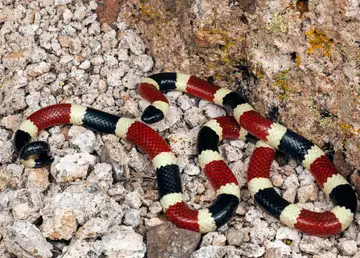

The Arizona coral snake, which Arizona Game and Fish calls the Sonoran coralsnake, is a small, slender, venomous snake with red, yellow or cream, and black rings around its body and a black snout. Its venom is neurotoxic. No deaths have been reported from its bite in Arizona, but Arizona Game and Fish says it should be considered dangerous and should not be handled. It lives in central and southern Arizona and far southwestern New Mexico. Arizona Game and Fish Department
On this page
Is the Arizona coral snake dangerous?
Arizona Game and Fish Department: no reported deaths from its bite in Arizona, but it should be considered dangerous and should not be handled. Arizona Game and Fish Department
“There have been no reported deaths from its bite in Arizona but this snake should be considered dangerous and should not be handled.”
Bites and stings: Bites are unlikely: AZ Poison calls it shy and rarely responsible for significant bites, citing its size and immobile fangs. It delivers neurotoxic venom through fixed fangs at the front of the mouth. Saguaro National Park compares the venom to a cobra's and says anyone bitten should seek medical attention immediately.
If someone is bitten or stung, call 911 or Poison Help at 1-800-222-1222.
How to identify an Arizona coral snake
A photo or description can narrow it down, but cannot confirm what an animal is or that it is safe. Look from a distance and do not handle wild animals.
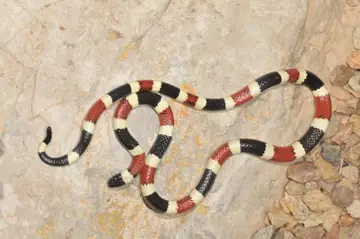
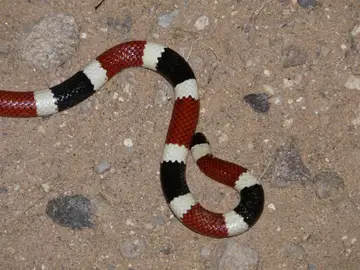
Size: Small: up to 24 in (Arizona Game and Fish); averages less than 2 ft (AZ Poison); body length 13-21 in (Tonto NPS). Arizona Game and Fish Department
Colors: red, yellow or cream, and black; new Mexico source: the narrower rings may be white or yellow. Pattern: rings that completely encircle the body; red bands touch the yellow bands.
Key features
- Black head and snout Arizona Game and Fish Department
- Blunt head barely wider than the neck; short, blunt tail Arizona Game and Fish Department
- Round pupils and smooth, shiny scales Arizona Game and Fish Department
- When threatened it hides its head, curls and shows its tail, and makes a popping noise Arizona Game and Fish Department
Animals mistaken for the Arizona coral snake
Arizona Coral Snake or Sonoran mountain kingsnake?
Arizona Coral Snake
Sonoran mountain kingsnake Lampropeltis pyromelana
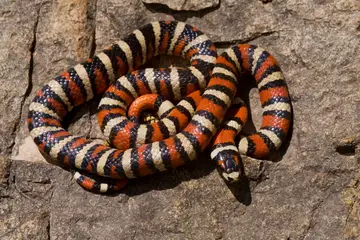

On the kingsnake the red bands are bordered by black. On the coral snake the red bands are bordered by yellow. The band next to the red is not always yellow: Arizona Game and Fish says yellow or cream, New Mexico State says white or yellow, and Fort Bowie NPS says white, so a white or cream band touching red is also described for the coral snake. College of ACES
Arizona Game and Fish lists it as non-venomous.
Arizona Coral Snake or Milk snake?
Arizona Coral Snake
Milk snake Lampropeltis triangulum
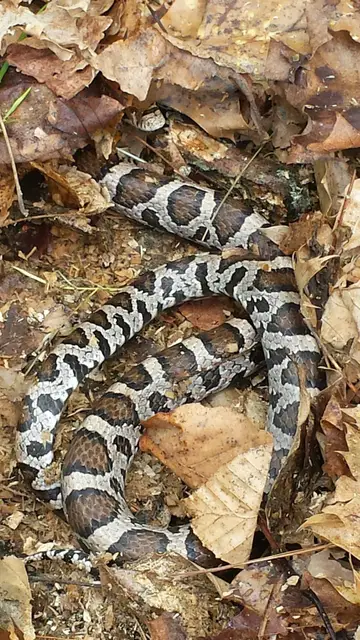
On the milk snake the red bands are bordered by black. On the coral snake the red bands are bordered by yellow. The band next to the red is not always yellow: Arizona Game and Fish says yellow or cream, New Mexico State says white or yellow, and Fort Bowie NPS says white, so a white or cream band touching red is also described for the coral snake. Arizona Game and Fish says the Arizona milksnake also has a black snout, and NPS Montezuma Castle says the two can be confused. College of ACES
Arizona Game and Fish lists it as non-venomous.
Arizona Coral Snake or Long-nosed snake?
Arizona Coral Snake
Long-nosed snake Rhinocheilus lecontei
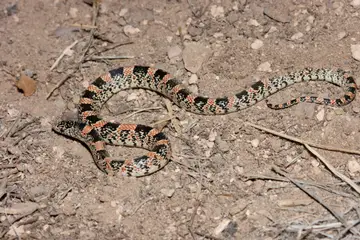

Paler than the coral snake, with markings that do not extend around the body and white flecks on the top and sides. College of ACES
Arizona Game and Fish lists it as non-venomous.
Arizona Coral Snake or Western shovel-nosed snake?
Arizona Coral Snake
Western shovel-nosed snake Chionactis occipitalis
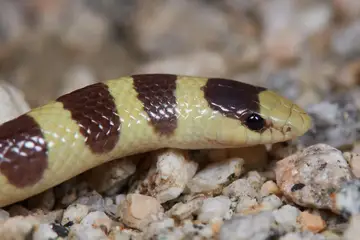
The shovel-nosed snake has a cream or light yellow snout; the coral snake's snout is black. Arizona Game and Fish Department
Arizona Game and Fish lists it as having mildly toxic saliva.
Arizona Coral Snake or Sonoran shovel-nosed snake?
Arizona Coral Snake
Sonoran shovel-nosed snake Chionactis palarostris
The shovel-nosed snake has a cream or light yellow snout; the coral snake's snout is black. Arizona Game and Fish Department
Arizona Game and Fish lists it as having mildly toxic saliva.
Where the Arizona coral snake lives
- Native or listed
- Nonnative or not established
- No official record in our data
- 1–9
- 10–99
- 100–999
- 1,000+
On our state guides
State boundaries: U.S. Census Bureau, cartographic boundary file cb_2024_us_state_20m.
When it is active
Primarily active at night or dusk, but can be active around the clock when conditions are favorable. Hibernates in the cold months of late fall and winter. Arizona Game and Fish Department
US open-licence records peak in July to September.
Habitat and habits
Habitat: Sonoran, Mohave and Chihuahuan desertscrub, semidesert grassland and lower woodlands; usually in or near rocky or gravelly drainages, mesquite-lined washes and canyons. Arizona Game and Fish Department
Behavior: Ground-dwelling and spends much of its time underground. Not aggressive. When disturbed it may bury its head in its coils, wave its tail and make a popping sound.
Diet: Mainly small snakes such as threadsnakes, groundsnakes and black-headed snakes; occasionally small lizards.
Young: Lays a clutch of up to 3 eggs during the summer monsoon (July-August).
Legal status and reporting
Federal: No record returned by the USFWS ECOS query for Micruroides euryxanthus on 2026-11-03; not itself a statement of listing status. US Fish and Wildlife Service
Questions about the Arizona coral snake
Are there coral snakes in arizona?
Yes. The Sonoran coralsnake lives across most of southern Arizona below about 6,000 ft and into central Arizona. It is Arizona's only member of the Elapidae, the snake family that includes cobras.
Are there coral snakes in southern arizona?
Yes. Arizona Game and Fish says it is found across most of the southern part of the state below about 6,000 ft, though its range in the low deserts of western Arizona is spotty and poorly known.
Are there coral snakes in phoenix?
No official source on file names the city of Phoenix. Arizona Game and Fish's range statement covers most of southern Arizona below about 6,000 ft, and its species account includes a photo credited to Maricopa County. It says this snake should not be handled.
Arizona coral snake
A small venomous snake with red, yellow or cream, and black rings and a black snout. Arizona Game and Fish says there have been no reported deaths from its bite in Arizona, but it should be considered dangerous and not be handled.
Sources
- Online Field Guide species account: Sonoran Coralsnake (Micruroides euryxanthus). Arizona Game and Fish Department. 2023; checked November 3, 2026.
Quoted passages (11)
“There have been no reported deaths from its bite in Arizona but this snake should be considered dangerous and should not be handled.”
“A small (up to 615 mm or 24″ in total length), slender, brightly-colored snake”
“The head and snout are black.”
“The blunt head is barely distinct from the neck and the tail is relatively short and blunt.”
“The pupils are round and the scales are smooth and shiny.”
“When threatened this snake hides its head beneath the coils, curls and presents the tail”
“It is usually encountered above the flats in or near rocky or gravelly drainages, mesquite lined washes, and canyons.”
“It uses its neurotoxic venom to subdue a variety of small snakes including threadsnakes, groundsnake’s, and black-headed snakes. It also occasionally feeds on small lizards.”
“This ground-dwelling snake is primarily nocturnal or crepuscular but it can be active around the clock when conditions are favorable. It hibernates during the cold months of late fall and winter.”
“A clutch of up to 3 eggs is laid during the summer monsoon (July-August).”
“Its black snout distinguishes this snake from the similar looking Western Shovel-nosed Snake and Sonoran Shovel-nosed Snake”
- Arizona Coral Snake. Arizona Poison and Drug Information Center (University of Arizona College of Pharmacy). 2026 (footer copyright; checked November 3, 2026.
- Snakes - Montezuma Castle National Monument. National Park Service. updated May 5, 2025; checked November 3, 2026.
- New Mexico Snakes: Information for New Mexico Homeowners (Circular 541). New Mexico State University Cooperative Extension Service (College of ACES). Revised and electronically distributed July 1998; checked November 3, 2026.
Quoted passages (2)
“On the milk snake and Sonoran mountain king snake, the red bands are bordered by black. The western coral snake has red bands bordered by yellow.”
“The longnose snake is pale compared with the western coral snake, with stripes that don’t extend around the body and white flecks on the top and side of the body.”
- Snakes - Saguaro National Park. National Park Service. updated May 6, 2025; checked November 3, 2026.
Quoted passages (1)
“When disturbed, the coralsnake will often bury its head in its coils, and wave its coiled tail in an attempt to draw attention away from its head.”
- ECOS species report query for the four taxa. U.S. Fish and Wildlife Service. live query result 2026-11-03; checked November 3, 2026.
- GBIF.org occurrence records, human observations licensed CC0 1.0 or CC BY 4.0 only, accessed November 3, 2026. The datasets behind these counts are listed on our Sources page.
- State boundaries: U.S. Census Bureau, cartographic boundary file cb_2024_us_state_20m.