Barn spider (barn orbweaver)
Araneus cavaticus · also called barn orbweaver · Last checked November 3, 2026.
The barn spider (barn orbweaver, Araneus cavaticus) is a medium-to-large orb-weaving spider that builds big round webs on barns, houses, rock walls and rock faces, sometimes strung overnight across doorways. Females are about 1/2 to 7/8 inch long. Ohio DNR says it was likely the model for Charlotte in Charlotte's Web. It is not one of the spiders official sources call dangerous: Ohio DNR says only black widows and recluse spiders are considered dangerous to people in Ohio, and Maryland DNR says the black widow is the only native Maryland spider dangerous to humans. Official sources confirm it in Ohio and Maryland. Ohio Department of Natural Resources, Division of Wildlife
On this page
Is the barn spider dangerous?
Ohio DNR: nearly all Ohio spiders have venom, but it has little effect on humans or pets; only black widows and recluse spiders are considered dangerous to people. Ohio Department of Natural Resources, Division of Wildlife
“In Ohio, all but one of our spiders possess venom, but their venom has little effect on humans or pets. … Only two groups of Ohio spiders, the black widows and the recluse spiders are considered dangerous to humans.”
Bites and stings: No species-specific official statement. Ohio DNR says spider bites are rare and spiders bite people only in self-defense, for example when pressed against skin.
No official source we use states whether this animal is venomous. That does not mean it is harmless: do not handle it.
How to identify a barn spider
A photo or description can narrow it down, but cannot confirm what an animal is or that it is safe. Look from a distance and do not handle wild animals.
Size: Females 1/2 to 7/8 inch (13 to 22 mm); males 3/8 to 3/4 inch (10 to 20 mm). Ohio State Extension gives about 1/2 to 3/4 inch measured from the tips of the legs. Ohio Department of Natural Resources, Division of Wildlife
Key features
- Large circular orb web, often between a rock wall or building and the ground; support lines may stretch 10 feet or more and the orb may be several feet across Ohio Department of Natural Resources, Division of Wildlife
- Commonly builds webs on barns and homes, including across doorways overnight BYGL
Animals mistaken for the barn spider
Barn spider (barn orbweaver) or Spotted orbweaver (arboreal orbweaver; also called 'barn spider' by MDC)?
Barn spider (barn orbweaver)
Spotted orbweaver (arboreal orbweaver; also called 'barn spider' by MDC) Neoscona crucifera
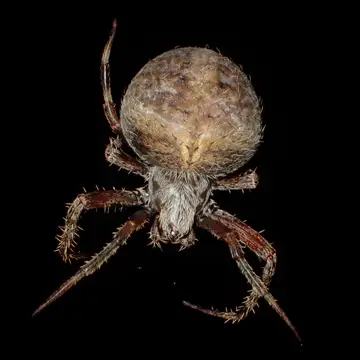
MDC says spiders in genus Neoscona are difficult to distinguish, even by specialists, and that spiders in genus Araneus are similar as well. Missouri Department of Conservation
MDC: orbweavers don't bite unless molested, and their bites are not dangerous.
Where the barn spider lives
- Native or listed
- Nonnative or not established
- No official record in our data
- 1–9
- 10–99
- 100–999
- 1,000+
On our state guides
State boundaries: U.S. Census Bureau, cartographic boundary file cb_2024_us_state_20m.
When it is active
Adult females usually lay eggs in autumn and die with the first hard frosts; in some years a few females survive the winter and are seen again in early spring. Ohio Department of Natural Resources, Division of Wildlife
US open-licence records peak in July to September.
Habitat and habits
Habitat: Barns, houses and other structures, rock walls and rock faces, and forests; sometimes in groups (Ohio DNR counted over 100 webs along one rock face in the Hocking Hills). Ohio Department of Natural Resources, Division of Wildlife
Behavior: Builds large orb webs, often overnight; Ohio State Extension says early risers can walk into webs strung across doorways.
Young: Females lay eggs in autumn.
Legal status and reporting
Federal: No Araneus cavaticus record in the USFWS ECOS species database (query 2026-11-03 returned 0 rows). ECOS
Questions about the barn spider
Barn spider
Usually the barn orbweaver (Araneus cavaticus), a large orb weaver that builds big round webs on barns, homes and rock walls; Ohio DNR says it likely inspired Charlotte in Charlotte's Web. In Missouri, MDC uses 'barn spider' for the spotted orbweaver (Neoscona crucifera). Neither is among the spiders official sources call dangerous: in Ohio only black widows and recluses are, and in Maryland only the black widow; MDC says orbweaver bites are not dangerous.
Sources
- Common Spiders of Ohio Field Guide (Publication 5140). Ohio Department of Natural Resources, Division of Wildlife (text by Richard A. Bradley, Ph.D.). PUBLICATION 5140; checked November 3, 2026.
Quoted passages (6)
“In Ohio, all but one of our spiders possess venom, but their venom has little effect on humans or pets. … Only two groups of Ohio spiders, the black widows and the recluse spiders are considered dangerous to humans.”
“FEMALE: 1/2’ - 7/8’ (13 - 22mm) MALE: 3/8’ - 3/4’ (10 - 20mm)”
“…often builds its beautiful circular web between a rock wall or building and the ground. The support for the web may stretch 10 feet or more. The orb may be several feet in diameter.”
“On occasion they can be found in groups, such as over 100 barn orbweaver webs along one rock face in the Hocking Hills.”
“…adult female barn orbweavers typically lay their eggs in autumn and die with the first hard frosts. In some years, a few of the females survive the winter and can be found again in early spring.”
“…adult female barn orbweavers typically lay their eggs in autumn”
- In Your Face Spiders and Other Orb Weavers (Buckeye Yard & Garden onLine). Ohio State University Extension (BYGL). September 11, 2020; checked November 3, 2026.
Quoted passages (2)
“…it commonly constructs webs on structures such as barns or homes. Early risers may become entangled in large, sticky spider webs strung overnight across outdoor doorway openings.”
“Early risers may become entangled in large, sticky spider webs strung overnight across outdoor doorway openings.”
- Dancing, Deception and Cannibalism: The myths and realities of Maryland spiders. Maryland Department of Natural Resources (news.maryland.gov/dnr). archived copy, captured March 15, 2026; checked November 3, 2026.
- USFWS ECOS species report export (JSON), scientific-name query. U.S. Fish and Wildlife Service (ECOS). live query 2026-11-03; checked November 3, 2026.
- Arboreal Orbweaver (Spotted Orbweaver) (Field Guide). Missouri Department of Conservation. undated page; checked November 3, 2026.
Quoted passages (1)
“In general, spiders in this group are difficult to distinguish, even by specialists. … Spiders in genus Araneus are similar, as well”
- GBIF.org occurrence records, human observations licensed CC0 1.0 or CC BY 4.0 only, accessed November 3, 2026. The datasets behind these counts are listed on our Sources page.
- State boundaries: U.S. Census Bureau, cartographic boundary file cb_2024_us_state_20m.