Blacklegged Tick
Ixodes scapularis · also called Deer Tick and Black-legged Tick · Last checked November 3, 2026.
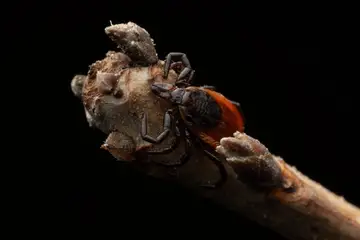
The blacklegged tick, or deer tick, is a very small tick of the eastern US: adults are about the size of a sesame seed and nymphs about the size of a poppy seed. It is dangerous as a carrier of disease. CDC says it transmits the germs that cause Lyme disease, anaplasmosis, babesiosis and Powassan virus disease, among others. Official sources do not describe it as venomous. CDC
On this page
Is the blacklegged tick dangerous?
CDC: transmits Anaplasma phagocytophilum (anaplasmosis), Babesia microti (babesiosis), Borrelia burgdorferi and B. mayonii (Lyme disease), B. miyamotoi (hard tick relapsing fever), Ehrlichia muris eauclairensis (ehrlichiosis) and Powassan virus (Powassan virus disease). CDC
“Transmits: Anaplasma phagocytophilum (anaplasmosis), Babesia microti (babesiosis), Borrelia burgdorferi and B. mayonii (which cause Lyme disease), B. miyamotoi (hard tick relapsing fever), Ehrlichia muris eauclairensis (ehrlichiosis), and Powassan virus (Powassan virus disease).”
Bites and stings: Yes. CDC: nymphs and adult females are more often reported on people, but larvae also bite people. OSU Extension: all stages may attach to humans.
No official source we use states whether this animal is venomous. That does not mean it is harmless: do not handle it.
If someone is bitten or stung, call 911 or Poison Help at 1-800-222-1222.
How to identify a blacklegged tick
A photo or description can narrow it down, but cannot confirm what an animal is or that it is safe. Look from a distance and do not handle wild animals.
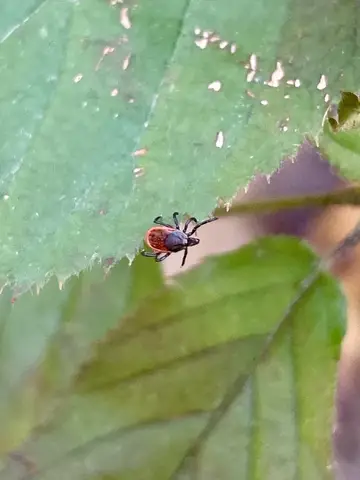
Size: CDC: adults about the size of a sesame seed, nymphs about the size of a poppy seed. CDC
Colors: Adult females: brown to reddish-orange body with a dark brown to black shield behind the head. Males: dark brown, no red; rear half of adult female red or orange. Pattern: No white markings: the shield is uniformly colored, unlike the American dog tick's.
Key features
- Black legs and upper body MDC
- Long mouthparts University of Kentucky Entomology Extension
- Smaller than other medically important ticks at each stage Ohio State University Extension (Ohioline); co-authors from the Ohio Department of Health
Young
Larvae are extremely tiny and nearly translucent. Nymphs are translucent to slightly gray or brown.
Animals mistaken for the blacklegged tick
Blacklegged Tick or American Dog Tick (wood tick)?
Blacklegged Tick
American Dog Tick (wood tick) Dermacentor variabilis
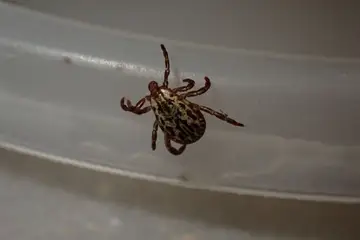
Larger, with white markings on the shield. Illinois: adult blacklegged ticks are about half the size of the female American dog tick. University of Arkansas Arthropod Museum
Minnesota Department of Health: American dog ticks may spread Rocky Mountain spotted fever and tularemia.
Blacklegged Tick or Lone Star Tick?
Blacklegged Tick
Lone Star Tick Amblyomma americanum
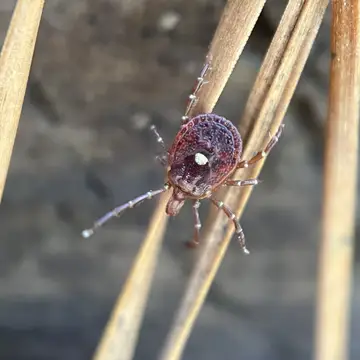
Illinois: the adult female lone star tick has a white spot in the middle of her back. IDPH
Disease carrier; see its page.
Where the blacklegged tick lives
- Native or listed
- Nonnative or not established
- No official record in our data
- 1–9
- 10–99
- 100–999
- 1,000+
State boundaries: U.S. Census Bureau, cartographic boundary file cb_2024_us_state_20m.
When it is active
CDC: greatest risk of being bitten is in spring, summer and fall, but adults may seek a host any time winter temperatures are above freezing. CDC
US open-licence records peak in March to May and October.
Habitat and habits
Habitat: Wooded, brushy areas; woods, trails and the woods edge. Rarely in open areas such as yards near wooded habitat. Minnesota Department of Health
Behavior: Searches for a host from the tips of low plants and shrubs, not from trees.
Diet: Blood. Larvae and nymphs feed on small mammals and birds; adults on larger mammals, especially white-tailed deer. Any stage can feed on people, livestock and pets.
Young: A 2-to-3-year life cycle with four stages: egg, larva, nymph, adult. The larva and nymph each need a blood meal to develop, and the female needs blood to produce eggs. OSU: a female deposits about 2,000 eggs in one location.
Legal status and reporting
Federal: Not listed under the Endangered Species Act: the ECOS query returned no record for the genus. ECOS
Report: Ohio: ticks can be submitted for species identification to the C. Wayne Ellett Plant and Pest Diagnostic Clinic at Ohio State (614-292-5006). Other states: ask the state health department or Cooperative Extension. Ohio State University Extension (Ohioline); co-authors from the Ohio Department of Health
Questions about the blacklegged tick
Deer tick size
CDC says adults are about the size of a sesame seed and nymphs about the size of a poppy seed. UMaine Extension says a fed adult female can reach as much as 1/2 inch.
Deer tick nymph
Nymphs are about the size of a poppy seed and translucent to slightly gray or brown. Pennsylvania DEP says the nymph stage is implicated in the majority of Lyme disease transmission because of its small size.
Deer tick diseases
CDC lists Lyme disease, anaplasmosis, babesiosis, hard tick relapsing fever, ehrlichiosis and Powassan virus disease.
Deer tick bite
CDC says nymphs and adult females are more often reported on people, and that in most cases a tick must be attached more than 24 hours before the Lyme disease bacterium can be transmitted. For an emergency, call 911 or Poison Help at 1-800-222-1222.
Deer tick vs dog tick
The American dog tick is larger and its shield has white markings; the blacklegged tick's shield is uniformly colored. Illinois says an adult blacklegged tick is about half the size of the female American dog tick.
Deer tick vs wood tick
Illinois says the American dog tick is sometimes known as the wood tick. It is larger than the blacklegged tick and has white markings on its shield.
Deer tick vs lone star tick
The adult female lone star tick has a white spot in the middle of her back. Minnesota Department of Health says the lone star tick is larger than the blacklegged tick.
When is tick season in mn?
For blacklegged ticks, Minnesota Department of Health says adults peak in May and return from late September through October, and nymphs peak from the end of May through June.
When is tick season in ohio?
For blacklegged ticks, OSU Extension says one or more life stages may be active during every month of the year, depending on temperature.
When is tick season in pa?
For blacklegged ticks, Penn State Extension says adults are present in fall, through winter and in early spring, nymphs from late spring through summer, and larvae in late summer.
When is tick season in illinois?
For blacklegged ticks, Illinois Department of Public Health says larvae and nymphs are active in spring and early summer, and adults may be active in spring and fall.
When is tick season in tennessee?
Tennessee Department of Health says most bites occur in warmer seasons, but the black-legged tick may pose a threat year-round when temperatures are above freezing.
When is tick season in ny?
New York State Department of Health says young deer ticks (nymphs) are active from mid-May to mid-August.
Sources
- Blacklegged Tick Surveillance. CDC. archived copy, captured October 18, 2026; checked November 3, 2026.
Quoted passages (1)
“Be aware, adult ticks may be searching for a host any time winter temperatures are above freezing.”
- Where Ticks Live. CDC. archived copy, captured September 28, 2026; checked November 3, 2026.
Quoted passages (1)
“Transmits: Anaplasma phagocytophilum (anaplasmosis), Babesia microti (babesiosis), Borrelia burgdorferi and B. mayonii (which cause Lyme disease), B. miyamotoi (hard tick relapsing fever), Ehrlichia muris eauclairensis (ehrlichiosis), and Powassan virus (Powassan virus disease).”
- How Lyme Disease Spreads. CDC. archived copy, captured October 14, 2026; checked November 3, 2026.
Quoted passages (2)
“In general, adult ticks are approximately the size of a sesame seed and nymphal ticks are approximately the size of a poppy seed.”
“Blacklegged ticks have a 2-to-3-year life cycle. During this time, they go through four life stages: egg, larva, nymph, and adult.”
- Ticks (MDC Field Guide). Missouri Department of Conservation (MDC). undated page; checked November 3, 2026.
Quoted passages (1)
“Legs and upper body are black.”
- Ticks and Disease in Kentucky (EF618). University of Kentucky Entomology Extension. Revised 3/26; checked November 3, 2026.
Quoted passages (1)
“Mouthparts are long.”
- Ticks and Tick-Borne Diseases (HYG-2073). Ohio State University Extension (Ohioline); co-authors from the Ohio Department of Health. June 6, 2013; checked November 3, 2026.
Quoted passages (3)
“All comparable stages of the blacklegged tick are relatively smaller than other medically important ticks.”
“The larval stage of the blacklegged tick is extremely tiny and nearly translucent, which makes it extremely difficult to see. The nymphal stage is translucent to slightly gray or brown.”
“Ticks can be submitted for species identification to the C. Wayne Ellett Plant and Pest Diagnostic Clinic (PPDC) at The Ohio State University.”
- Ticks (Minnesota Department of Health). Minnesota Department of Health. updated June 30, 2025; checked November 3, 2026.
Quoted passages (2)
“Blacklegged ticks live in wooded, brushy areas that provide food and cover for white-footed mice, deer and other mammals.”
“Blacklegged ticks search for a host from the tips of low-lying vegetation and shrubs, not from trees.”
- Common Ticks and Tick-borne Diseases in Pennsylvania. Penn State Extension. updated November 27, 2025; checked November 3, 2026.
Quoted passages (1)
“However, any stage is capable of feeding on humans, livestock, and companion animals.”
- USFWS ECOS species report: Scientific Name like 'Ixodes%' (ESA listing status). U.S. Fish and Wildlife Service (ECOS). database queried November 3, 2026; checked November 3, 2026.
- Deer ticks (Arkansas Arthropods). University of Arkansas Arthropod Museum (Department of Entomology and Plant Pathology). WordPress modified 2017-07-05; checked November 3, 2026.
Quoted passages (1)
“The American dog tick is larger, and its scutum bears white markings.”
- Common Ticks (Structural Pest Control). Illinois Department of Public Health (IDPH). undated page; checked November 3, 2026.
Quoted passages (1)
“The adult female has a white spot in the middle of her back.”
- Blacklegged Tick or Deer Tick (Tick Lab). University of Maine Cooperative Extension. page modified 2026-10-20; checked November 3, 2026.
- Blacklegged Tick (Ixodes scapularis). Pennsylvania Department of Environmental Protection, Vector Management. undated page; checked November 3, 2026.
- Vector-Borne Diseases. Tennessee Department of Health. archived copy, captured August 6, 2026; checked November 3, 2026.
- Be Tick Free - A Guide for Preventing Lyme Disease. New York State Department of Health. undated page; checked November 3, 2026.
- GBIF.org occurrence records, human observations licensed CC0 1.0 or CC BY 4.0 only, accessed November 3, 2026. The datasets behind these counts are listed on our Sources page.
- State boundaries: U.S. Census Bureau, cartographic boundary file cb_2024_us_state_20m.