Coqui (common coqui)
Eleutherodactylus coqui · also called Coqui frog, Common coqui, Puerto Rican coqui and Coqui comun · Last checked November 3, 2026.
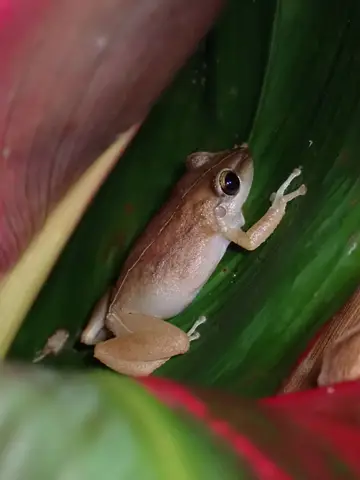

The coqui is a small (1 to 2 inch) tan to dark-brown tree frog from Puerto Rico, named for the male's loud "ko-KEE" call at night. University of Hawaii Extension says coquis do not bite and are not poisonous; the problems official sources describe are noise and harm to native insects and ecosystems. It is an invasive, injurious species in Hawaii. USGS also records it in southern Florida (limited to areas around a few greenhouses) and California (nursery and home records), and it is established in the U.S. Virgin Islands. University of Hawaii at Manoa, College of Tropical Agriculture and Human Resources (CTAHR) Cooperative Extension
On this page
Is the coqui dangerous?
University of Hawaii CTAHR Extension: coquis do not bite and are not poisonous. Official sources describe the harm as noise (calls up to 95 dB per HISC), loss of sleep and property value, and damage to native insects and ecosystems. University of Hawaii at Manoa, College of Tropical Agriculture and Human Resources (CTAHR) Cooperative Extension
“They do not bite and are not poisonous.”
Bites and stings: No: UH CTAHR Extension says coquis do not bite.
No official source we use states whether this animal is venomous. That does not mean it is harmless: do not handle it.
How to identify a coqui
A photo or description can narrow it down, but cannot confirm what an animal is or that it is safe. Look from a distance and do not handle wild animals.
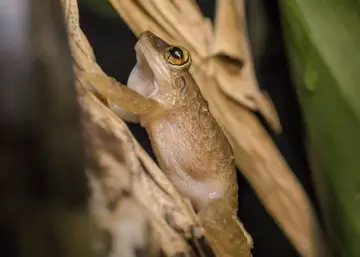
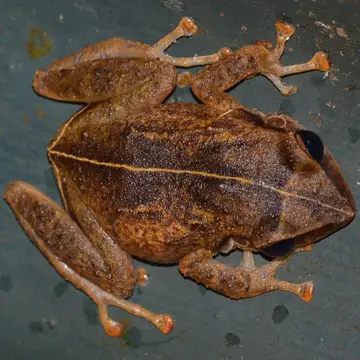
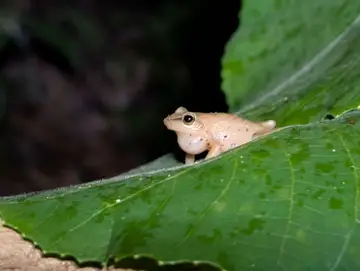
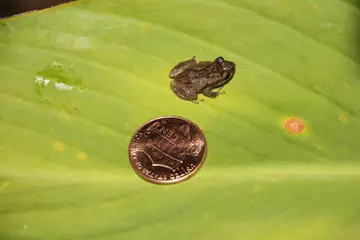

Size: 1 to 2 inches (HISC; CDFW: average 1 to 2 inches, females slightly larger). USGS: 33 to 57 mm snout to rear, Florida animals slightly smaller. Hawaii DLNR
Colors: Tan to dark brown; brown to gray on the back; white to yellow belly speckled with brown. Pattern: Back pattern varies: none, one or two broad cream stripes, V-shaped marks, spots, blotches, or a faint "M" between the shoulders.
Key features
- Loud, whistling "ko-KEE" call of the male, heard at night California Department of Fish and Wildlife
- Round body, broad rounded snout and distinct toe pads Hawaii DLNR
- Eyes gold to brown; large toes for climbing and no webbing on the feet California Department of Fish and Wildlife
- Calls mostly from 3 to 7 feet up in plants Hawaii DLNR
Young
No tadpole stage: tiny froglets hatch straight from eggs laid in plants, not water (a froglet can sit on a penny, per a CDFW photo caption).
Animals mistaken for the coqui
Coqui (common coqui) or Greenhouse Frog?
Coqui (common coqui)
Greenhouse Frog Eleutherodactylus planirostris
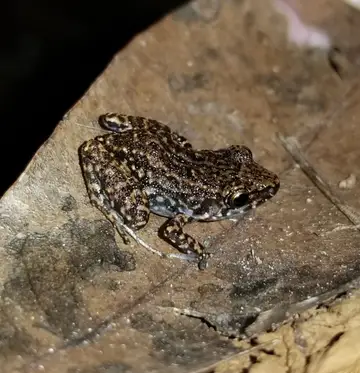
USGS: the coqui has gold, golden-brown or brown eyes, not red like the greenhouse frog, and has toe pads for climbing. US Geological Survey, Nonindigenous Aquatic Species Database
Also non-native (USGS). HISC calls it a common look-alike to the coqui.
Coqui (common coqui) or Native Florida treefrogs?
Coqui (common coqui)
Native Florida treefrogs
USGS notes the coqui may superficially resemble native Florida treefrogs; it gives no single feature to separate them. US Geological Survey, Nonindigenous Aquatic Species Database
Not stated.
Where the coqui lives
- Native or listed
- Nonnative or not established
- No official record in our data
- 1–9
- 10–99
- 100–999
- 1,000+
On our state guides
State boundaries: U.S. Census Bureau, cartographic boundary file cb_2024_us_state_20m.
When it is active
Night: calls from dusk until dawn (HISC); by day in leaf litter and low plants, moving into trees at night (CDFW). USGS: outside greenhouses in Florida they tend to die off in winter freezes. Hawaii DLNR
US open-licence records peak in January to February, April to June, September and December.
Habitat and habits
Habitat: In Hawaii from sea level to 3,800 m (CDFW); on the ground and in trees and bushes (HISC). In Florida, near greenhouses in rock piles, palm leaves, tree cavities and under rocks and logs (CDFW). California Department of Fish and Wildlife
Behavior: Nocturnal (USGS: nocturnal insectivores). By day in leaf litter and low plants, moving into trees at night (CDFW); calls mostly from 3 to 7 feet up (HISC). Hawaiian densities reach up to 91,000 frogs per hectare (HISC).
Diet: Insects, spiders, crustaceans and even smaller frogs; USGS reports groups can eat up to 114,000 invertebrates per hectare in a night.
Young: Internal fertilization; eggs laid in damp sheltered spots in plants, guarded by the male; froglets hatch directly with no tadpole stage.
Legal status and reporting
Invasive status: Hawaii Injurious Wildlife (Exhibit 5, Chapter 13-124); highly invasive in Hawaii. Hawaii DLNR
Report: Hawaii: on Oahu, Maui, Molokai, Lanai and Kauai report at 643pest.org or call 808-643-7378 (643-PEST); on Hawaii Island, HISC asks residents to control it on their property. California: report to the CDFW Invasive Species Program, [email protected] or (866) 440-9530.
Questions about the coqui
Coqui invasive species hawaii
Yes. The coqui is listed as Hawaii Injurious Wildlife and USGS describes Hawaii's many established populations as highly invasive. It was accidentally brought to Hawaii in plants around or before 1988. Report it on Oahu, Maui, Molokai, Lanai and Kauai at 643pest.org or 808-643-7378.
Hawaii frogs coquis
Hawaii has no native frogs (USGS). The coqui is an introduced Puerto Rican tree frog, 1 to 2 inches long, tan to dark brown, with a loud "ko-KEE" call from dusk to dawn. HISC names the greenhouse frog as its common look-alike; USGS says the greenhouse frog has red eyes, while the coqui's are gold to brown.
Sources
- Coqui Frog Control for Homeowners (MP-5). University of Hawaii at Manoa, College of Tropical Agriculture and Human Resources (CTAHR) Cooperative Extension. CTAHR publication MP-5, May 2006, May 2016; checked November 3, 2026.
Quoted passages (1)
“They do not bite and are not poisonous.”
- Coqui frog (invasive species profile). Hawaii Invasive Species Council (Hawaii DLNR). undated page; checked November 3, 2026.
Quoted passages (6)
“The coqui is a small, nocturnal, 1-2 inch tree frog with colors varying from tan to dark brown.”
“It has a round body shape and a broad rounded snout with distinctive toe pads.”
“…their calls are primarily made from 1-2m (3-7 feet) high.”
“Hawaiian populations reach densities of up to 91,000 frogs/hectare (Beard et al., 2009), two to three times higher than estimates for native populations in Puerto Rico (Woolbright et al., 2006), and among the highest known for any amphibian worldwide.”
“Produces loud, incessant and annoying call from dusk until dawn.”
“Regulatory Status: Hawai’i Injurious Wildlife (Exhibit 5, Chapter 13-124)”
- Coqui (Eleutherodactylus coqui) - Species Profile. U.S. Geological Survey, Nonindigenous Aquatic Species Database. Revision Date 5/30/2019; checked November 3, 2026.
Quoted passages (4)
“…development is direct with well-developed neonate frogs hatching from eggs in vegetation without any aquatic tadpole stage”
“Males brood eggs in an elevated, sheltered spot such as a cavity or a bromeliad”
“…unlike the nonindigenous greenhouse frog (Eleutherodactylus planirostris), has eyes that are gold, golden-brown, or brown, rather than red, and has toe disks (toepads) for climbing”
“May superficially resemble indigenous Floridian treefrogs.”
- California's Invaders: Common Coqui. California Department of Fish and Wildlife (Invasive Species Program). undated page; checked November 3, 2026.
Quoted passages (4)
“Coquis are named after the call of the male, which is a loud, whistling ‘ ko-KEE ’ sound.”
“Eye color of the common coqui ranges from gold to brown. Coquis have large toes for climbing and lack webbing on their feet.”
“In Hawaii, they have been found from sea level to 3800 meters. During the day they inhabit leaf litter and ground vegetation and then move into trees during the night.”
“Coquis prey upon insects, spiders, crustaceans, and even smaller frogs”
- GBIF.org occurrence records, human observations licensed CC0 1.0 or CC BY 4.0 only, accessed November 3, 2026. The datasets behind these counts are listed on our Sources page.
- State boundaries: U.S. Census Bureau, cartographic boundary file cb_2024_us_state_20m.