Millipedes
Diplopoda · also called Thousand-leggers, 1,000-legged worms and Rain worms · Last checked November 3, 2026.
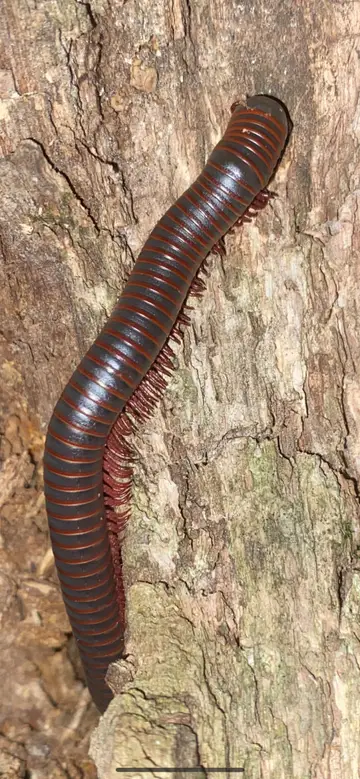
Millipedes are slow, wormlike animals with many body segments, most of which carry two pairs of legs. They live in damp leaf litter, mulch and soil and eat decaying plant matter. Sometimes they wander into homes in large numbers after heavy rains or as the weather cools. UGA Extension says millipedes are not poisonous and do not carry diseases that affect people. Many species can release irritating defensive fluids, though: some can burn or stain skin and can be dangerous to the eyes, and a few species give off a cyanide-containing secretion. Missouri Department of Conservation
This page covers a class (Diplopoda), not a single species.
On this page
Are millipedes dangerous?
UGA Extension: millipedes are not poisonous, but many species make irritating fluids that may cause allergic reactions. Some sprays contain hydrochloric acid that can chemically burn skin and cause long-term discoloration, and the fluid can be dangerous to the eyes. UGA advises against handling millipedes with bare hands and says to wash hands thoroughly with soap and water after contact. CAES
“Millipedes are not poisonous, but many species have glands capable of producing irritating fluids that may cause allergic reactions in some individuals.”
Bites and stings: No official source checked describes millipedes biting or stinging people (none states that they never do). MDC says their most notable behaviors involve defense: they often curl into a coil when disturbed and some can emit a foul-smelling substance. MDC and UGA contrast centipedes, which have pincers or poison jaws and can bite.
No official source we use states whether this animal is venomous. That does not mean it is harmless: do not handle it.
If someone is bitten or stung, call 911 or Poison Help at 1-800-222-1222.
How to identify millipedes
A photo or description can narrow it down, but cannot confirm what an animal is or that it is safe. Look from a distance and do not handle wild animals.
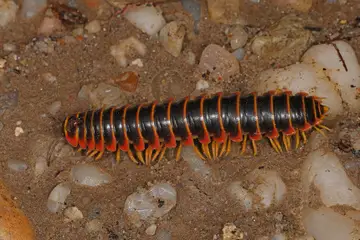

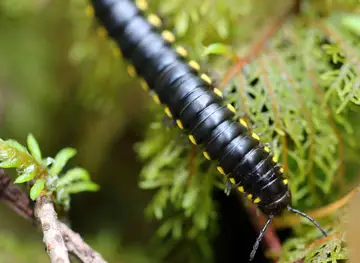

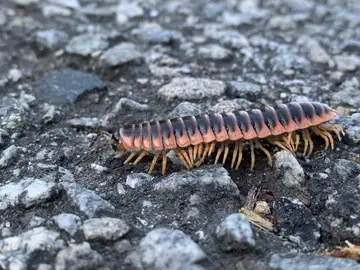
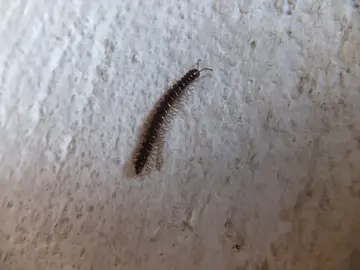

Size: Most millipedes people find are dark brown, about an inch long and 1/16 inch thick (Penn State). The largest North American species is about 6 inches long (MDC). Penn State Extension
Colors: brown and black. Pattern: segmented.
Key features
- Two pairs of legs on each body segment, except the first three segments, which have one pair each. Penn State Extension
- Usually round in cross-section (not flattened) and slow-moving. CSU notes that polydesmid millipedes are more flattened, with more prominent legs that extend to the side. Missouri Department of Conservation
- Often curls into a coil when disturbed. Missouri Department of Conservation
- Legs are small and tucked under the body, so they can be hard to see. Colorado State University, Dept. of Bioagricultural Sciences and Pest Management
Young
Young millipedes have only the first three pairs of legs and no more than seven segments, and add segments and legs with each molt; maturity usually takes 2 to 5 years depending on species.
Animals mistaken for millipedes
Millipedes or Centipedes?
Millipedes
Centipedes Chilopoda
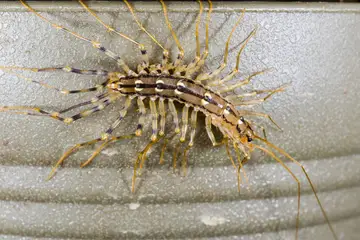

MDC: centipedes are usually flattened, move quickly and have only one pair of legs per body segment; they have pincers, are mostly carnivorous and can bite. Millipedes are most typically round in cross-section and generally slow-moving, and most body segments have two pairs of legs. Some millipedes (polydesmids) are also flattened (CSU). Missouri Department of Conservation
UGA: centipedes have poison glands and can bite; the poison usually produces only a moderate reaction similar to a bee sting, but people allergic to insect venoms and other toxins may suffer severe reactions.
Millipedes or Wireworms (click beetle larvae)?
Millipedes
Wireworms (click beetle larvae) Elateridae
Wireworms have only six legs, are typically dark yellow, and do not crawl about on the soil surface. Penn State Extension
Where millipedes live
- Native or listed
- Nonnative or not established
- No official record in our data
- 1–9
- 10–99
- 100–999
- 1,000+
State boundaries: U.S. Census Bureau, cartographic boundary file cb_2024_us_state_20m.
When it is active
Most active at night (UGA). In Colorado, CSU calls them a minor nuisance invader of buildings in spring and fall and says they occasionally enter basements in spring and early fall. UGA says they sometimes migrate in large numbers, particularly after heavy rains in the late summer or as the weather cools. CAES
US open-licence records for all millipedes (class Diplopoda) peak in April to August.
Habitat and habits
Habitat: Cool, damp, dark places: leaf litter, under stones and rotting logs, mulch, compost and grass-clipping piles. Penn State Extension
Behavior: Sometimes migrate in large numbers and end up in window wells, basements and garages. These migrations often follow heavy rains or cooler weather.
Diet: Mostly decaying plant material and leaf litter; a few eat living plants or seedlings.
Young: Millipedes lay 20 to 300 eggs in the soil in spring (UGA); young add segments and legs with each molt and usually mature in 2 to 5 years. MDC says some species live nearly a decade.
Questions about millipedes
Millipede poisonous
University of Georgia Extension says millipedes are not poisonous, but many species release irritating fluids that may cause allergic reactions. Some sprays can chemically burn or discolor skin, and the fluid can be dangerous to the eyes. The Missouri Department of Conservation adds that a few species give off a cyanide-containing secretion when harassed. UGA advises not handling millipedes with bare hands and washing hands with soap and water after contact. If someone gets millipede fluid in the eyes or has a reaction, call 911 or Poison Help at 1-800-222-1222.
Millipede how many legs
It depends on the species and age. Penn State says each body segment has two pairs of legs except the first three, which have one pair each; MDC adds that the head and tail are also exceptions and that the last few segments may lack legs. Millipedes add segments, and so legs, each time they molt; UGA says young millipedes have only the first three pairs. Despite the nickname 'thousand-leggers', the sources here give no fixed number.
Millipede legs
Millipedes have two pairs of legs on each body segment except the first three, which have one pair each. The legs are small and tucked under the body, so they can be hard to see.
Millipede vs centipede
Millipedes are usually round in cross-section, slow and have two pairs of legs on most body segments; they eat mostly decaying plants and defend themselves by coiling up and, in some species, with fluids. Centipedes are usually flattened, fast, have one pair of legs per segment, hunt other animals and can bite with poison jaws. Some millipedes are flattened too, so body shape alone is not given by the sources as a test.
Centipede vs millipede
Centipedes are usually flattened, move quickly and have one pair of legs per body segment, with pincers that can bite. Millipedes are most typically round and slow, have two pairs of legs on most segments and eat mostly decaying plant material; some millipedes are flattened (CSU).
Millipede in house
Millipedes come in from damp outdoor spots, often in large numbers after heavy rains or as the weather cools, entering at ground-level doors and foundation cracks. Penn State says they do not live more than a few days indoors.
Millipede infestation
Big indoor invasions are usually migrations from damp outdoor habitat such as mulch, compost, leaf litter and grass clippings near the foundation. Penn State recommends finding the outdoor source and making it less attractive. It notes that millipedes do not live more than a few days indoors, so indoor treatment is not necessary.
Sources
- Millipedes (Field Guide). Missouri Department of Conservation. undated page; checked November 3, 2026.
Quoted passages (4)
“Millipedes are long, segmented animals that are most typically round in cross-section (not flattened). They are generally slow-moving.”
“They often curl into a coil when disturbed, and some can emit a foul-smelling substance.”
“A great majority of species in this class of animals are detritus-eaters, softening rotting leaves and other decaying materials with saliva as they chew.”
“Millipedes are long, segmented animals that are most typically round in cross-section (not flattened). They are generally slow-moving. … Centipedes (class Chilopoda) are usually flattened, move quickly, and have only one pair of legs per body segment. They have pincers, are mostly carnivorous, and are capable of biting.”
- Bulletin 1088 Millipedes and Centipedes (Elmer Gray). University of Georgia Cooperative Extension (CAES). published with minor revisions on June 28, 2024; checked November 3, 2026.
Quoted passages (4)
“Millipedes are not poisonous, but many species have glands capable of producing irritating fluids that may cause allergic reactions in some individuals.”
“Young millipedes have only the first three pairs of legs and no more than seven segments.”
“They are typically found in moist habitats or areas with high humidity and are most active at night.”
“In the spring, millipedes lay between 20 and 300 eggs in the soil.”
- Millipedes. Penn State Extension. updated June 24, 2026; checked November 3, 2026.
Quoted passages (5)
“Most of the millipedes that people come in contact with are a dark brown color, approximately an inch long, and one-sixteenth of an inch in diameter.”
“Millipedes can be easily identified by their two pairs of legs per body segment (except for the first three segments, which have one pair each).”
“Millipedes normally live in cool, damp places such as those found under stones, leaf mold, mulch, compost heaps, piles of grass clippings, and brick pathways.”
“At certain times of the year, millipedes become restless and migrate from their normal living places; they appear in window wells, basements, garages, and other places where they become an annoyance.”
“However, they should not be confused with the beetle larvae known as wireworms (family Elateridae: the click beetles), which have only six legs, feed on grass roots, are typically a dark yellow color and will not crawl about on the soil surface.”
- Millipedes (julid millipedes) ID sheet (Cranshaw & Peairs). Colorado State University, Dept. of Bioagricultural Sciences and Pest Management. Version: July 30, 2009; checked November 3, 2026.
Quoted passages (1)
“Two pairs of legs occur on all body segments, but the legs are small and directed beneath the body so that they may be difficult to see.”
- GBIF.org occurrence records, human observations licensed CC0 1.0 or CC BY 4.0 only, accessed November 3, 2026. The datasets behind these counts are listed on our Sources page.
- State boundaries: U.S. Census Bureau, cartographic boundary file cb_2024_us_state_20m.