Spadefoot toad
Scaphiopodidae · also called spadefoot, spadefoots, North American spadefoots and eastern spadefoot · Last checked November 3, 2026.
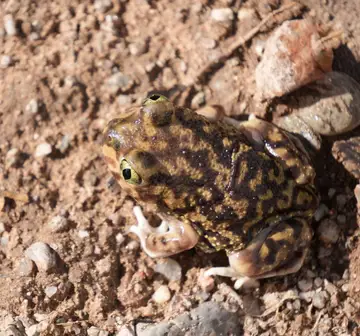
Spadefoot toads are stout, toad-like amphibians of the family Scaphiopodidae, named for the hard black spade on each hind foot that they use to dig backwards into loose or sandy soil. Unlike true toads, they have vertical, cat-like pupils and fairly smooth skin. They spend most of the year underground and appear in large numbers for only a few nights after heavy rains, when they breed in temporary pools. The eastern spadefoot lives in the eastern US; six other species live in the Great Plains and the West. They are not described as venomous, but their skin secretions can irritate: Tennessee warns they can be harmful in the eyes, nose or mouth, and North Carolina says many people have reported severe allergic reactions. Missouri advises washing your hands before touching your face or eyes. The eastern spadefoot is protected in several northeastern states, and the western spadefoot of California is proposed for federal listing as threatened. MDC
This page covers a family (Scaphiopodidae), not a single species.
On this page
Is the spadefoot toad dangerous?
Tennessee Wildlife Resources Agency: eastern spadefoot skin toxins can be harmful if they get in the eyes, nose or mouth. Tennessee Wildlife Resources Agency
“Like many toads, Eastern spadefoots secret toxins from their skin which can be harmful if they come into contact with the eyes, nose or mouth”
No official source we use states whether this animal is venomous. That does not mean it is harmless: do not handle it.
If someone is bitten or stung, call 911 or Poison Help at 1-800-222-1222.
How to identify a spadefoot toad
A photo or description can narrow it down, but cannot confirm what an animal is or that it is safe. Look from a distance and do not handle wild animals.
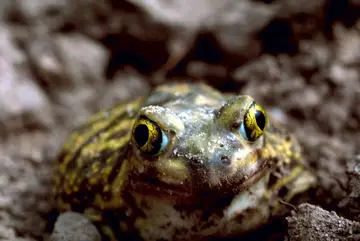

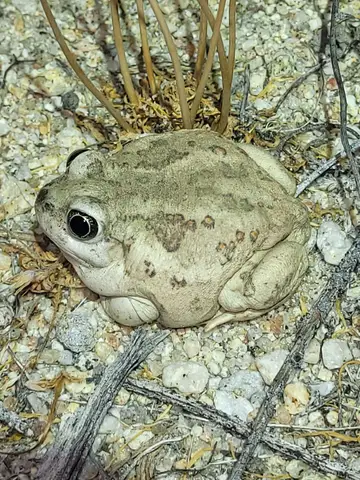
Size: Small to medium: about 1.5 to 3 inches; Couch's spadefoot rarely up to 3.5 inches. Connecticut Department of Energy and Environmental Protection (DEEP), Wildlife Division
Colors: brown, gray, olive, tan, yellowish and greenish yellow. Pattern: two light back stripes forming a lyre or hourglass (eastern spadefoot); dark spots or mottling; small scattered warts, sometimes red-tipped.
Key features
- A hard, black spade on each hind foot, used for digging (sickle-shaped in Scaphiopus, wedge-shaped in Spea). Illinois Natural History Survey (INHS), Prairie Research Institute, University of Illinois Urbana-Champaign
- Large eyes with vertical, cat-like pupils; true toads have horizontal pupils. N.C. Wildlife Resources Commission
- Relatively smooth skin with small, scattered warts, and no large parotoid glands like true toads. Connecticut Department of Energy and Environmental Protection (DEEP), Wildlife Division
- Western Spea species: plains spadefoot has a hard (bony) lump or 'boss' between the eyes, Great Basin a glandular lump, Mexican/New Mexico spadefoot none. Colorado Parks and Wildlife
- Some spadefoots are reported to smell like peanuts or peanut butter when handled. University of Georgia Savannah River Ecology Laboratory
Young
Eggs can hatch within a day and tadpoles can turn into tiny toadlets in as little as one to two weeks. Some western spadefoot tadpoles develop a large carnivorous form that eats fairy shrimp and other tadpoles.
Animals mistaken for the spadefoot toad
Spadefoot toad or True toads (American toad, Fowler's toad, southern toad and others)?
Spadefoot toad
True toads (American toad, Fowler's toad, southern toad and others) Anaxyrus spp.
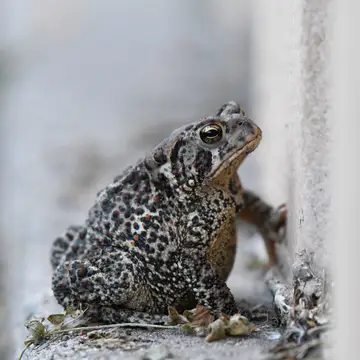

Look at the eye: spadefoots have vertical pupils, true toads horizontal. True toads also have large, wart-like parotoid glands behind the eyes and drier, wartier skin. Illinois Natural History Survey (INHS), Prairie Research Institute, University of Illinois Urbana-Champaign
MDC (Missouri toads and frogs): people are normally not affected by the skin secretions, but human eyes are sensitive to them. See the true toad pages.
Spadefoot toad or Cane toad?
Spadefoot toad
Cane toad Rhinella marina
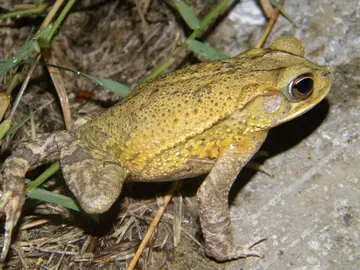

In Florida, the eastern spadefoot is rarely over 2 inches, has flattened, indistinct poison glands, no head crests, and a prominent digging spade; the invasive cane toad may be larger than 3 inches, with enlarged poison glands, but young cane toads are smaller, so size alone does not separate them. UF/IFAS warns to identify correctly before removing any toad. UF/IFAS Extension
UF/IFAS: cane toads are potentially lethal to pets that attack them; see the cane toad page.
Where the spadefoot toad lives
- Native or listed
- Nonnative or not established
- No official record in our data
- 1–9
- 10–99
- 100–999
- 1,000+
State boundaries: U.S. Census Bureau, cartographic boundary file cb_2024_us_state_20m.
When it is active
Active above ground mainly at night after heavy rains. In the East, breeding follows heavy rain (North Carolina: in any season; Maryland: March to September, mostly late March to mid-May). In the Southwest, Couch's and Mexican spadefoots emerge with the summer monsoon; Couch's stays buried 8 to 10 months a year. N.C. Wildlife Resources Commission
US open-licence records for all spadefoots (family Scaphiopodidae) peak in May to August.
Habitat and habits
Habitat: Places with loose, sandy or soft soil they can burrow into: fields, sandy woods and farmland in the East; deserts, grasslands, sagebrush and pinyon-juniper in the West. They breed in temporary, fishless pools, flooded fields, ditches and stock ponds filled by heavy rain. MDC
Behavior: They dig backwards into soil with their hind feet and can stay buried for months. They are nocturnal above ground and are mostly seen at breeding pools or crossing roads on warm, rainy nights.
Diet: Insects and spiders, plus worms and snails; Couch's spadefoot can feast on winged termites that emerge with the first monsoon storms.
Young: Explosive breeders: after heavy rains they gather at temporary pools for a few nights, and MDC says exceptionally heavy rains can stimulate thousands to breed. Eggs hatch in about a day and tadpoles transform within one to several weeks, racing the pool drying up. In dry years they may not breed at all.
Legal status and reporting
Federal: Western spadefoot (Spea hammondii): proposed for listing as threatened (northern and southern distinct population segments), with a 4(d) rule; proposed rule published 2023-12-05; ECOS still shows 'Proposed Threatened' on 2026-11-03 (no final listing found). Plains spadefoot: Not Listed. Couch's spadefoot: ECOS 'Species of Concern' (an informal term, not an ESA listing). Eastern, Hurter's, Mexican and Great Basin spadefoots: no ECOS record returned (not federally listed). ECOS
Protection: Eastern spadefoot: state endangered in Connecticut (collection prohibited) and Ohio; state threatened in Massachusetts and Pennsylvania; special concern in New York and New Jersey. Western spadefoot: CDFW Species of Special Concern and CESA candidate endangered in California. Couch's spadefoot: CDFW Species of Special Concern and Colorado State Special Concern. Plains spadefoot: Iowa special concern. Many states also restrict collecting native amphibians (e.g. North Carolina limits; Colorado needs a license). Connecticut Department of Energy and Environmental Protection (DEEP), Wildlife Division
Invasive status: No official source describes any spadefoot as invasive or introduced in the US.
Report: Not invasive. Connecticut asks people to photograph and report eastern spadefoots to the DEEP Wildlife Division ([email protected], 860-424-3011) and not to try to capture them. Washington asks for Great Basin spadefoot sightings through the WDFW wildlife reporting form. Connecticut Department of Energy and Environmental Protection (DEEP), Wildlife Division
Questions about the spadefoot toad
Spadefoot toad
A spadefoot toad is a toad-like amphibian of the North American spadefoot family (Scaphiopodidae). It has a hard spade on each hind foot for digging and vertical, cat-like pupils, and spends most of its life buried, coming out to breed after heavy rains. Spadefoots are not true toads. Their skin secretions can be harmful in the eyes, nose or mouth and some people have had severe allergic reactions, so officials advise washing your hands after touching one.
Arizona frogs after rain
In Arizona, Couch's spadefoot stays buried for 8 to 10 months and comes out at the start of the summer monsoon. On the first night of or after the first big summer storm, they move to rain-filled pools to breed, and they are often seen on roads on warm, humid summer nights. The Mexican spadefoot also emerges with the monsoon.
Arizona monsoon frogs
Arizona's spadefoots, including Couch's, Mexican, plains and Great Basin spadefoots, breed in temporary pools after rain. Couch's and Mexican spadefoots emerge with the summer monsoon. Couch's spadefoot tadpoles can turn into toadlets in as little as 7 to 8 days.
North carolina toads poisonous
For North Carolina's eastern spadefoot, the N.C. Wildlife Resources Commission says many people have reported severe allergic reactions to its skin secretions and recommends washing your hands thoroughly after handling one. (This answer covers spadefoots only; see the state page for true toads.)
Sources
- MDC Field Guide: Reptiles and Amphibians > Frogs and toads (species accounts). Missouri Department of Conservation (MDC). undated page; checked November 3, 2026.
Quoted passages (1)
“Eastern spadefoots apparently prefer open fields where loose sand and soil facilitate burrowing.”
- Eastern Spadefoot (NCWRC species page). N.C. Wildlife Resources Commission. undated page; checked November 3, 2026.
Quoted passages (2)
“The eastern spadefoot is a small- to medium-sized, stocky toad with relatively smooth skin and large eyes with veritical pupils. Other toads have horizontal pupils.”
“They breed in any season, and are called "explosive" breeders, with all reproduction taking place on a few rainy nights each year.”
- Amphibians » Frogs and Toads (Tennessee Watchable Wildlife species accounts). Tennessee Wildlife Resources Agency (Tennessee Watchable Wildlife website). undated page; checked November 3, 2026.
Quoted passages (1)
“Like many toads, Eastern spadefoots secret toxins from their skin which can be harmful if they come into contact with the eyes, nose or mouth”
- Eastern Spadefoot (Wildlife Fact Sheet). Connecticut Department of Energy and Environmental Protection (DEEP), Wildlife Division. Content last updated March 5, 2019; checked November 3, 2026.
Quoted passages (7)
“The spadefoot is a medium-sized amphibian, ranging from 1.75 to 3 inches in body length.”
“The skin is smooth and warts are very small and scattered.”
“The eggs can hatch in as little as 24 hours with rapidly developing tadpoles that can grow into land-dwelling amphibians in as little as 14 days.”
“When spadefoots emerge from their burrows they are opportunistic hunters, feeding on a variety of spiders and insects.”
“When heavy rains fall, typically of 2 or more inches, the amphibians emerge from their burrows in large numbers and explosively breed.”
“Eastern spadefoots are protected by the Connecticut Endangered Species Act, and collection of these amphibians is prohibited.”
“If you find an Eastern spadefoot, please take a photograph and report it to the Wildlife Division at [email protected] or call 860-424-3011.”
- Species profile: Couch's Spadefoot. Colorado Parks and Wildlife. undated page; checked November 3, 2026.
- ECOS Species Report export: Spea* and Scaphiopus* ESA listing status. U.S. Fish and Wildlife Service (ECOS). live ECOS export retrieved 2026-11-03; checked November 3, 2026.
- Endangered and Threatened Wildlife and Plants: Threatened Status With Section 4(d) Rule for the Northern and Southern Distinct Population Segments of the Western Spadefoot (proposed rule, 88 FR 84252). U.S. Fish and Wildlife Service (Federal Register). published 2023-12-05; checked November 3, 2026.
- Eastern Spadefoot (Field Guide to Amphibians and Reptiles of Illinois). Illinois Natural History Survey (INHS), Prairie Research Institute, University of Illinois Urbana-Champaign. undated page; checked November 3, 2026.
Quoted passages (2)
“Plump body; vertical pupil; one large, black, elongate digging spade under heel of each hind foot.”
“American Toad and Fowler’s Toad are squat and plump, but do not have the vertical pupil.”
- Species profile: Plains Spadefoot. Colorado Parks and Wildlife. undated page; checked November 3, 2026.
Quoted passages (1)
“…hard lump between eyes, slightly forward of an imaginary line crossing the middle of both eyes”
- Eastern Spadefoot Toad (Scaphiopus holbrookii). University of Georgia Savannah River Ecology Laboratory (linked by SCDNR as its species information). undated page; checked November 3, 2026.
Quoted passages (1)
“Sometimes reported to have an odor reminiscent of peanut butter.”
- Great Basin spadefoot (Spea intermontana). Washington Department of Fish and Wildlife. undated page; checked November 3, 2026.
Quoted passages (1)
“They are able to quickly bury themselves in loose soils by using their hind legs in a circular motion to back into the soil.”
- WEC387 The Cane or "Bufo" Toad (Rhinella marina) in Florida. UF/IFAS Extension (EDIS). Original July 2017; checked November 3, 2026.
Quoted passages (1)
“Rarely larger than 2 inches”
- Online Field Guide species account: Couch’S Spadefoot (Scaphiopus couchii). Arizona Game and Fish Department. 2023; checked November 3, 2026.
- Online Field Guide species account: Mexican Spadefoot (Spea multiplicata). Arizona Game and Fish Department. 2023; checked November 3, 2026.
- Online Field Guide species account: Plains Spadefoot (Spea bombifrons). Arizona Game and Fish Department. 2023; checked November 3, 2026.
- Online Field Guide species account: Great Basin Spadefoot (Spea intermontana). Arizona Game and Fish Department. 2023; checked November 3, 2026.
- GBIF.org occurrence records, human observations licensed CC0 1.0 or CC BY 4.0 only, accessed November 3, 2026. The datasets behind these counts are listed on our Sources page.
- State boundaries: U.S. Census Bureau, cartographic boundary file cb_2024_us_state_20m.