Spectacled caiman
Caiman crocodilus · also called Common caiman, Caimán and Pululo · Last checked November 3, 2026.
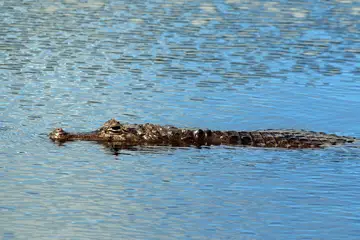

The spectacled (common) caiman is a medium-sized crocodilian, usually 3.5 to 6 feet long, from southern Mexico, Central America and South America. It is not native to the US. The pet trade imported thousands from the 1950s to the early 1980s, and released or escaped caimans have turned up in many states. USGS says it is established and invasive in south Florida (Miami-Dade and Broward counties) and that no other US state has an established population; it is also established in Puerto Rico. Florida FWC describes it as secretive but feisty when cornered. It can be told from the American alligator and crocodile by a curved bony ridge between the eyes. US Geological Survey, Nonindigenous Aquatic Species database
On this page
Is the spectacled caiman dangerous?
Florida FWC: this "small" crocodilian is secretive but feisty when cornered. Florida Fish and Wildlife Conservation Commission
“This "small" crocodilian is secretive but is feisty when cornered.”
If someone is bitten or stung, call 911 or Poison Help at 1-800-222-1222.
How to identify a spectacled caiman
A photo or description can narrow it down, but cannot confirm what an animal is or that it is safe. Look from a distance and do not handle wild animals.
Size: Usually 3.5 to 6 feet (1.1 to 1.8 m) long; record 8 ft 8 in. FWC: south Florida caimans are typically under 6 feet. US Geological Survey, Nonindigenous Aquatic Species database
Colors: Greenish-, brownish- or yellowish-gray with darker crossbands. Pattern: Darker crossbands, clearest in the young.
Key features
- A curved bony ridge across the snout just in front of and between the eyes, which the American alligator and American crocodile lack US Geological Survey, Nonindigenous Aquatic Species database
- The snout is not as broad and round as an American alligator's US Geological Survey, Nonindigenous Aquatic Species database
Young
Hatchlings are banded very dark brown on dark olive; they darken and the pattern fades with age.
Animals mistaken for the spectacled caiman
Spectacled caiman or American alligator?
Spectacled caiman
American alligator Alligator mississippiensis
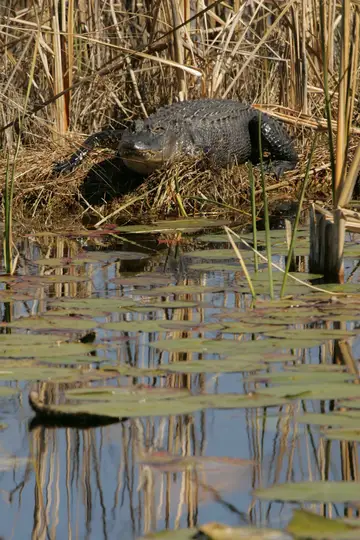

The alligator has a broader, rounder snout and no bony ridge between the eyes. US Geological Survey, Nonindigenous Aquatic Species database
See the American alligator page.
Spectacled caiman or American crocodile?
Spectacled caiman
American crocodile Crocodylus acutus
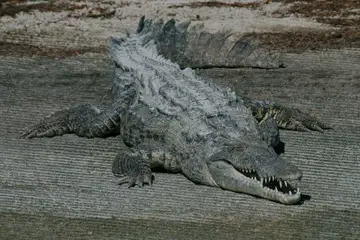
The American crocodile has no bony ridge between the eyes. US Geological Survey, Nonindigenous Aquatic Species database
See the American crocodile page.
Where the spectacled caiman lives
- Native or listed
- Nonnative or not established
- No official record in our data
- 1–9
- 10–99
- 100–999
- 1,000+
State boundaries: U.S. Census Bureau, cartographic boundary file cb_2024_us_state_20m.
When it is active
Too few open-licence records to chart by month: GBIF has only 1 record CC0 or CC BY human observations of this species in the US.
Habitat and habits
Habitat: In south Florida: freshwater marshes, heavily vegetated ponds and lakes, and canals. USGS: it can use almost any natural or man-made body of water. Florida Fish and Wildlife Conservation Commission
Behavior: Secretive but feisty when cornered. It does not tolerate cold: occasional freezes limit its spread north in Florida, and USGS says it does not seem to tolerate temperatures below 35 F.
Diet: A generalist predator: a wide variety of aquatic invertebrates and vertebrates, plus land insects.
Young: Lays hard-shelled eggs in a mound nest of plants; the mother may guard the nest, and the young stay together with parental care for several months. Florida FWC reported a nest of 41 eggs collected in Broward County in 2001.
Legal status and reporting
Federal: Under the Endangered Species Act, ECOS lists the common caiman (Caiman crocodilus crocodilus) and the brown caiman (C. c. fuscus) as 'Similarity of Appearance (Threatened)', wherever found, since 2000-05-04. The Apaporis River caiman (C. c. apaporiensis) is Endangered. ECOS does not say which subspecies the Florida animals are. USGS adds that the species is subject to international and federal trade regulations. US Fish and Wildlife Service, ECOS
Invasive status: Invasive in Florida (Miami-Dade and Broward counties), per USGS. Eradication attempts in Miami-Dade have failed. USGS says it could harm native wildlife and can carry a parasite (caiman tongueworm) that could pass to native fish and crocodilians. US Geological Survey, Nonindigenous Aquatic Species database
Report: Florida: report nonnative reptiles such as caimans through the IveGot1 app or IveGot1.org. FWC's hotline 888-IveGot1 (483-4681) is listed for nonnative snakes, monitors and tegus. Elsewhere: USGS NAS has a 'Report a Sighting' form on its website. FWC
Questions about the spectacled caiman
Are there caimans in california?
Not as a resident population. USGS NAS has three California records, from 1976 to 1989, all marked 'failed' (released or escaped animals that did not establish). USGS says there are no established populations anywhere in the US except Florida.
Are there caimans in Georgia, Hawaii, Louisiana, South Carolina and Tennessee?
No resident caimans. USGS NAS lists no spectacled (common) caiman records for these states, and it says there are no established populations in any US state except Florida. USGS also says its records surely underrepresent the animals that show up across the US.
Sources
- Caiman crocodilus (Common Caiman) - Species Profile. U.S. Geological Survey, Nonindigenous Aquatic Species database. Revision Date 6/22/2012; checked November 3, 2026.
Quoted passages (6)
“Caiman crocodilus is a medium-sized crocodilian that reaches a total length of 1.1-1.8 m (3.5-6 ft), with a record of 2.64 m (8 ft 8 in) (Conant and Collins, 1998).”
“Unlike A. mississippiensis and Crocodylus acutus, the American crocodile, the common caiman has a unique bony ridge in front of and between the eyes (Behler and King, 1979; Conant and Collins, 1998; Powell et al., 1998).”
“The snout is not as broad and round as in Alligator mississippiensis, the American alligator (Conant and Collins, 1998).”
“Caiman crocodilus is an adaptable, generalist, with an omnicarnivorous diet that includes a broad variety of aquatic invertebrates and vertebrates, including terrestrial insects (Ellis, 1980; Alvarez del Toro, 1982; Grenard, 1991; Schwartz and Henderson, 1991; Murphy, 1997; Aguirre and Poss, 2000).”
“The female lays hard-shelled eggs in terrestrial mound nests constructed of surrounding vegetation; the nests may be guarded by the mother, opened by either parent to assist neonates during hatching, and additional parental care extended toward the young for several months afterwards while they remain together in a crèche (Alvarez del Toro, 1982; Wilson and Porras, 1983; Shine, 1988; Magnusson et al., 1989; Allsteadt, 1994; Rivero, 1998).”
“Common caiman are established and invasive in Dade and Broward Counties (Ellis, 1980; Wilson and Porras, 1983; Grenard, 1991; McCann et al., 1996; Conant and Collins, 1998).”
- Nonnatives - Spectacled Caiman. Florida Fish and Wildlife Conservation Commission. archived copy, captured November 27, 2018; checked November 3, 2026.
Quoted passages (4)
“This "small" crocodilian is secretive but is feisty when cornered.”
“Hatchlings are banded with very dark brown on a dark olive ground color, and the color darkens and the pattern obscures as they grow.”
“Breeding populations occur in localized areas of Dade and Broward counties, where they inhabit freshwater marshes, heavily vegetated ponds and lakes, and canals.”
“It is susceptible to cold weather, and its northern expansion is limited by occasional freezes in south Florida (Bartlett and Bartlett 1999).”
- Checklist of Florida's Amphibians and Reptiles (Revised 2023). Florida Fish and Wildlife Conservation Commission (FWC). Revised 2023; checked November 3, 2026.
Quoted passages (1)
“If nonnative snakes, monitors, or tegus are observed, they should be reported to FWC’s Invasive Species Hotline at 888-Ive-Got1 (483-4681). All other nonnative reptile and amphibian species can be reported via the IveGot1 app or IveGot1.org.”
- ECOS species report: scientific name like 'Caiman%'. U.S. Fish and Wildlife Service, ECOS. live query 2026-11-03; checked November 3, 2026.
- NAS occurrence records, Caiman crocodilus, all states (API). U.S. Geological Survey, Nonindigenous Aquatic Species database. live query 2026-11-03; checked November 3, 2026.
- GBIF.org occurrence records, human observations licensed CC0 1.0 or CC BY 4.0 only, accessed November 3, 2026. The datasets behind these counts are listed on our Sources page.
- State boundaries: U.S. Census Bureau, cartographic boundary file cb_2024_us_state_20m.