Trapdoor spiders
Mygalomorph trapdoor spiders: mainly Halonoproctidae (Ummidia, Bothriocyrtum), Euctenizidae (Myrmekiaphila, Aptostichus, Eucteniza), Antrodiaetidae (Antrodiaetus); in Hawaii, Barychelidae (Nihoa) · also called Trap-door spider, Cork-lid trapdoor spider (Ummidia) and Foldingdoor / folding trapdoor spider (Antrodiaetus) · Last checked November 3, 2026.
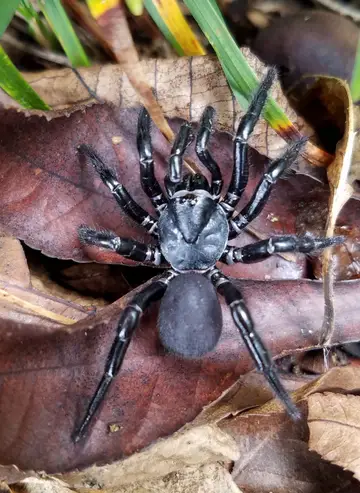
Trapdoor spiders are heavy-bodied, dark, burrowing spiders related to tarantulas. They live in silk-lined burrows closed by a hinged, camouflaged lid and ambush passing prey at night. Females rarely leave the burrow, so most people see wandering males. Extension services say bites are uncommon and happen only if the spider is harassed. NC State Extension says a bite is not dangerous and not much more painful than a wasp sting, and Mississippi State says it is painful but not considered seriously venomous to people. In the US they live mainly in the East and the Southwest, north to Colorado, with many species in California. Mississippi State University Extension Service
This page covers a group (Mygalomorph trapdoor spiders: mainly Halonoproctidae (Ummidia, Bothriocyrtum), Euctenizidae (Myrmekiaphila, Aptostichus, Eucteniza), Antrodiaetidae (Antrodiaetus); in Hawaii, Barychelidae (Nihoa)), not a single species.
On this page
Are trapdoor spiders dangerous?
NC State Extension: cork-lid trapdoor spiders (Ummidia) are not dangerous; bites are uncommon, happen only if the spider is harassed, and are not much more painful than a wasp sting. NC State Extension
“We can also breathe easy knowing that they are not dangerous, especially compared to their superficially-similar cousins from Australia.”
Bites and stings: Uncommon; happen only when the spider is provoked or handled. Males may rear up and show their fangs. NC State: a bite is not dangerous and not much more painful than a wasp sting. University of Arkansas: when first disturbed they readily bite but soon calm down.
No official source we use states whether this animal is venomous. That does not mean it is harmless: do not handle it.
If someone is bitten or stung, call 911 or Poison Help at 1-800-222-1222.
How to identify trapdoor spiders
A photo or description can narrow it down, but cannot confirm what an animal is or that it is safe. Look from a distance and do not handle wild animals.
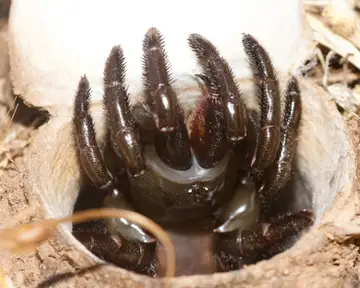
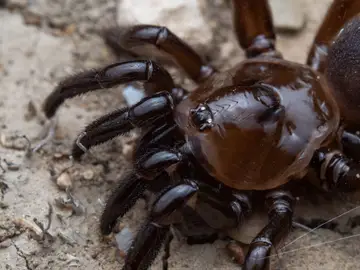
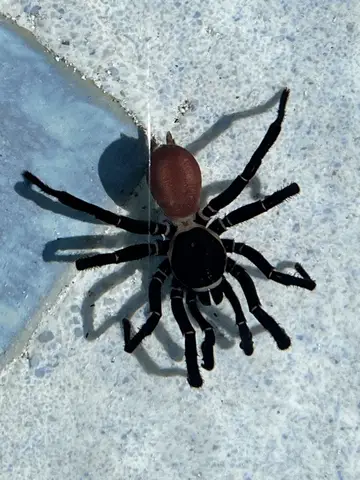
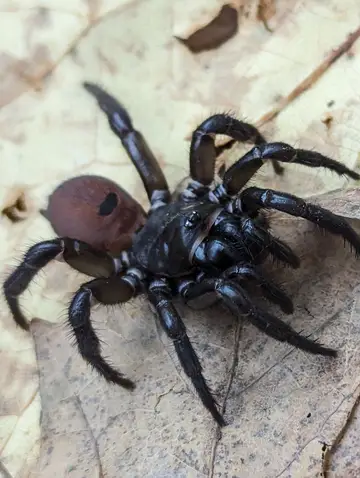
Size: Stout, chunky spiders. A large female Ummidia audouini in Mississippi was 1.5 inches long; NC State compares Ummidia to the size of a sports-drink bottle cap. Ohio's foldingdoor spider is smaller: females about 1/2 inch.
Colors: black and dark brown. Pattern: plain, no markings.
Key features
- Fangs point downward and strike in a stabbing motion, like a tarantula's (same suborder). Mississippi State University Extension Service
- Lives in a silk-lined burrow closed by a round, hinged lid camouflaged with soil and plant bits, often on slopes or ravine sides.
- Burrow lids are about 1 inch across; burrows usually less than 5 inches deep (Arkansas). University of Arkansas Arthropod Museum
- Foldingdoor spiders (Antrodiaetus) close the burrow with a split, two-part silk lid (Ohio). Ohio Department of Natural Resources, Division of Wildlife
Young
Spiderlings of at least some species disperse by ballooning on silk threads.
Animals mistaken for trapdoor spiders
Trapdoor spiders or Tarantulas?
Trapdoor spiders
Tarantulas Theraphosidae
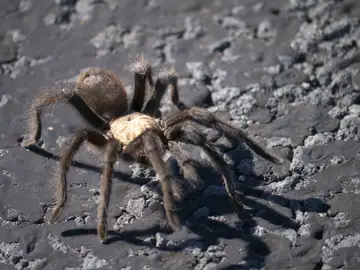

No official source read gives a feature for telling trapdoor spiders from tarantulas. Mississippi State Extension says trapdoor spiders are the closest thing to tarantulas in Mississippi: they are in the same suborder and share downward-pointing, stabbing fangs. NC State says North Carolina has no true tarantulas.
See tarantula page.
Trapdoor spiders or Sydney funnel-web spider (Australia only)?
Trapdoor spiders
Sydney funnel-web spider (Australia only) Atrax robustus
NC State Extension: the large black Ummidia trapdoor spiders people find in North Carolina are often mistaken for the Australian Sydney funnel-web spider, which does not live in North Carolina. NC State Extension
NC State calls the Australian Sydney funnel-web 'sometimes deadly' and says North Carolina is not being invaded by dangerous spiders.
Trapdoor spiders or Purse-web spiders?
Trapdoor spiders
Purse-web spiders Sphodros spp.
NC State: purse-web spiders live in silken tubes and bite through the tube when insects walk on it, instead of using a lidded burrow. NC State Extension
Where trapdoor spiders live
- Native or listed
- Nonnative or not established
- No official record in our data
- 1–9
- 10–99
- 100–999
- 1,000+
State boundaries: U.S. Census Bureau, cartographic boundary file cb_2024_us_state_20m.
When it is active
Active at night. Wandering males are seen most: July and August in Arkansas, October for Ohio's foldingdoor spider. Desert females are easiest to find after winter rains, when they clear out their burrows (NPS).
US open-licence records for trapdoor spiders of the families Halonoproctidae, Euctenizidae, Antrodiaetidae and Barychelidae peak in January to April, July, September and December.
Habitat and habits
Habitat: Silk-lined burrows in the sides of hills, slopes and forested ravines (Mississippi, Arkansas). Ohio's foldingdoor spider uses loose soil near cliffs, cave entrances or tree bases in moist forests.
Behavior: Nocturnal ambush hunters. Females stay in or near the burrow for many years; males leave to search for mates and may rear up and show their fangs if disturbed.
Diet: Ambushes passing insects and other small prey from behind the partly open lid.
Young: Males wander to find females in their burrows and die after mating; females live for years.
Legal status and reporting
Federal: No trapdoor-spider genus checked appears in the USFWS ECOS species database (Ummidia, Antrodiaetus, Aptostichus, Myrmekiaphila, Bothriocyrtum, Eucteniza, Nihoa: 0 rows each, queried 2026-11-03). ECOS
Protection: No legal protection is stated by the sources read. Conservation listings: Virginia lists the Robust Trapdoor Spider (Antrodiaetus robustus) as Wildlife Action Plan Tier II (DWR says WAP tiers are not a legal status). Hawaii's 2025 State Wildlife Action Plan covers two endemic brushed trapdoor spiders (Nihoa) of Nihoa and Mokumanamana islands. NPS says the Cabrillo trapdoor spider (Aptostichus cabrillo) is endemic to Cabrillo National Monument, where park biologists work to protect all species in the park.
Report: Not invasive. Mississippi State Extension asks people who find trapdoor spiders in Mississippi to share sightings and photos, because their distribution in the state is not well known. Mississippi State University Extension Service
Questions about trapdoor spiders
Trapdoor spider
Trapdoor spiders are stout, tarantula-related spiders that live in silk-lined burrows closed with a hinged, camouflaged lid and ambush prey at night (Mississippi State Extension, University of Arkansas). NC State Extension says they are not dangerous. Bites are uncommon, happen only if the spider is harassed, and are not much more painful than a wasp sting.
Are there trapdoor spiders in pennsylvania?
Not confirmed. No Pennsylvania agency or Penn State Extension source we checked lists trapdoor spiders, and that does not mean they are absent. Next door, Ohio DNR's Common Spiders of Ohio includes the foldingdoor spider (Antrodiaetus unicolor), a burrowing spider with a split silk lid, and Virginia lists the Robust Trapdoor Spider (Antrodiaetus robustus).
Sources
- Trapdoor Spider, Bug's Eye View Vol. 7, No. 28 (Blake Layton). Mississippi State University Extension Service. 2021 (Bug's Eye View Vol. 7, No. 28; checked November 3, 2026.
Quoted passages (3)
“They are in the same suborder as tarantulas with which they share the trait of having fangs that point downward and are used in a stabbing motion”
“This allows them to hunt by lying in wait under the partly opened lid and darting out to capture prey that ventures too close.”
“If you do encounter trapdoor spiders in the state, we would appreciate hearing about it and seeing pictures.”
- Local Spiders Confused for Deadly Relatives - Plant Disease and Insect Clinic. NC State Extension (N.C. Cooperative Extension). June 22, 2022; checked November 3, 2026.
Quoted passages (3)
“We can also breathe easy knowing that they are not dangerous, especially compared to their superficially-similar cousins from Australia.”
“This is not a deadly Sydney funnel web spider, but a local trapdoor spider in the genus Ummidia.”
“Others (a personal favorite) are called purse-web spiders, since the spiders live in silken tubes and use their giant fangs to pierce through the tube when insects crawl on it.”
- Trapdoor Spider. University of Arkansas Arthropod Museum (state university natural-history collection). undated page; checked November 3, 2026.
Quoted passages (2)
“They are usually less than five inches deep and are hidden under trapdoors that are hinged on one side. The trapdoors are about one inch in diameter”
“Spiderlings of at least some species disperse aerially by ballooning on silken threads caught in a breeze.”
- Our Own Celebrity Spider - Cabrillo National Monument. National Park Service. November 23, 2018; checked November 3, 2026.
- Common Spiders of Ohio Field Guide (Publication 5140). Ohio Department of Natural Resources, Division of Wildlife (text by Richard A. Bradley, Ph.D.). PUBLICATION 5140; checked November 3, 2026.
Quoted passages (1)
“The top of the burrow is closed with a split silken lid disguised with bits of material found near the entrance.”
- USFWS ECOS species report export (JSON), scientific-name queries: Ummidia, Antrodiaetus, Aptostichus, Myrmekiaphila, Bothriocyrtum, Eucteniza, Nihoa. U.S. Fish and Wildlife Service (ECOS). live query 2026-11-03; checked November 3, 2026.
- List of Native and Naturalized Fauna of Virginia. Virginia Department of Wildlife Resources (DWR). May, 2026; checked November 3, 2026.
- GBIF.org occurrence records, human observations licensed CC0 1.0 or CC BY 4.0 only, accessed November 3, 2026. The datasets behind these counts are listed on our Sources page.
- State boundaries: U.S. Census Bureau, cartographic boundary file cb_2024_us_state_20m.