Yellow Sac Spider
Cheiracanthium (mainly C. mildei and C. inclusum) · also called yellow-legged sac spider, long-legged sac spider, longlegged sac spider and agrarian sac spider · Last checked November 3, 2026.
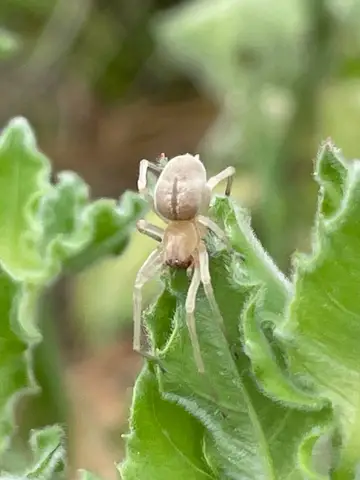
Yellow sac spiders are small, pale yellow to beige night-hunting spiders, about 4 to 10 mm long in the body, often seen on walls and ceilings or in a small silk sac in a corner. They are venomous and can bite when trapped against skin in clothing or bedding. Bites are usually painful at first. Official sources disagree on how serious they are: Penn State and Virginia Extension say serious problems or large necrotic wounds have not been confirmed, while an older New York brochure calls the venom necrotic. Two species are found widely in the US, with official records including California, Colorado, New Mexico, New York, Ohio, Pennsylvania, Texas and Virginia. If bitten and concerned, call 911 or Poison Help at 1-800-222-1222. Penn State Extension
This page covers a genus (Cheiracanthium (mainly C. mildei and C. inclusum)), not a single species.
On this page
Is the yellow sac spider dangerous?
Official sources disagree. Newer extension sources: bites are usually painful but not serious, and necrotic wounds have not been confirmed in verified bites (Penn State 2026, Virginia Extension 2025). Ohio: a few cases of slow-healing wounds, not well documented. Older New York DEC brochure (2007): necrotic venom causing slow-healing sores. The site should not call them safe. Penn State Extension
“Although most of these bites are painful at the outset, they normally do not result in any serious medical conditions.”
Bites and stings: Bites usually happen when the spider is trapped against skin in clothing or bedding. UC IPM: initial pain like a bee sting, redness and sometimes swelling. CSU: painful, usually with no other symptoms. Penn State adds that the bite can burn, then blister and itch, and some people have fever, cramps or nausea. Penn State also says C. mildei has been seen biting without provocation.
If someone is bitten or stung, call 911 or Poison Help at 1-800-222-1222.
How to identify a yellow sac spider
A photo or description can narrow it down, but cannot confirm what an animal is or that it is safe. Look from a distance and do not handle wild animals.
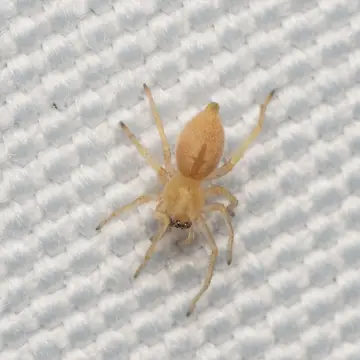
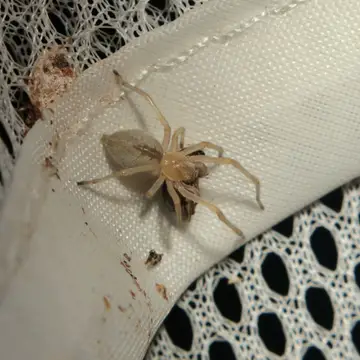
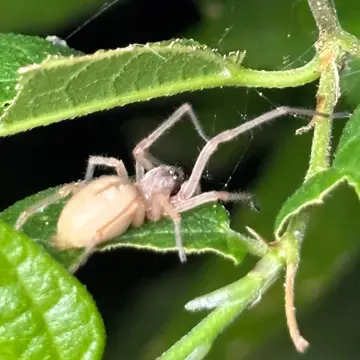
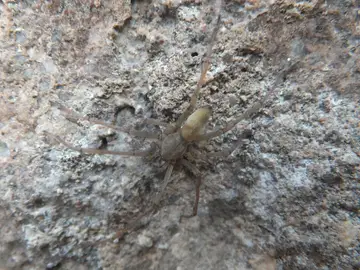

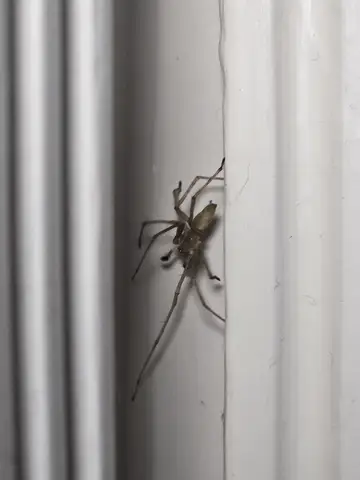
Size: Body 4 to 10 mm (0.2 to 0.4 inch). Females 5 to 10 mm, males 4 to 8 mm; about 3/4 inch with legs spread. Virginia Cooperative Extension, Virginia Tech
Colors: light yellow or beige, or pale grayish-tan; C. mildei may look slightly greenish; dark-brown mouthparts and leg tips. Pattern: faint darker stripe down the middle of the abdomen; otherwise no conspicuous markings.
Key features
- 8 eyes in two rows University of California Statewide IPM Program
- long, delicate legs, front pair longest Colorado State University, Department of Agricultural Biology
- hides by day in a silk tube or sac, often in a ceiling corner; does not build a capture web Penn State Extension
Young
Spiderlings stay in the silk retreat briefly, then go out at night and return at daybreak.
Animals mistaken for the yellow sac spider
Yellow Sac Spider or Brown recluse?
Yellow Sac Spider
Brown recluse Loxosceles reclusa
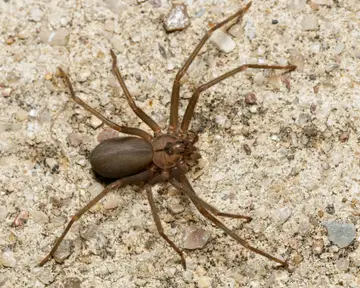
Count the eyes with a hand lens: recluse spiders have 6 eyes in pairs, yellow sac spiders have 8 in two rows. University of California Statewide IPM Program
The brown recluse is venomous; see its page.
Where the yellow sac spider lives
- Native or listed
- Nonnative or not established
- No official record in our data
- 1–9
- 10–99
- 100–999
- 1,000+
State boundaries: U.S. Census Bureau, cartographic boundary file cb_2024_us_state_20m.
When it is active
Active at night and in a silk retreat by day. Most common wandering spider in Colorado homes in fall, at night. Colorado State University Extension
US open-licence records for all yellow sac spiders (genus Cheiracanthium) peak in April to June and August to October.
Habitat and habits
Habitat: Outdoors on foliage, under leaf litter, stones and boards; indoors in corners of walls and ceilings and behind shelves and pictures. C. mildei is more often indoors, C. inclusum more often outdoors. Penn State Extension
Behavior: Active night hunter that does not use a web to catch prey. Runs on walls and ceilings at night and quickly drops to the floor if disturbed.
Diet: Hunts insects, including eggs, and other spiders; Ohio adds plant nectar.
Young: Eggs laid in early summer (June or July) in a silk retreat, about 40 in a loose mass, and the female guards them. One-year life cycle.
Questions about the yellow sac spider
Yellow sac spider bite
Usually happens when the spider is trapped against skin in clothing or bedding. UC IPM describes initial pain like a bee sting, redness and sometimes swelling. Penn State says most bites do not lead to serious medical conditions, though some people have whole-body reactions. If bitten and concerned, call 911 or Poison Help at 1-800-222-1222.
Yellow sac spider poisonous
They are venomous. Penn State and Virginia Extension say verified bites have not confirmed large necrotic wounds and that the venom's dangerous reputation is not deserved. New York DEC's 2007 brochure calls them moderately poisonous with necrotic venom. Sources do not agree, and the page should not call them safe.
Yellow sac spider size
Body about 4 to 10 mm (0.2 to 0.4 inch), and about 3/4 inch with the legs spread.
Yellow sac spider vs brown recluse
Count the eyes with a hand lens: recluse spiders have 6, yellow sac spiders have 8 in two rows. New York DEC says bites blamed on brown recluses in New York are almost certainly from yellow sac spiders.
Yellow sac spider ny
Yes. New York DEC names C. mildei and C. inclusum, and calls them the only moderately poisonous spiders in New York. That 2007 brochure is older than the Penn State and Virginia reviews of verified bites.
Yellow sac spider ohio
Yes. Ohio DNR lists C. mildei, which it says is introduced and more common than the native C. inclusum, and is active at night in buildings.
Yellow sac spider colorado
Yes. CSU says C. mildei is common indoors and outdoors throughout Colorado; C. inclusum records are limited to Elbert and Alamosa counties, though it is likely more widespread.
Yellow sac spider michigan
No official state page could be read for these states. Penn State says C. mildei is found throughout the US north of Virginia, Utah and California, and C. inclusum over much of the US except the northernmost states.
Sources
- Agrarian Sac Spider and Longlegged Sac Spider. Penn State Extension. updated January 19, 2026; checked November 3, 2026.
Quoted passages (4)
“Although most of these bites are painful at the outset, they normally do not result in any serious medical conditions.”
“These retreats are silken tubes or sacs in which the spiders hide during the daytime.”
“The young spiderlings will often remain within the silken retreat for a short period, eventually venturing out at night in search of food.”
“Sac spiders can be found walking about on foliage; under leaf litter, stones, and boards; on buildings under the windowsills and siding; and in the corners of walls and ceilings within homes.”
- ENTO-73 Spiders with Potentially Harmful Venom Found in Virginia. Virginia Cooperative Extension, Virginia Tech. Publication Date August 1, 2025; checked November 3, 2026.
Quoted passages (1)
“Both species are similar in size (4-10 mm or 0.2-0.4 inch)”
- Pest Notes: Spiders (UC ANR Publication 7442). University of California Statewide IPM Program (UC ANR, Cooperative Extension). 2020-10; checked November 3, 2026.
Quoted passages (3)
“The 8 eyes of this spider are all about equal in size and arranged in 2 horizontal rows.”
“Yellow sac spiders can be seen running on walls and ceilings at night and quickly drop to the floor to escape if they are disturbed.”
“A more diagnostic feature of recluse spiders is their 6 eyes, arranged in pairs in a semicircle, which can be seen with the use of a good hand lens.”
- Common spiders brochure (11 species and groups). NYSDEC, text by Cornell University Department of Entomology, reprinted from New York State Conservationist. June 2007; checked November 3, 2026.
Quoted passages (1)
“They have necrotic venom that causes itchy or painful ulcerating sores that are slow to heal.”
- Colorado Insect of Interest: Yellow-legged Sac Spiders. Colorado State University, Department of Agricultural Biology. undated page; checked November 3, 2026.
Quoted passages (3)
“Legs of yellow-legged sac spiders are long and delicate, with the front pair somewhat longer than the others.”
“A wide variety of insects (including eggs) and other spiders may be eaten.”
“The eggs are produced in a loose mass of about 40 eggs”
- Spiders in the Home. Colorado State University Extension. Published September 2013; checked November 3, 2026.
Quoted passages (1)
“They are usually the most common spider found wandering in homes during fall, particularly at night.”
- Common Spiders of Ohio Field Guide (Publication 5140). Ohio Department of Natural Resources, Division of Wildlife. PUBLICATION 5140; checked November 3, 2026.
- GBIF.org occurrence records, human observations licensed CC0 1.0 or CC BY 4.0 only, accessed November 3, 2026. The datasets behind these counts are listed on our Sources page.
- State boundaries: U.S. Census Bureau, cartographic boundary file cb_2024_us_state_20m.