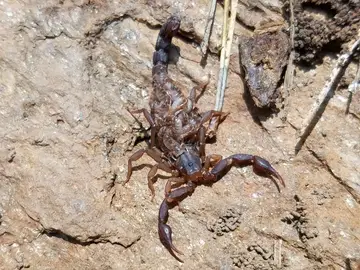
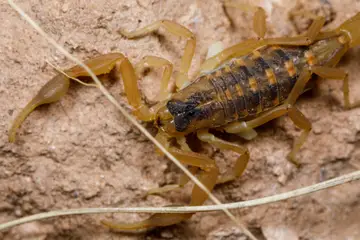
Southern devil (unstriped) scorpion, mostly in the northeast; striped bark scorpion, rare and possibly brought in accidentally.
Mississippi State University Extension Service: “Scorpions in Mississippi? They are not that common, but they are here. Actually, there are two species, southern devil scorpions and striped bark scorpions.” Source
Think you have seen one in Mississippi? Keep your distance and contact the Mississippi Department of Wildlife, Fisheries, and Parks (MDWFP), including the Mississippi Museum of Natural Science (MMNS).
Although they occur in other areas of the state, southern devil scorpions, also known as southern unstriped scorpions, are most often found in the Northeast corner of … Mississippi State University Extension Service
What the sources say
Venom: “As with bee or wasp stings, there may be individuals who are hypersensitive to the venom.” (Mississippi State University Extension Service)
Range: Although they occur in other areas of the state, southern devil scorpions, also known as southern unstriped scorpions, are most often found in the Northeast corner of the state, roughly from Columbus to Corinth, and a row or two of counties to the west.
Habitat: Unlike western species, the southern devil scorpion favors moist, humid environments. (Mississippi State University Extension Service)
“Scorpions in Mississippi? They are not that common, but they are here. Actually, there are two species, southern devil scorpions and striped bark scorpions.”
“As with bee or wasp stings, there may be individuals who are hypersensitive to the venom.”
“Both species can and will sting, and, although the sting is painful, it is very rarely deadly. Many folks who have been stung report only short-lived local pain with localized swelling, much like that caused by a wasp sting. Some have reported systemic effects, such as headaches, neck aches, and other symptoms.”
“Both species can and will sting, and, although the sting is painful, it is very rarely deadly.”
“Scorpions are active at night, when they leave their refuges to search for insects and spiders to eat.”