Cellar Spider
Pholcidae (cellar spiders); most common US species Pholcus phalangioides (longbodied cellar spider) · also called Daddy longlegs spider, Daddy long-legs spider, Longbodied cellar spider and Pholcid · Last checked November 3, 2026.
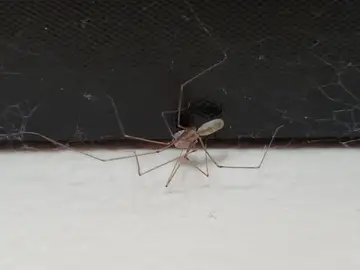
Cellar spiders are small, pale spiders with extremely long, thin legs that hang upside down in loose, messy webs in basements, garages and ceiling corners. Like most spiders they have venom, but UF/IFAS says it is only strong enough to affect their invertebrate prey. Penn State Extension says they are not known to bite people and are not medically important. The story that they are the most venomous spider but cannot bite is a myth, according to UF/IFAS and Missouri Department of Conservation. Penn State Extension says the longbodied cellar spider is the most common cellar spider in the United States and is found in many types of buildings. Missouri Department of Conservation
This page covers a family (Pholcidae (cellar spiders); most common US species Pholcus phalangioides (longbodied cellar spider)), not a single species.
On this page
Is the cellar spider dangerous?
Penn State Extension: longbodied cellar spiders are not known to bite people and are not a medically important species, and are not known to be in any way harmful. Penn State Extension
“These spiders are not known to bite people and are not a medically important species.”
Bites and stings: Penn State Extension: not known to bite people. UC IPM: only marginally capable of biting humans, because the fangs are too short to pierce skin in most cases.
If someone is bitten or stung, call 911 or Poison Help at 1-800-222-1222.
How to identify a cellar spider
A photo or description can narrow it down, but cannot confirm what an animal is or that it is safe. Look from a distance and do not handle wild animals.
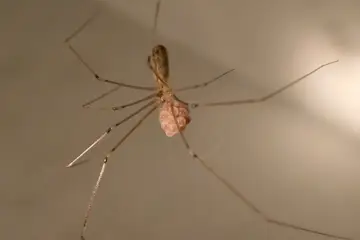
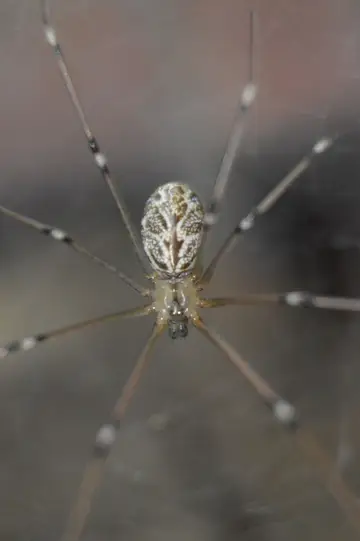

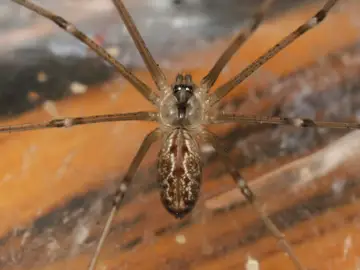
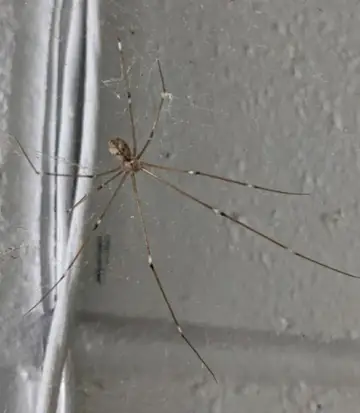
Size: Body usually no more than about 1/4 inch, not counting the legs Missouri Department of Conservation
Colors: Gray, tan or whitish; longbodied cellar spider: pale tan or yellow with a gray mark in the center of the carapace. Pattern: Some species have dark leg joints ("knobby-kneed").
Key features
- Extremely long, thin legs Missouri Department of Conservation
- Hang upside down in loose, disorganized, non-sticky cobwebs near ceilings NYSDEC, text by Cornell University Department of Entomology, reprinted from New York State Conservationist
- Vibrate or bounce rapidly in the web when disturbed, becoming a blur Penn State Extension
- Longbodied cellar spider: abdomen about three times as long as wide, cylindrical Penn State Extension
- Eight eyes in many common species: two in the center plus a cluster of three on each side Missouri Department of Conservation
Animals mistaken for the cellar spider
Cellar Spider or Brown Recluse?
Cellar Spider
Brown Recluse Loxosceles reclusa
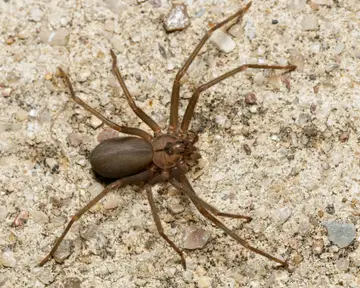
Cellar spiders often have dark markings on the head region that people mistake for a recluse's violin. UC IPM says the most definitive recluse feature is 6 equal-sized eyes in 3 pairs; many common cellar spiders have 8 eyes (MDC). University of California Statewide IPM Program
Venomous; CDC/NIOSH lists the brown recluse among US venomous spiders. Call 911 or Poison Help 1-800-222-1222.
Cellar Spider or Harvestmen (also called daddy longlegs)?
Cellar Spider
Harvestmen (also called daddy longlegs) Opiliones
Harvestmen are not spiders. They have one apparently unified, usually egg-shaped body, while true spiders have a separate head and abdomen. Harvestmen spin no webs and have no venom glands. Missouri Department of Conservation
No venom glands (MDC; UF/IFAS).
Cellar Spider or Black Widow?
Cellar Spider
Black Widow Latrodectus spp.
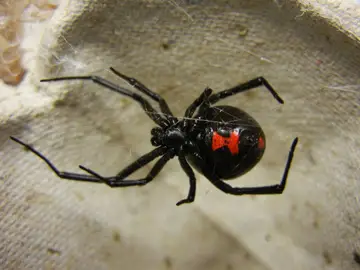

UF/IFAS: widow spiders have characteristic red markings on their large round abdomens and build a messy cobweb where they usually hang upside down. UF/IFAS Extension
Venomous and medically significant (CDC/NIOSH; UF/IFAS). Call 911 or Poison Help 1-800-222-1222.
Where the cellar spider lives
- Native or listed
- Nonnative or not established
- No official record in our data
- 1–9
- 10–99
- 100–999
- 1,000+
State boundaries: U.S. Census Bureau, cartographic boundary file cb_2024_us_state_20m.
When it is active
Found in heated buildings year-round Penn State Extension
US open-licence records for all cellar spiders (family Pholcidae) peak in April to August and October.
Habitat and habits
Habitat: Indoors in garages, basements and cellars, and ceiling corners anywhere in the home. In nature, cave openings, cliff crevices and other protected places. Missouri Department of Conservation
Behavior: Some enter other spiders' webs, jiggle them like trapped insects, then bite and eat the resident spider.
Diet: Other small arthropods (insects and spiders), often prey much larger than themselves, including wolf spiders and crane flies
Young: Females lay clusters of 25 to 60 eggs wrapped in thin silk and hold them in their jaws. Spiders take about a year to mature and can live two or more years as adults.
Questions about the cellar spider
Cellar spider
A cellar spider is a small, pale spider with extremely long, thin legs that hangs upside down in a loose cobweb in basements, garages and ceiling corners. Penn State Extension says it is not known to bite people and is not medically important.
Brown recluse vs cellar spider
UC IPM says cellar spiders are often mistaken for brown recluses because of dark markings on the head region, and that the violin marking is not a reliable way to identify a recluse. The surest recluse sign is 6 equal-sized eyes in 3 pairs; MDC says many common cellar spiders have 8 eyes. The brown recluse is venomous (CDC/NIOSH). If bitten by a spider you think is dangerous, call 911 or Poison Help at 1-800-222-1222.
Brown recluse vs daddy long legs
"Daddy longlegs" can mean a cellar spider or a harvestman. Harvestmen have one egg-shaped body and no venom glands. Cellar spiders are true spiders with very long legs. Both differ from the brown recluse, which UC IPM says has 6 equal-sized eyes in 3 pairs and CDC/NIOSH lists as venomous.
Black widow vs daddy long legs
Black widows have red markings on a large, round abdomen, build messy cobwebs where they usually hang upside down, and are venomous and medically significant (UF/IFAS, CDC/NIOSH). Cellar spiders (daddy longlegs spiders) are pale with very long, thin legs (MDC), and Cornell's NYS IPM program says they will take down black widows. Harvestmen, also called daddy longlegs, have no venom glands (MDC).
Are daddy long legs the most venomous spider?
No. UF/IFAS says the myth that daddy long legs are the most venomous spider but cannot bite humans is untrue: cellar spiders have venom only strong enough to affect invertebrate prey. MDC says pholcid venom is comparatively mild.
Sources
- Cellar Spiders (Field Guide). Missouri Department of Conservation. undated page; checked November 3, 2026.
Quoted passages (7)
“Length: bodies usually no more than about ¼ inch long (not including legs)”
“…extremely long, thin legs”
“Many common spiders in this family have 8 eyes arranged into three groups”
“Some species of cellar spiders are very common in homes, especially in garages, basements, and cellars, hence the common name.”
“Often, they capture prey much larger than themselves, including wolf spiders and crane flies.”
“Some cellar spider species have been known to enter the webs of other spiders, jiggle the web in a way that replicates the struggles of trapped insects, then bite and eat the ‘host’ spider when it approaches.”
“…harvestmen’s having one apparently unified (usually egg-shaped) body, while true spiders have clearly separate head and abdomen regions. Harvestmen do not have silk glands, so they cannot spin webs; they also lack the venom glands that true spiders possess.”
- Longbodied Cellar Spider. Penn State Extension. updated January 19, 2026; checked November 3, 2026.
Quoted passages (5)
“These spiders are not known to bite people and are not a medically important species.”
“An unusual behavior is that the spiders will rapidly vibrate in a circular fashion in the web if threatened, making it difficult to see them.”
“The abdomen is about three times as long as it is wide and cylindrical in shape.”
“Both male and female spiders can be found in heated structures throughout the year.”
“The eggs, which are about 1 millimeter in diameter, are deposited in clusters of twenty-five to sixty and wrapped in a thin layer of silk.”
- ENY2080 An Introduction to Some Common and Charismatic Florida Spiders (Powell & Taylor). UF/IFAS Extension (EDIS). Original publication date February 2023; checked November 3, 2026.
Quoted passages (2)
“Spiders in this family do have venom but it is only strong enough to affect their invertebrate prey”
“Widow spiders have characteristic red markings on their large round abdomens. They build a messy cobweb where they usually hang upside down”
- Common spiders brochure (11 species and groups). NYSDEC, text by Cornell University Department of Entomology, reprinted from New York State Conservationist. June 2007; checked November 3, 2026.
Quoted passages (1)
“They hang upside down in a very loose web of disorganized threads on walls close to the ceiling of homes.”
- Pest Notes: Brown Recluse and Other Recluse Spiders (UC ANR Publication 7468). University of California Statewide IPM Program (UC ANR, Cooperative Extension). 2018-11; checked November 3, 2026.
Quoted passages (1)
“Many common tan or gray spiders have dark markings on the head region, which convinces people that they have caught a true recluse spider. These spiders include cellar spiders (Pholcus phalangioides, Psilochorus spp., Physocyclus spp.)”
- Venomous Spiders (Outdoor Workers). CDC / NIOSH. archived copy, captured September 29, 2026; checked November 3, 2026.
- Venomous Spiders at Work. CDC/NIOSH. archived copy, captured October 6, 2026; checked November 3, 2026.
- Spider FAQs One Two Three. New York State Integrated Pest Management, Cornell University. March 10, 2016; checked November 3, 2026.
- GBIF.org occurrence records, human observations licensed CC0 1.0 or CC BY 4.0 only, accessed November 3, 2026. The datasets behind these counts are listed on our Sources page.
- State boundaries: U.S. Census Bureau, cartographic boundary file cb_2024_us_state_20m.