Desert Tortoise
Gopherus agassizii; Arizona south and east of the Colorado River has the separate Sonoran Desert Tortoise, Gopherus morafkai · also called Mojave Desert Tortoise, Mohave Desert Tortoise, Agassiz's Desert Tortoise and Sonoran Desert Tortoise (the separate species Gopherus morafkai in Arizona) · Last checked November 3, 2026.
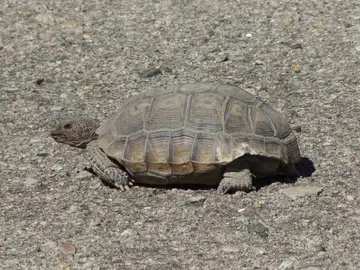
The desert tortoise is a high-domed land tortoise of the Southwest, with a shell 8 to 15 inches long and elephant-like hind legs. No official source checked says whether it is venomous or dangerous to people; official advice is about protecting it. It is federally threatened north and west of the Colorado River in Arizona, Utah, Nevada and California, and endangered under California law. Do not pick one up: handling wild tortoises is illegal under the Endangered Species Act, and a frightened tortoise can lose water it needs to survive. US Fish and Wildlife Service
On this page
Is the desert tortoise dangerous?
Bites and stings: No desert tortoise bite statement for people was found. CDC says generally that most turtles lack teeth but can still have painful bites.
How to identify a desert tortoise
A photo or description can narrow it down, but cannot confirm what an animal is or that it is safe. Look from a distance and do not handle wild animals.
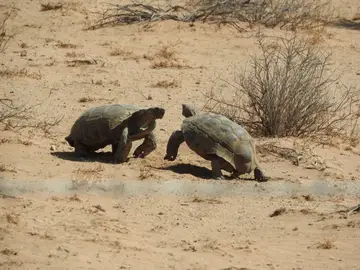
Size: Shell 8 to 15 inches long and 4 to 6 inches high; adults weigh 8 to 15 pounds. US Fish and Wildlife Service
Colors: Top shell brown, gray or black, with a lighter underside; arizona: horn, orange-brown, gray-brown or dark gray; underside usually tan or yellow. Pattern: Distinct growth rings on a dome-shaped shell.
Key features
- Short tail, flattened front legs for digging, elephant-like hind legs and a high-domed shell US Fish and Wildlife Service
- Males have throat shields on the underside that extend out beneath the throat Arizona Game and Fish Department
Young
Hatchling shells stay very soft and flexible for several weeks, which leaves them vulnerable to predators.
Animals mistaken for the desert tortoise
Desert Tortoise or Sonoran Desert Tortoise?
Desert Tortoise
Sonoran Desert Tortoise Gopherus morafkai
Agassiz's Desert Tortoise has a wider shell and longer throat shields; location also separates them, with Agassiz's north and west of the Colorado River in Arizona. Arizona Game and Fish Department
Where the desert tortoise lives
- Native or listed
- Nonnative or not established
- No official record in our data
- 1–9
- 10–99
- 100–999
- 1,000+
On our state guides
State boundaries: U.S. Census Bureau, cartographic boundary file cb_2024_us_state_20m.
When it is active
Hibernates in burrows for up to nine months a year; most active March to June and September to October. NPS adds that tortoises may emerge after summer storms and often cross roads after rain.
US open-licence records peak in March to May.
Habitat and habits
Habitat: Sandy flats to rocky foothills, including alluvial fans, washes and canyons. NPS: desert valleys between about 1,000 and 4,000 feet, typically in creosote bush.
Behavior: Spends about 95% of its life in burrows and may urinate as a defense when frightened; adults can survive more than a year without free water.
Diet: Herbs, grasses, cacti and wildflowers.
Young: Matures at 13 to 20 years and can live about 50 to 80 years. NPS (Joshua Tree): peak mating is March to early October, clutches average five eggs, usually laid May to July, and hatch in 70 to 120 days.
Legal status and reporting
Federal: Threatened since April 2, 1990, wherever found except Arizona south and east of the Colorado River and Mexico. Tortoises from that excluded area are listed as Similarity of Appearance (Threatened) when found outside Mexico or that Arizona range. ECOS shows the Sonoran Desert Tortoise (G. morafkai) with ESA listing status "Resolved Taxon", not Threatened or Endangered.
Protection: Protected: federal law bars harassing, harming, capturing or collecting listed tortoises, and Arizona law protects them throughout the state. NPS: handling wild tortoises is illegal under the Endangered Species Act, it is illegal to take one home as a pet, and adoption is the only legal way to keep one as a pet. NPS: do not release pet tortoises into the wild; they may carry diseases. NPS gives one exception for picking one up: when it is on or near a road and in imminent danger of being struck.
Report: In Mojave National Preserve, NPS asks you to take a GPS location with your phone and email your sighting; Joshua Tree asks for a wildlife observation card from a visitor center or entrance station. No statewide reporting line was confirmed.
Questions about the desert tortoise
Are there tortoises in new mexico?
Yes. New Mexico's BISON-M database lists Bolson's Tortoise as extant in the state and the Sonoran Desert Tortoise as accidental. It does not show the Mojave desert tortoise as occurring in New Mexico.
Arizona turtles and tortoises
Arizona has two desert tortoises: Agassiz's in far northwestern Arizona north of the Colorado River, and the Sonoran across most of southwestern and south-central Arizona. Both are protected throughout the state.
Sources
- Desert Tortoise (Gopherus agassizii). U.S. Fish and Wildlife Service. undated page; checked November 3, 2026.
Quoted passages (3)
“Shell length: 8 to 15 inches … Shell height: 4 to 6 inches … Adult tortoises weigh eight to 15 pounds.”
“…has a short tail, flattened front legs that are adapted for digging, elephant-like hind legs and a high-domed shell”
“…eat various herbs, grasses, cacti and wildflowers”
- Desert Tortoise. National Park Service, Joshua Tree National Park. updated September 23, 2024; checked November 3, 2026.
- California Endangered Species Act (CESA). California Fish and Game Commission. undated page; checked November 3, 2026.
- State and Federally Listed Endangered and Threatened Animals of California. California Department of Fish and Wildlife, CNDDB. October 2026; checked November 3, 2026.
- Online Field Guide species account: Agassiz’S Desert Tortoise (Gopherus agassizii). Arizona Game and Fish Department. 2023; checked November 3, 2026.
Quoted passages (2)
“In males the gular shields of the plastron extend out underneath the throat”
“This species has a wider shell and longer gular shields than the similar looking Sonoran Desert Tortoise”
- Desert Tortoise. Nevada Department of Wildlife. undated page; checked November 3, 2026.
Quoted passages (1)
“Young hatchlings’ shells remain very soft and flexible for several weeks after hatching.”
- Desert Tortoise (Gopherus agassizii). National Park Service, Mojave National Preserve. updated April 2, 2026; checked November 3, 2026.
Quoted passages (1)
“They spend about 95% of their lives in burrows … When frightened, they may urinate as a defense mechanism. … Adult Desert tortoises lose water at such a slow rate that they can survive for more than a year without access to free water.”
- BISON-M (Biota Information System of New Mexico) species search export: taxonomic name "Testudines". New Mexico Department of Wildlife (BISON-M, with Natural Heritage New Mexico). database queried November 3, 2026; checked November 3, 2026.
- Online Field Guide species account: Sonoran Desert Tortoise (Gopherus morafkai). Arizona Game and Fish Department. 2023; checked November 3, 2026.
- GBIF.org occurrence records, human observations licensed CC0 1.0 or CC BY 4.0 only, accessed November 3, 2026. The datasets behind these counts are listed on our Sources page.
- State boundaries: U.S. Census Bureau, cartographic boundary file cb_2024_us_state_20m.