States Wildlife

Nevada Turtles: Identification Guide With Pictures

Last checked November 3, 2026 against official sources.

On this page
  1. All 4 turtles
  2. When they are active
  3. About this list
  4. Sources

This page lists 4 turtles. 2 are nonnative.

All 4 turtles

From A to Z.

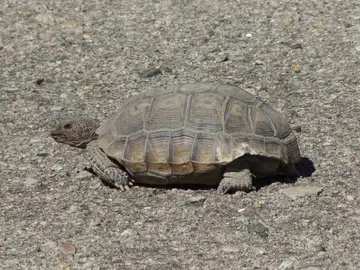
Desert Tortoise
Photo: Wendy St. John · CC BY-SA 4.0 · iNaturalist · resized

Desert Tortoise

Gopherus agassizii

Size
Shell 8 to 15 inches long and 4 to 6 inches high; adults weigh 8 to 15 pounds.
How to recognize it
  • Short tail, flattened front legs for digging, elephant-like hind legs and a high-domed shell
  • Males have throat shields on the underside that extend out beneath the throat
Where in Nevada
Southern Nevada (NDOW page map) NDOW
Conservation
NV state status: Priority Species, Threatened; federal column on NDOW page: Vulnerable
96 records by month.
What the sources say

Habitat: Desert Tortoise spend most of their lives in their burrows. Soils in their habitats need to be firm enough to hold their burrow shape. They can find these soils in many different types of habitats found in the Mojave Desert, such as washes, canyons, sandy flats, or rocky foothills. (NDOW)

Full Desert Tortoise guide

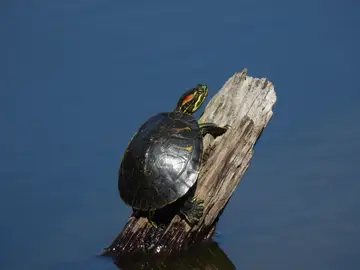
Red-eared Slider
Photo: ncb1221 · CC BY 4.0 · iNaturalist

Red-eared Slider

Trachemys scripta elegans

Invasive

Where in Nevada
Statewide (NDOW page map: eastern, southern, western regions) NDOW
Conservation
NV state status: Unprotected; federal column on NDOW page: Least Concern
What the sources say

Habitat: Red-eared Sliders are native to parts of the Midwest United States but are now common in Nevada, where they were introduced through the pet trade. They are often seen in urban ponds, parks, and golf course water features, where they bask on rocks, logs, or the edges of ponds. (NDOW)

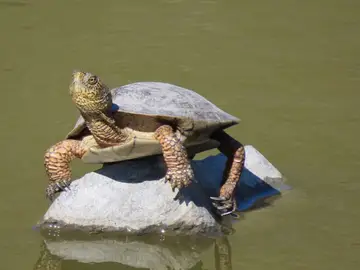
Western Pond Turtle
Photo: John Hibbard · CC BY 4.0 · iNaturalist

Western Pond Turtle

Actinemys marmorata

Where in Nevada
Western Nevada (NDOW page map) NDOW
Conservation
NV state status: Priority Species, Unprotected; federal column on NDOW page: Vulnerable
What the sources say

Habitat: The Western Pond Turtle is found in permanent and temporary waters of rivers, creeks, small lakes and ponds, marshes, irrigation ditches, and reservoirs. In Nevada they are confined to the Truckee and Carson Rivers. (NDOW)

When turtles are active in Nevada

Records of turtles in Nevada peak in March to May. They show when people record turtles, not how many there are (about month bars).

149 records of turtles in Nevada by month (GBIF, CC0 and CC BY records).
About this list

The species list comes from NAC 503.080 (Reptiles), combined with Commission Regulation 19-02 (non-native table) and the NDOW Species Information database (Nevada Legislature (regulations of the Board of Wildlife Commissioners), NAC Rev. 10/22/2025; pages retrieved 2026-11-03). 4 more entries come from other official sources named on each card.

Venom labels come only from official sources and link to them; "Not stated" never means harmless. How labels work.

"Nonnative" and "Invasive" follow the wording of the source list. See invasive species in Nevada.

Sources

  1. Species Information. Nevada Department of Wildlife (NDOW). undated page; checked November 3, 2026.
  2. Nevada Administrative Code Chapter 503: Hunting, Fishing and Trapping; Miscellaneous Protective Measures. Nevada Legislature (regulations of the Board of Wildlife Commissioners). file header "Rev. 10/22/2025"; checked November 3, 2026.
  3. Desert Tortoise - Species Information. Nevada Department of Wildlife (NDOW). undated page; checked November 3, 2026.
  4. Western Pond Turtle - Species Information. Nevada Department of Wildlife (NDOW). undated page; checked November 3, 2026.
  5. Red-eared Slider - Species Information. Nevada Department of Wildlife (NDOW). undated page; checked November 3, 2026.
  6. Commission Regulation 19-02, 2019 & 2020 Noncommercial Collection Seasons & Limits for Live, Unprotected Reptiles & Amphibians (NDOW memo and table). Nevada Department of Wildlife (NDOW) / Nevada Board of Wildlife Commissioners. memo dated October 11, 2018; checked November 3, 2026.
  7. GBIF.org occurrence records, human observations licensed CC0 1.0 or CC BY 4.0 only, accessed November 3, 2026. The datasets behind these counts are listed on our Sources page.