Giant Desert Centipede
Scolopendra heros · also called Giant Redheaded Centipede and Giant Red-Headed Bark Centipede · Last checked November 3, 2026.
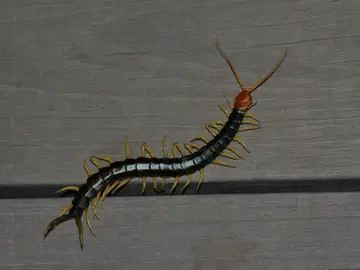
The giant desert centipede, more often called the giant redheaded centipede, is the largest centipede in North America: usually up to 6.5 inches and sometimes 8. In its eastern range it has a rusty-red head, a black body and yellow legs. It is venomous. The Missouri Department of Conservation says its bite can be intensely painful and cause swelling, usually no worse than a wasp or scorpion sting, but infants, the elderly, people in poor health and people with allergies could be at greater risk. It is found from Arkansas and southern Missouri west through Oklahoma and Texas to New Mexico and Arizona. MDC
On this page
Is the giant desert centipede dangerous?
MDC: there are few credible reports of serious harm. Most authorities agree healthy adults are not harmed beyond intense pain and swelling, usually no worse than a wasp or scorpion sting. Infants, the elderly or people in poor health could be harmed, and some people may have an allergic reaction that needs immediate medical treatment. MDC
“Most authorities agree that healthy adult humans are not harmed by this centipede, except for intense pain and swelling, which is usually no worse than a wasp or scorpion sting. But infants, the elderly, or people in poor health could potentially be harmed by this animal and may need to seek treatment.”
Bites and stings: Yes. MDC: it bites with its fangs, can also pinch with its last pair of legs, and uses its venom to fight off anything that molests it, including humans.
If someone is bitten or stung, call 911 or Poison Help at 1-800-222-1222.
How to identify a giant desert centipede
A photo or description can narrow it down, but cannot confirm what an animal is or that it is safe. Look from a distance and do not handle wild animals.
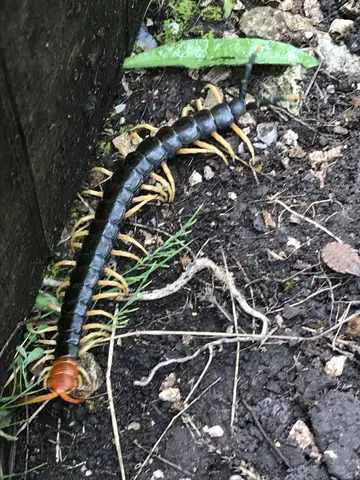
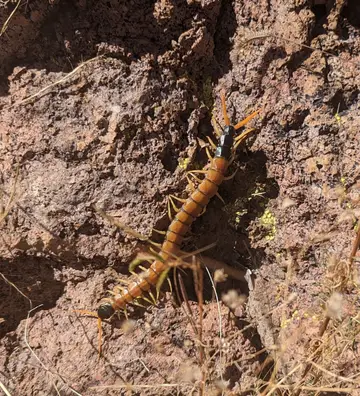
Size: Usually up to 6.5 inches, may reach 8 inches MDC
Colors: In the Missouri/Arkansas region: black body, bright yellow legs, rusty-red head and first body segment; many color variants; Arkansas specimens: chestnut-red head, black trunk tinged with green, yellow legs, black last legs with yellow tips. Pattern: Bright warning coloration.
Key features
- 21 pairs of legs, one pair per segment; last pair points backward like tails MDC
- Largest centipede in North America MDC
Young
Nearly colorless when they hatch, then brownish, then adult coloring; young have the same number of legs as adults.
Animals mistaken for the giant desert centipede
Giant Desert Centipede or Eastern Bark Centipede?
Giant Desert Centipede
Eastern Bark Centipede Hemiscolopendra marginata
Much smaller (to 3 inches), bluish cast, blue marks on pale yellowish legs. Missouri Department of Conservation
Giant Desert Centipede or House Centipede?
Giant Desert Centipede
House Centipede Scutigera coleoptrata
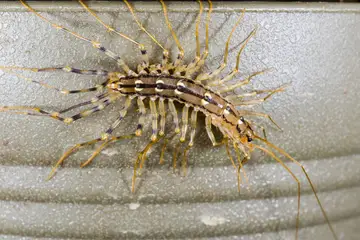

Adults have only 15 pairs of long, banded legs. Missouri Department of Conservation
Giant Desert Centipede or Millipedes?
Giant Desert Centipede
Millipedes Class Diplopoda
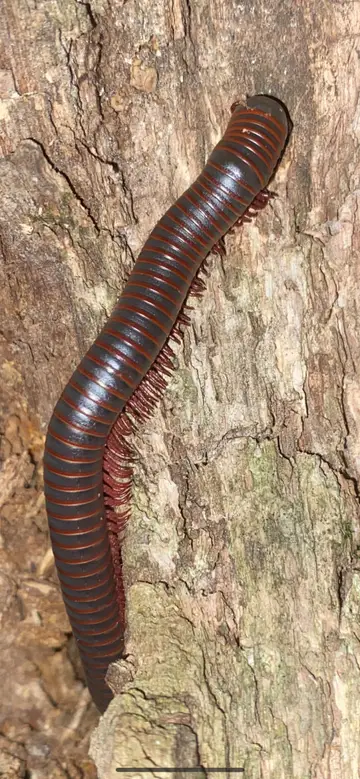
Millipedes have rounder bodies and 2 pairs of legs per body segment. Missouri Department of Conservation
Where the giant desert centipede lives
- Native or listed
- Nonnative or not established
- No official record in our data
- 1–9
- 10–99
- 100–999
- 1,000+
State boundaries: U.S. Census Bureau, cartographic boundary file cb_2024_us_state_20m.
When it is active
University of Arkansas Arthropod Museum, citing Baerg (1920s): found under stones and logs, at least in the warmer seasons. University of Arkansas Arthropod Museum
US open-licence records peak in April to May and August to September.
Habitat and habits
Habitat: Rocky woodlands, under rocks, wood piles or other hiding places. MDC
Behavior: Confrontational; bites with its fangs and pinches with its last pair of legs.
Diet: Predator of arthropods; also newborn mice, small snakes and small amphibians.
Young: Eggs are laid in burrows in rotting wood; the female curls around the eggs and guards the young.
Legal status and reporting
Federal: Not listed under the Endangered Species Act: the ECOS query for the genus Scolopendra returned no records. ECOS
Questions about the giant desert centipede
Giant desert centipede
'Giant desert centipede' is another name for the giant redheaded centipede (Scolopendra heros), the largest centipede in North America (up to about 8 inches). It is venomous: MDC says the bite is intensely painful with swelling, usually no worse than a wasp or scorpion sting, with higher risk for infants, the elderly, people in poor health and anyone with an allergic reaction. For an emergency, call 911 or Poison Help at 1-800-222-1222.
Centipede bite
For this species, MDC says bites are not fatal but may cause severe swelling and irritation for hours. MDC advises seeking medical attention if the swelling worsens, breathing becomes difficult or other symptoms occur. For an emergency, call 911 or Poison Help at 1-800-222-1222.
Sources
- Giant Red-headed Centipede (MDC Field Guide species page; also listed under Safety Concerns > Venomous). Missouri Department of Conservation (MDC). undated page; checked November 3, 2026.
Quoted passages (10)
“Most authorities agree that healthy adult humans are not harmed by this centipede, except for intense pain and swelling, which is usually no worse than a wasp or scorpion sting. But infants, the elderly, or people in poor health could potentially be harmed by this animal and may need to seek treatment.”
“It’s of the few centipedes in our state capable of inflicting a painful, venomous bite.”
“Length: usually up to 6½ inches, but may reach 8 inches.”
“They are generally flattened and have 21 pairs of legs (counting the last pair, which point backward like a pair of tails), with only one pair of legs per leg-bearing segment.”
“The largest centipede in North America.”
“New hatchlings lack color but soon become brownish and eventually acquire the adult coloration.”
“Occurs in rocky woodlands under rocks, wood piles, or other hiding places.”
“This species can feed on a wide variety of arthropods, as well as newborn mice, small snakes, and small amphibians.”
“They have a confrontational attitude, and they can bite with their fangs and also pinch with their last pair of legs.”
“The female curls snugly around her egg mass to protect it and continues to guard the young once they hatch.”
- Centipedes (Field Guide). Missouri Department of Conservation. undated page; checked November 3, 2026.
Quoted passages (3)
“Eastern bark centipede (Hemiscolopendra marginata) occurs in the eastern United States; to 3 inches long; has 21 pairs of legs; has a bluish cast, blue marks on pale yellowish legs, blue antennae, orangish hind legs, and rusty red forcipules.”
“Adults have only 15 pairs of legs, which are banded.”
“Millipedes are easily distinguished by their more cylindrical (not flattened) bodies, their elbowed antennae, and their having 2 pairs (not 1 pair) of legs per body segment.”
- Giant redheaded centipede (Arkansas Arthropods). University of Arkansas Arthropod Museum (Department of Entomology and Plant Pathology). WordPress modified 2017-07-05; checked November 3, 2026.
Quoted passages (1)
“…at least during the warmer seasons, under stones and logs.”
- USFWS ECOS species report: Scientific Name like 'Scolopendra%' (ESA listing status). U.S. Fish and Wildlife Service (ECOS). database queried November 3, 2026; checked November 3, 2026.
- GBIF.org occurrence records, human observations licensed CC0 1.0 or CC BY 4.0 only, accessed November 3, 2026. The datasets behind these counts are listed on our Sources page.
- State boundaries: U.S. Census Bureau, cartographic boundary file cb_2024_us_state_20m.