Tarantula hawks (tarantula hawk wasps)
Pepsis and Hemipepsis (family Pompilidae, spider wasps) · also called tarantula hawk wasp, tarantula-hawk wasp, tarantula wasp and Pepsis wasp · Last checked November 3, 2026.
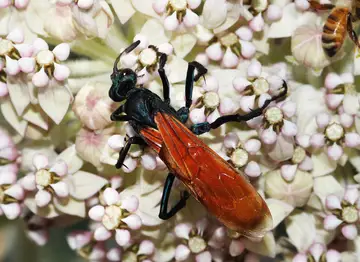

Tarantula hawks are very large spider wasps (genera Pepsis and Hemipepsis) with shiny blue-black bodies and bright orange wings, about 2 inches long (CSU: 1/2 to 2 inches; NPS Grand Canyon-Parashant: 1½ to 2½ inches). Females hunt tarantulas: they paralyze one with a sting, drag it to a burrow and lay an egg on it, and the larva feeds on the living spider. Adults drink nectar, especially from milkweed. Only females sting. They are not aggressive and rarely sting people unless provoked or handled, but the sting is rated among the most painful of any insect. The National Park Service says it is not lethal to humans. In the US they live mainly in the deserts of the Southwest; official sources confirm them in Arizona, New Mexico, Texas, Colorado and California. The tarantula hawk is New Mexico's state insect. Anyone who has a severe allergic reaction to a sting needs emergency care: call 911. National Park Service
This page covers a genus (Pepsis and Hemipepsis (family Pompilidae, spider wasps)), not a single species.
On this page
Are tarantula hawks dangerous?
Venomous sting that is extremely painful but not lethal to humans, according to the National Park Service; NMSU Extension says there is no direct threat to human life. As with any wasp sting, people allergic to venom can have a severe, life-threatening reaction that needs emergency care (CDC/NIOSH, general statement on stinging insects). National Park Service
“While the sting of a tarantula hawk wasp is not lethal to humans it is rated at the highest level of pain for an insect sting.”
Bites and stings: Stings (females only; NPS: the stinger is about 1/4 inch). No official source checked describes tarantula hawks biting people. They are docile and sting only when provoked, for example when a person catches one (NPS, CSU, NMSU). The pain is intense but brief: NPS Parashant says it can be the most excruciating 3 minutes of a person's life; Texas Parks & Wildlife quotes Justin Schmidt that the pain is so debilitating few can keep normal coordination, and says it subsides after a few minutes and leaves no permanent damage.
If someone is bitten or stung, call 911 or Poison Help at 1-800-222-1222.
How to identify tarantula hawks
A photo or description can narrow it down, but cannot confirm what an animal is or that it is safe. Look from a distance and do not handle wild animals.
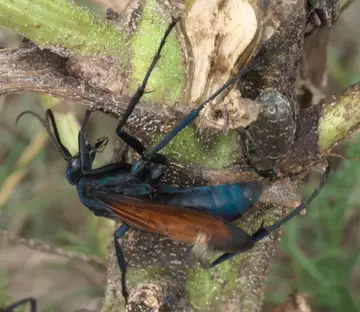

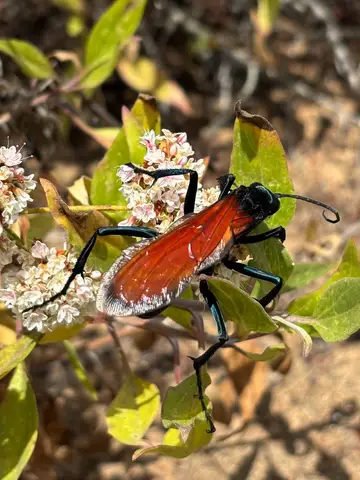
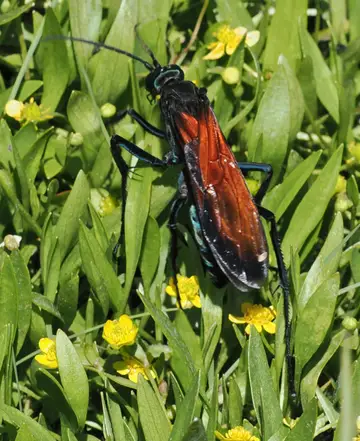
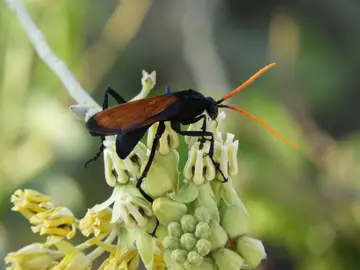
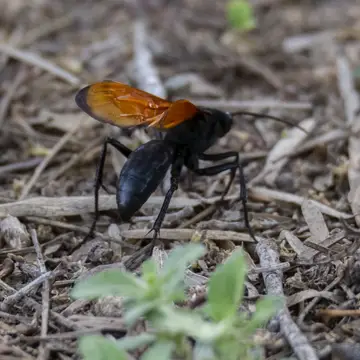

Size: Large wasps. CSU: about 1/2 to 2 inches (10-50 mm) depending on species; NPS Grand Canyon: the common Pepsis thisbe reaches about 2 inches; NPS Grand Canyon-Parashant: 1½ to 2½ inch body; NMSU: about 2 inches long with a wingspan up to 3 inches (New Mexico state insect); Texas Parks & Wildlife: body length typically up to 2 inches. Colorado State University Extension
Colors: dark blue to blue-black, iridescent body; bright orange wings (orange to yellow; some species orange-brown or with black tips); some Texas species have black, orange or red wings and antennae. Pattern: solid dark body with contrasting bright wings (warning coloration).
Key features
- long legs National Park Service
- skinny body, similar to the smaller paper wasps (NMSU, New Mexico state insect) New Mexico State University Cooperative Extension Service
- males have straight antennae, females curly antennae National Park Service
- often seen flying over the ground, scanning for tarantulas; adults visit flowers, especially milkweed
- holds wings at its side when not flying; wings smoky near the margins (NM state insect) New Mexico Office of the Secretary of State
Animals mistaken for tarantula hawks
Tarantula hawks (tarantula hawk wasps) or Cicada killer?
Tarantula hawks (tarantula hawk wasps)
Cicada killer Sphecius speciosus (eastern), Sphecius grandis (western)
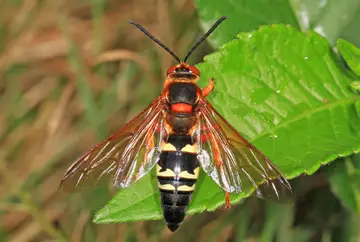
NMSU: cicada killers are about 2.5 inches long with a plump body, black with yellow stripes like a hornet, and orange to brown wings; they are often seen hovering near the ground or sandy mounds, sometimes carrying prey. The tarantula hawk (NMSU) has a shiny black/blue body with orange-hued wings, and the body is skinny like a paper wasp's. New Mexico State University Cooperative Extension Service
NMSU: does NOT pose a direct threat to humans or pets; not a threat unless harassed.
Tarantula hawks (tarantula hawk wasps) or Asian giant hornet (northern giant hornet)?
Tarantula hawks (tarantula hawk wasps)
Asian giant hornet (northern giant hornet) Vespa mandarinia
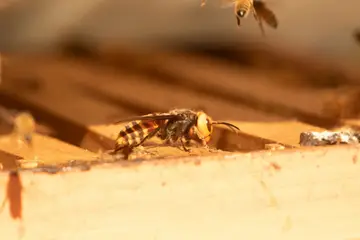
NMSU: yellow-orange head and body with coarse hairs and black and yellow-orange stripes, about 2.5 inches long; the tarantula hawk has a shiny black/blue body with orange-hued wings. As of July 2020, NMSU said no Asian giant hornets had been found in the US Southwest and none were in New Mexico. New Mexico State University Cooperative Extension Service
NMSU (2020): normally not aggressive toward humans unless actively provoked; found only in Washington state in the US as of July 2020. NMSU advises that anyone who has an allergic reaction to an insect bite or sting seek emergency medical help immediately.
Where tarantula hawks live
- Native or listed
- Nonnative or not established
- No official record in our data
- 1–9
- 10–99
- 100–999
- 1,000+
State boundaries: U.S. Census Bureau, cartographic boundary file cb_2024_us_state_20m.
When it is active
Active by day, especially mornings and evenings (Texas). Most often seen in late spring and summer, sometimes in winter (Grand Canyon-Parashant, Arizona). National Park Service
US open-licence records for all tarantula hawks (genera Pepsis and Hemipepsis) peak in June to August.
Habitat and habits
Habitat: Deserts and dry scrubland of the Southwest, often where tarantulas are common; adults visit flowers. National Park Service
Behavior: Females search the ground for tarantulas, sting and paralyze them, and drag them into a burrow; they will even enter occupied tarantula burrows. Adults are otherwise docile and calm around people. Few predators eat them; NPS names the roadrunner as one.
Diet: Adults feed on flower nectar (and pollen), especially milkweed, mesquite and soapberry; larvae eat a paralyzed tarantula provided by the mother.
Young: After mating, a female stings a tarantula, drags it to a burrow, lays one egg on it and seals the burrow. The larva feeds on the living spider, then spins a cocoon and becomes an adult in two to three weeks. One tarantula per larva. Adult females live about 40-50 days.
Legal status and reporting
Invasive status: Not described as invasive by any official source found; CSU says there are no recommended control measures. Colorado State University Extension
Questions about tarantula hawks
Tarantula hawk
A very large spider wasp of the Southwest, with a shiny blue-black body and orange wings, about 2 inches long (NPS Grand Canyon-Parashant: 1½ to 2½ inches). Females paralyze tarantulas with a sting as food for their young; adults drink nectar. The sting is extremely painful but NPS says it is not lethal to humans.
Tarantula wasp
The wasps that hunt tarantulas are the tarantula hawks (genera Pepsis and Hemipepsis, CSU Extension): females paralyze tarantulas and feed them to their young.
What states have tarantula hawks?
NPS says that in the US they live in the deserts of the Southwest. Official sources confirm them in Arizona, New Mexico (state insect), Texas (about 13 species), Colorado (six species) and California. We found no official source for other states.
Are there tarantula hawks in ohio?
Ohio DNR says no insects with the top sting-pain score of 4 occur in Ohio, and names tarantula hawk wasps in the genus Pepsis (some of which occur in the southwest US) as its example of a 4. Ohio DNR's bees-and-wasps guide does list other spider wasps (family Pompilidae), such as Entypus and Tachypompilus.
Are there tarantula hawks in Alabama, Georgia, Hawaii, Illinois, Indiana, Louisiana, Michigan, Missouri, New Jersey, North Carolina, Pennsylvania, South Carolina, Tennessee, Virginia and Wisconsin?
Not confirmed. We found no official source from these states that lists tarantula hawks. NPS says that in the US they are found in the deserts of the Southwest.
Sources
- Tarantula Hawk (Grand Canyon National Park). National Park Service. updated 2020-09-22; checked November 3, 2026.
Quoted passages (3)
“Tarantula hawks have dark blue, iridescent bodies, bright orange wings, and long legs.”
“Males have straight antennae, females have curly antennae.”
“Tarantula hawks are found in every continent except Europe and Antartica. In the United States, they are found in the deserts of the southwest.”
- Tarantula Hawk Wasp (Grand Canyon-Parashant National Monument). National Park Service. updated 2019-12-03; checked November 3, 2026.
Quoted passages (3)
“While the sting of a tarantula hawk wasp is not lethal to humans it is rated at the highest level of pain for an insect sting.”
“Tarantula hawk wasps feed on the nectar of flowers from milkweed, and mesquite and soapberry trees.”
“There is very little predation on the tarantula hawk wasp and they are most often active during the late spring and summer months however, they have been known to be out and about in the winter months as well.”
- Tarantula Hawks of Colorado. Colorado State University Extension. published 2025-10-17, modified 2025-12-12; checked November 3, 2026.
Quoted passages (4)
“These color patterns are an example of ‘aposematic coloration’, meaning that they may serve to warn would-be predators of the tarantula hawk’s toxic venom (Schmidt 2004).”
“They range in size from about 10-50 mm (1/2 –2 inches), or about the same length as a matchstick (Schmidt 2004), and they are large-bodied wasps.”
“Soon after the spider’s death, the larva spins a cocoon, developing into an adult wasp within two to three weeks (Alcock and O’Neill1987).”
“There are no recommended control measures and interventions are not typically needed.”
- Large Wasps in New Mexico or the Asian Giant Hornet (Guide H-175). New Mexico State University Cooperative Extension Service. July 2020; checked November 3, 2026.
Quoted passages (3)
“The body itself is skinny, similar to the smaller paper wasps commonly found in the area”
“These wasps are about 2.5 inches long with a plump body. They do resemble a hornet’s body: black in color with yellow stripes. The wings can be orange to brown in color … They are often seen hovering near the ground or sandy mounds, sometimes carrying prey. … This wasp has a shiny black/blue body with orange-hued wings. The body itself is skinny, similar to the smaller paper wasps”
“The Asian giant hornet has a distinctive yellow-orange head and body with coarse hairs and black and yellow-orange stripes on its body. It is about 2.5 inches long … No Asian giant hornets have been found in the U.S. Southwest … As of July 2020, the Asian giant hornet is NOT present in Albuquerque nor the state of New Mexico. … This wasp has a shiny black/blue body with orange-hued wings.”
- Meet the Wasps That Hunt Tarantulas. Texas Parks & Wildlife magazine (Texas Parks and Wildlife Department). July 2015 issue; checked November 3, 2026.
- Insects (El Morro National Monument). National Park Service. updated 2025-05-06; checked November 3, 2026.
- Insects and Scorpions at Work. CDC / NIOSH. archived copy, captured October 4, 2026; checked November 3, 2026.
- Tarantula Hawk Wasp or Tarantula Hawk (Pepsis formosa) – state insect. New Mexico Office of the Secretary of State. archived copy, captured February 7, 2026; checked November 3, 2026.
Quoted passages (1)
“It has long legs and holds the wings at the side when not flying.”
- Invertebrates (Organ Pipe Cactus National Monument). National Park Service. updated 2024-11-17; checked November 3, 2026.
Quoted passages (1)
“Female tarantula hawks scan the ground looking for tarantulas, to which they deliver a paralyzing sting.”
- What Is That Huge Thing on the Milkweed? (aka Tarantula Hawk Wasp). University of California Cooperative Extension (Master Gardener column). undated page; checked November 3, 2026.
- Bees and Wasps of Ohio Field Guide (Publication 5488). Ohio Department of Natural Resources, Division of Wildlife. Publication date 3/16; checked November 3, 2026.
- GBIF.org occurrence records, human observations licensed CC0 1.0 or CC BY 4.0 only, accessed November 3, 2026. The datasets behind these counts are listed on our Sources page.
- State boundaries: U.S. Census Bureau, cartographic boundary file cb_2024_us_state_20m.