Asian giant hornet (now officially northern giant hornet)
Vespa mandarinia · also called northern giant hornet, murder hornet and giant hornet · Last checked November 3, 2026.
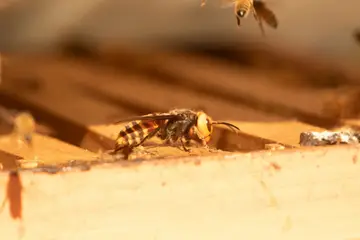
The Asian giant hornet, now officially called the northern giant hornet, is the world's largest hornet, usually 1.5 to 2 inches long, with a large orange or yellow head and a black-and-orange striped abdomen. It is not typically aggressive to people, but it stings while defending its nest, and its sting is more dangerous than that of local bees and wasps. In the US it was confirmed only in Washington State, where all four nests were found in Whatcom County (2020 to 2021). Washington State and USDA declared it eradicated from the United States in December 2024. Official sources name the European hornet and the cicada killer as large wasps often mistaken for it in other states. Washington State Department of Agriculture
On this page
Is the Asian giant hornet dangerous?
Not typically aggressive toward people, but it can sting people who try to handle it, and it stings while defending its nest or a beehive it is attacking. Its sting is more dangerous than that of local bees and wasps and can damage tissue and cause substantial pain. Mass attacks are very rare but can cripple or kill. Washington State Department of Agriculture
“The sting is more dangerous than that of local bees and wasps. A sting can damage tissue and cause substantial pain.”
Bites and stings: It stings. WSDA says it can sting people who try to handle it, and that it stings while defending its nest or beehives it is attacking.
If someone is bitten or stung, call 911 or Poison Help at 1-800-222-1222.
How to identify an Asian giant hornet
A photo or description can narrow it down, but cannot confirm what an animal is or that it is safe. Look from a distance and do not handle wild animals.
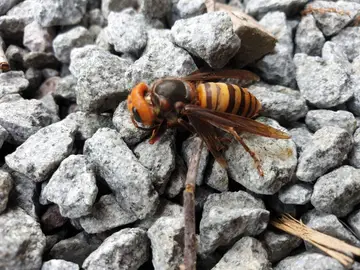
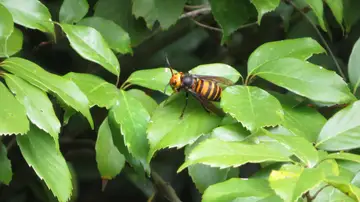
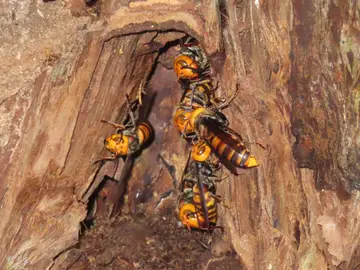
Size: Usually 1.5 to 2 inches long; the world's largest hornet. Washington State Department of Agriculture
Colors: Large orange head with prominent eyes; black and orange/yellow striped abdomen; yellow or orange and black stripes; large yellow or orange head. Pattern: Black and orange/yellow striped abdomen.
Key features
- Size: no native wasp or hornet in Washington grows this large Washington Invasive Species Council
- Large yellow or orange head Washington Invasive Species Council
- Sign of attack: piles of dead, mostly headless honey bees outside a hive Washington State Department of Agriculture
Animals mistaken for the Asian giant hornet
Asian giant hornet (now officially northern giant hornet) or European hornet?
Asian giant hornet (now officially northern giant hornet)
European hornet Vespa crabro
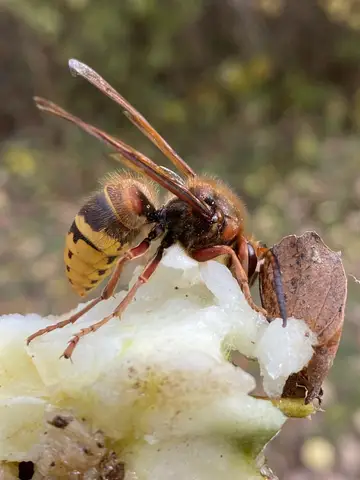
Penn State: the European hornet is the species most commonly mistaken for the Asian giant hornet in eastern North America. Its head is red-brown and yellow; the Asian giant hornet's head is entirely yellow (WSDA describes it as orange). The Asian giant hornet also has a larger gap between the rear of the eye and the rear of the head. Penn State Extension
A stinging social wasp; NC State Extension notes its defensive nature near nests.
Asian giant hornet (now officially northern giant hornet) or Eastern cicada killer?
Asian giant hornet (now officially northern giant hornet)
Eastern cicada killer Sphecius speciosus
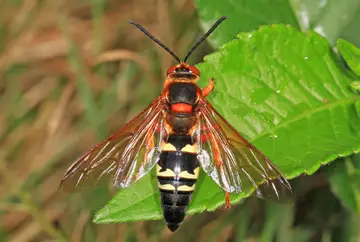
University of Kentucky: since 2020 cicada killers are often confused with it. Asian giant hornets have larger heads, larger jaws and smaller eyes. University of Kentucky Entomology
University of Kentucky says it does not present the hazard associated with the Asian giant hornet; stings almost always come from stepping on or grasping one.
Asian giant hornet (now officially northern giant hornet) or Yellowjackets?
Asian giant hornet (now officially northern giant hornet)
Yellowjackets Vespula spp.
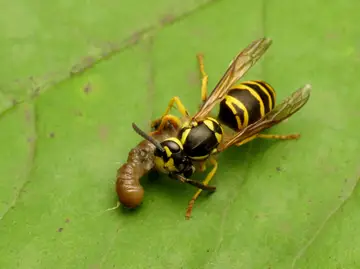
WSDA: yellowjackets are less than an inch long, with distinctly yellow faces and a black area near the top of the head. Washington State Department of Agriculture
Stinging social wasps (CDC/NIOSH lists wasps among stinging insects).
Asian giant hornet (now officially northern giant hornet) or Bald-faced hornet?
Asian giant hornet (now officially northern giant hornet)
Bald-faced hornet Dolichovespula maculata
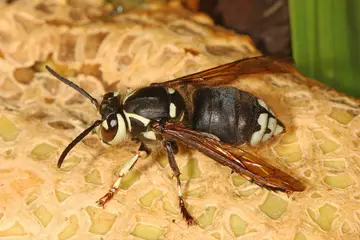

WSDA: about an inch long and mostly black with white stripes and spots. Washington State Department of Agriculture
Penn State: docile away from the nest, but defends it when directly threatened and stings repeatedly when provoked. See the bald-faced-hornet page.
Asian giant hornet (now officially northern giant hornet) or Paper wasps?
Asian giant hornet (now officially northern giant hornet)
Paper wasps Polistes spp.
WSDA: more slender and smaller, without an orange/yellow head. Washington State Department of Agriculture
Asian giant hornet (now officially northern giant hornet) or Yellow-legged hornet?
Asian giant hornet (now officially northern giant hornet)
Yellow-legged hornet Vespa velutina
WSDA: workers are usually 0.75 to 1 inch (queens slightly larger), with yellow leg tips and a yellow-orange 4th abdominal segment. This invasive hornet has been detected in Georgia (2023), South Carolina (2023) and at the Port of Vancouver, Washington (2026). Washington State Department of Agriculture
WSDA: not generally aggressive unless the nest is disturbed; people allergic to bee or wasp venom should avoid them.
Where the Asian giant hornet lives
- Native or listed
- Nonnative or not established
- No official record in our data
Observation records. Too few open-licence records to map: GBIF has no CC0 or CC BY human observations of this species in the US. The official-presence map is the better guide here.
On our state guides
State boundaries: U.S. Census Bureau, cartographic boundary file cb_2024_us_state_20m.
When it is active
Washington Invasive Species Council: mass attacks on honeybee colonies happen in late summer through fall. US nests were found in October 2020 and August to September 2021. Washington Invasive Species Council
Too few open-licence records to chart by month: GBIF has no CC0 or CC BY human observations of this species in the US.
Habitat and habits
Habitat: Nests usually in the ground, also in tree cavities; the US nests were in alder tree cavities in Whatcom County, Washington. Washington Invasive Species Council
Behavior: Can kill an entire honey bee hive in as little as 90 minutes. Not typically aggressive to people away from its colony.
Diet: Attacks all kinds of insects, with a particular threat to honey bees; it takes bee brood to feed its own young.
Legal status and reporting
Federal: Declared eradicated from the United States by USDA and WSDA (December 2024). Washington State Department of Agriculture
Invasive status: Invasive species from Asia; eradicated from the US, but new introductions are possible. Washington Invasive Species Council
Report: In Washington: report to WSDA online (Hornet Watch Report Form), by email to [email protected], or by phone at 1-800-443-6684, with a photo if possible. Outside Washington: report to your state or province's apiary inspector or agriculture department. Do not try to remove a colony. Washington State Department of Agriculture
Questions about the Asian giant hornet
Asian giant hornet in us
Not anymore, as far as official sources know. US detections were confined to Washington State, and all 4 nests were found and destroyed in Whatcom County in 2020 and 2021. WSDA and USDA declared it eradicated from the United States in December 2024, but new introductions are possible, so sightings should still be reported.
Murder hornets in us
'Murder hornet' is a nickname for the Asian (now northern) giant hornet. It was declared eradicated from the United States in December 2024 after no detections in 2022 to 2024.
Asian giant hornet sting
Washington State Department of Agriculture says the sting is more dangerous than that of local bees and wasps, can damage tissue and cause substantial pain, and a single sting can deliver a larger dose of venom. Mass attacks are very rare but can cripple or kill. It is not typically aggressive, but it can sting people who try to handle it and stings while defending its nest or a beehive it is attacking. Call 911 or Poison Help at 1-800-222-1222.
Murder hornet sting
Same insect as the Asian giant hornet. The Washington Invasive Species Council says it can sting multiple times and has powerful venom that can cause serious injury or, in some cases, death. Call 911 or Poison Help at 1-800-222-1222.
Asian giant hornet size
Usually 1.5 to 2 inches long, the world's largest hornet (WSDA). European hornet workers are up to about 1 inch, and yellowjackets are under an inch.
Murder hornet size
Usually 1.5 to 2 inches long, with a large orange head (WSDA).
Asian giant hornet queen
The official sources checked do not give a separate queen size. WSDA says the species is usually 1.5 to 2 inches long.
Asian giant hornet nest
It forms large colonies that usually nest in the ground but also in tree cavities. All four nests found in Washington were inside alder tree cavities. Do not try to remove a colony; report it.
Murder hornet nest
Usually in the ground or in tree cavities; the US nests were in alder tree cavities in Whatcom County, Washington, and all were destroyed by 2021.
Asian giant hornet nc
NC State Extension says the Asian giant hornet is not in North Carolina. It also says the European hornet, which does occur in the eastern US, is the largest true hornet found in the United States.
Murder hornet in nc
NC State Extension says neither the Asian giant ('murder') hornet nor the yellow-legged hornet is in North Carolina.
Asian giant hornet georgia
Georgia's Department of Agriculture did detect a different invasive hornet, the yellow-legged hornet, in August 2023.
Murder hornet georgia
The 2023 Georgia detection was the yellow-legged hornet, not the Asian giant ('murder') hornet. The Asian giant hornet was only found in Washington and was declared eradicated from the US in 2024.
Asian giant hornet texas
No official source checked reports it in Texas. Penn State Extension says that in North America it has been found only in Washington State and adjacent British Columbia, and it was declared eradicated from the US in December 2024.
Murder hornet texas
Not reported in Texas by any official source checked; the only US detections were in Washington, and the species was declared eradicated in 2024.
Asian giant hornet virginia
Not reported in Virginia by any official source checked; Penn State Extension says it does not occur in eastern North America, where the European hornet is the species most commonly mistaken for it.
Murder hornet in michigan
Not reported in Michigan by any official source checked; the only US detections were in Washington, and it was declared eradicated from the US in 2024.
Sources
- Identification (invasive hornets). Washington State Department of Agriculture. undated page; checked November 3, 2026.
Quoted passages (6)
“Usually 1.5 - 2 inches in length”
“These hornets will leave piles of dead bees, most of them headless, outside their beehive”
“Yellow jackets are less than an inch long. They have distinctly yellow faces with a black area near the top of the head.”
“Bald-faced hornets are about an inch long and are mostly black with white stripes and spots.”
“Paper wasps are more slender and smaller overall compared to the Asian giant hornet. They also do not have an orange/yellow head.”
“Ends of legs are yellow (basitarsus and tarsi)”
- Human Health (hornets). Washington State Department of Agriculture. undated page; checked November 3, 2026.
Quoted passages (1)
“The sting is more dangerous than that of local bees and wasps. A sting can damage tissue and cause substantial pain.”
- WSDA, USDA announce eradication of northern giant hornet from the United States. Washington State Department of Agriculture. News release dated 12/18/2024; checked November 3, 2026.
Quoted passages (2)
“Northern giant hornets are able to kill an entire honey bee hive in as little as 90 minutes.”
“After three years without confirmed detections, the Washington State Department of Agriculture (WSDA) and the United States Department of Agriculture (USDA) have declared the northern giant hornet (Vespa mandarinia) eradicated from Washington and the United States.”
- Northern giant hornet (FAQ). Washington State Department of Agriculture. undated page; checked November 3, 2026.
- European Hornet. Penn State Extension. updated July 19, 2024; checked November 3, 2026.
Quoted passages (1)
“European hornets are the species most commonly mistaken for Asian giant hornets in eastern North America.”
- Eastern Cicada-Killer Wasp (Field Guide). Missouri Department of Conservation. undated page; checked November 3, 2026.
- ENTFACT-004: Cicada Killer Wasps. University of Kentucky Entomology (Cooperative Extension). revised 2026-03; checked November 3, 2026.
Quoted passages (1)
“Closer inspection of the two species will also reveal that Asian giant hornets have larger heads than cicada killers, with larger jaws and smaller eyes”
- Northern Giant Hornet. Washington Invasive Species Council. dateModified 2025-03-19; checked November 3, 2026.
Quoted passages (5)
“There is not a native species of wasp or hornet in Washington State that grows to the size of a northern giant hornet.”
“In addition to its large size, its yellow or orange head is another identifying feature.”
“…it will attack anything that threatens its colonies, which usually is in the ground or in tree cavities.”
“In late summer through fall, the hornet may attack honeybee colonies en masse”
“However, new introductions are always possible, so the public still is asked to keep an eye out and report any sightings.”
- Hornets. Washington State Department of Agriculture. undated page; checked November 3, 2026.
Quoted passages (1)
“Northern giant hornet attacks all kinds of insects but poses a particular threat to honey bees.”
- Reporting Sightings (hornets). Washington State Department of Agriculture. undated page; checked November 3, 2026.
Quoted passages (1)
“If the suspected sighting is NOT in Washington State, please submit the report to your state or province's apiary inspector.”
- Non-Honey Bee Stinging Insects in North Carolina. NC State Extension. Published Feb. 5, 2015; checked November 3, 2026.
- GBIF.org occurrence records, human observations licensed CC0 1.0 or CC BY 4.0 only, accessed November 3, 2026. The datasets behind these counts are listed on our Sources page.
- State boundaries: U.S. Census Bureau, cartographic boundary file cb_2024_us_state_20m.