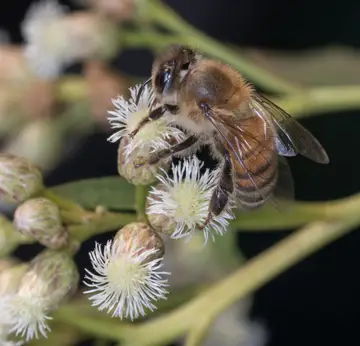
This page lists 4 insects.
1 is venomous by official accounts. 2 are nonnative.
Not every species: no complete official list of New Mexico insects exists, so this page covers the ones state and Extension sources name. How lists are built.
Which insects can hurt you
Official sources single out these insects in New Mexico, in their own words:
Mosquitoes
Disease (West Nile virus). “Cases of West Nile Virus in New Mexico have occurred every year since 2003.” New Mexico Department of Health
Rodent fleas
Disease (plague). “People usually get plague from the bite of a rodent flea that is carrying plague bacteria or by handling an infected animal.” New Mexico Department of Health
New World screwworm
Larvae infest wounds. “New World screwworm (Cochliomyia hominivorax) is a foreign animal disease and a serious threat to wildlife, livestock, pets and people.” New Mexico Department of Wildlife
Mass stinging attacks. “Rather than tolerating people or animals near their colonies as European bees usually did, Africanized bees were highly unpredictable and dangerously defensive.” College of ACES
All 4 insects
Venomous species first, then A to Z. Do not handle them.
“Rather than tolerating people or animals near their colonies as European bees usually did, Africanized bees were highly unpredictable and dangerously defensive.” College of ACES
Where in New Mexico
By 2009, virtually all New Mexico counties north to I-40 and Santa Fe County were infested. College of ACES
What the sources say
Venom: “The toxic dose (LD50) of honey bee venom is 8.6 stings per pound of body weight for an average person.” (College of ACES)
No confirmed photo of Mosquitoes (West Nile virus vectors)
Mosquitoes (West Nile virus vectors)
Not stated
Venom
No official source we use states whether this animal is venomous. That does not mean it is harmless: do not handle it.
No confirmed photo of New World screwworm
New World screwworm
Cochliomyia hominivorax
Not statedInvasive
Venom
No official source we use states whether this animal is venomous. That does not mean it is harmless: do not handle it.
Danger to people
“New World screwworm (Cochliomyia hominivorax) is a foreign animal disease and a serious threat to wildlife, livestock, pets and people.” New Mexico Department of Wildlife
No confirmed photo of Rodent fleas (plague vectors)
Rodent fleas (plague vectors)
Not stated
Venom
No official source we use states whether this animal is venomous. That does not mean it is harmless: do not handle it.
When insects are active in New Mexico
Records of insects in New Mexico peak in June to September. They show when people record insects, not how many there are (about month bars).
JanFebMarAprMayJunJulAugSepOctNovDec
32,097 records of insects in New Mexico by month (GBIF, CC0 and CC BY records).
If you are bitten or stung
Call 911 or Poison Help at 1-800-222-1222 right away. Poison Help connects you to your local poison center, any time of day.
Official advice from New Mexico Poison & Drug Information Center and College of ACES:
Living With Wildlife. New Mexico Department of Wildlife (formerly New Mexico Department of Game and Fish). page modified 2026-10-26; checked November 3, 2026.
Invasive Species and Diseases. New Mexico Department of Wildlife (formerly New Mexico Department of Game and Fish). page modified 2026-08-31; checked November 3, 2026.Quoted passages (1)
“New World screwworm (Cochliomyia hominivorax) is a foreign animal disease and a serious threat to wildlife, livestock, pets and people.”
New World Screwworm. New Mexico Department of Wildlife (formerly New Mexico Department of Game and Fish). page modified 2026-06-09; checked November 3, 2026.
West Nile Virus. New Mexico Department of Health. undated page; checked November 3, 2026.Quoted passages (1)
“Cases of West Nile Virus in New Mexico have occurred every year since 2003.”
Plague. New Mexico Department of Health. undated page; checked November 3, 2026.Quoted passages (1)
“People usually get plague from the bite of a rodent flea that is carrying plague bacteria or by handling an infected animal.”
Guide L-110: Honey Bees in New Mexico. New Mexico State University Cooperative Extension Service (College of ACES). Revised January 2017; checked November 3, 2026.Quoted passages (3)
“The toxic dose (LD50) of honey bee venom is 8.6 stings per pound of body weight for an average person.”
“Rather than tolerating people or animals near their colonies as European bees usually did, Africanized bees were highly unpredictable and dangerously defensive.”
“In that case the most important recommendation is simple: Run.”
Bites and Stings. New Mexico Poison & Drug Information Center (UNM Health Sciences; New Mexico's poison-control program). undated page; checked November 3, 2026.Quoted passages (1)
“If you think that you have been stung by a scorpion, call 1-800-222-1222 immediately for first aid advice.”