California kingsnake
Lampropeltis californiae · also called California king snake, Lampropeltis getula californiae (older name, used by Arizona Game and Fish) and Common kingsnake (name ODFW uses in Oregon) · Last checked November 3, 2026.
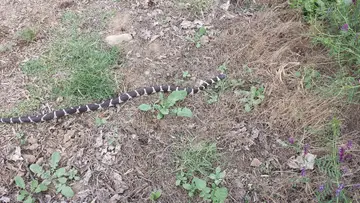

The California kingsnake (Lampropeltis californiae) is a glossy snake, banded or striped, in black or brown with white, cream or yellow. The National Park Service calls it non-venomous and says it generally poses no threat to people. It is a constrictor that eats rodents, lizards, birds and other snakes, including rattlesnakes, whose venom it tolerates. It lives throughout most of California and into Arizona and New Mexico (where it is ranked Imperiled). National Park Service
On this page
Is the California kingsnake dangerous?
NPS (Cabrillo National Monument): non-venomous and generally poses no threat to humans; usually not aggressive and avoids people. National Park Service
“Non-Venomous: The California Kingsnake is non-venomous and generally poses no threat to humans.”
If someone is bitten or stung, call 911 or Poison Help at 1-800-222-1222.
How to identify a California kingsnake
A photo or description can narrow it down, but cannot confirm what an animal is or that it is safe. Look from a distance and do not handle wild animals.
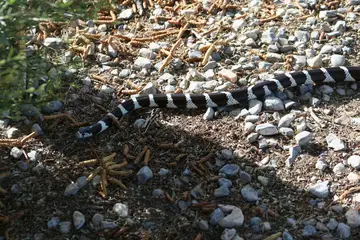

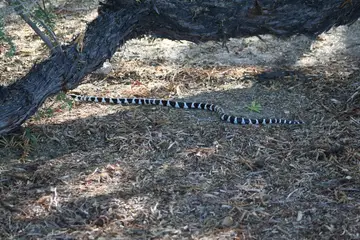

Size: Usually 2.5-3.5 ft, up to about 4 ft (NPS Cabrillo). Arizona Game and Fish gives up to 56 inches for the common kingsnake; NPS Tuzigoot (Arizona) gives 40-80 inches for kingsnakes there. These official figures differ.
Colors: black, dark brown, brown, white, cream and yellow. Pattern: light bands around the body; lengthwise stripe (some); dots or bars (rare morphs).
Key features
- Smooth, glossy scales ('Lampropeltis' means 'shiny shield'). National Park Service
- Arizona form: black or dark brown with 21 to 45 white bands that widen low on the sides; snout and face usually have small white blotches. Arizona Game and Fish Department
- Round pupils (Arizona Game and Fish, common kingsnake). Arizona Game and Fish Department
- Bands or lengthwise stripes; rare morphs show dots, zippers or bars. National Park Service
Animals mistaken for the California kingsnake
California kingsnake or Rattlesnakes?
California kingsnake
Rattlesnakes Crotalus spp.
NMSU Extension: the primary way to distinguish a rattlesnake from other snakes is the rattle, though it begins as a single soundless button on small snakes. Some non-poisonous snakes hiss or vibrate their tails and may be mistaken for rattlesnakes. Rattlesnakes also have a pit on each side of the face just below the nostrils, but you must be dangerously close to see it. Most have triangular heads, though many harmless snakes flatten their heads when threatened and can look like rattlesnakes. College of ACES
Venomous (NMSU Extension). Kingsnakes eat rattlesnakes (CDFW).
California kingsnake or Coral snakes (Sonoran coral snake in Arizona and New Mexico)?
California kingsnake
Coral snakes (Sonoran coral snake in Arizona and New Mexico) Micruroides euryxanthus
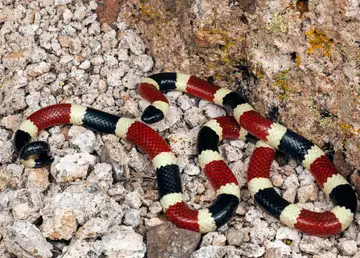

NMSU Extension: the western (Sonoran) coral snake has a black nose and alternating broad rings of red and black separated by narrower rings of white or yellow, and these rings go all the way around the body. College of ACES
Venomous. NMSU Extension says coral snakes rarely bite but their venom is highly poisonous. See the coral-snake page.
Where the California kingsnake lives
- Native or listed
- Nonnative or not established
- No official record in our data
- 1–9
- 10–99
- 100–999
- 1,000+
On our state guides
State boundaries: U.S. Census Bureau, cartographic boundary file cb_2024_us_state_20m.
When it is active
Active whenever temperatures allow: midday in cool spring and fall; early morning and late afternoon to early evening in hot summer; inactive in winter everywhere (CDFW). California Department of Fish and Wildlife
US open-licence records peak in April to June.
Habitat and habits
Habitat: Nearly all habitats except high mountains, most common near streams, rivers and irrigated farmland (CDFW). Often near rock outcrops and clumps of vegetation; NPS lists forests, grasslands, deserts and suburbs.
Behavior: Hunts on the ground, in mammal burrows and under objects; hides in rodent burrows and under rocks, logs and boards. Generally not aggressive (NPS).
Diet: Lizards and snakes (including rattlesnakes), plus many small rodents, birds and bird eggs (CDFW); also amphibians and large insects (NPS). It kills prey by constriction.
Young: Egg-layer. Mating March to June; usually lays about 9 eggs (range 2-12) in June or July; eggs hatch in about 70 days (CDFW).
Legal status and reporting
Protection: New Mexico: state-ranked Imperiled (S2) and a Species of Greatest Conservation Need, with limited protection against commercial take and a non-resident permit requirement (BISON-M). The same database lists Utah 'Special Concern/Conservation Taxa'. New Mexico Department of Wildlife
Report: No invasive-species reporting applies in the sources read. In California, CDFW asks people to report sick or dead snakes (snake fungal disease was confirmed in a California kingsnake in 2019). California Department of Fish and Wildlife
Questions about the California kingsnake
Is a king snake poisonous?
No. The National Park Service says the California kingsnake is non-venomous and generally poses no threat to humans. Arizona Game and Fish lists the common kingsnake, including its California subspecies, as non-venomous.
Is a king snake dangerous?
NPS (Cabrillo) says it generally poses no threat to people, is usually not aggressive and avoids people. Enjoy it from a distance. Rattlesnakes share its habitat, so if anyone is bitten by a snake, call 911 (NPS); you do not need to identify the snake.
Is a king snake a constrictor?
Yes. NPS calls California kingsnakes powerful constrictors, and NPS Tuzigoot says kingsnakes kill by constriction.
Is a king snake immune to rattlesnake venom?
NPS Cabrillo says California kingsnakes are immune to rattlesnake venom. NPS Tuzigoot calls it a high tolerance, and CDFW says kingsnakes are resilient against rattlesnake venom. They eat rattlesnakes.
Rattlesnake vs king snake
NMSU Extension says the primary way to distinguish a rattlesnake from other snakes is the rattle, though small ones may have only a soundless button and some other snakes vibrate their tails and may be mistaken for rattlesnakes. Rattlesnakes also have a pit on each side of the face below the nostrils, but you must be dangerously close to see it. NPS describes California kingsnakes as glossy, banded or striped, in black or brown with white or yellow. Kingsnakes eat rattlesnakes. Rattlesnakes are venomous: keep your distance.
King snake california
CDFW says the California kingsnake lives throughout California, including Santa Catalina Island. It is absent only from the high Sierra Nevada and the far northwest and northeast corners of the state, from sea level to 7,000 ft.
King snake arizona
Arizona Game and Fish says the common kingsnake lives across most of Arizona except the high mountains. Of the subspecies there, NPS says the California kingsnake is the one hikers are most likely to see in the Verde Valley. Both call it non-venomous.
Sources
- Snakes - Cabrillo National Monument. National Park Service. updated July 28, 2024; checked November 3, 2026.
Quoted passages (1)
“Non-Venomous: The California Kingsnake is non-venomous and generally poses no threat to humans.”
- The King of Snakes - Cabrillo National Monument. National Park Service. October 10, 2018; checked November 3, 2026.
Quoted passages (2)
“Whatever the pattern or color, their scales are smooth and glossy, a characteristic noted in their scientific name; ‘Lampropeltis’ means ‘shiny shield’ in Greek, a reference to their lustrous hide.”
“They can have bands around their bodies, or longitudinal stripes. Some odd snakes (aberrant morphs) can even exhibit patterns like dots, zippers, or bars.”
- California Wildlife Habitat Relationships System: California Kingsnake (Lampropeltis californiae), R058. California Department of Fish and Wildlife (California Interagency Wildlife Task Group). CWHR life history account R058; checked November 3, 2026.
Quoted passages (2)
“California kingsnakes may be active whenever temperatures are favorable. During the cooler periods of spring and fall most activity occurs mid-day, but when summer days are hot most activity is restricted to early morning, and late afternoon and early evening. Winter inactivity occurs at all localities.”
“Clutch sizes range from 2 to 12 (usually 9). Egg-laying usually occurs in June or July after the mating season, which extends from March to June. Courtship in kingsnakes is somewhat elaborate and in males involves neck-biting behavior (Leweke 1979). Eggs hatch in about 70 days.”
- Snakes - Tuzigoot National Monument. National Park Service. updated January 11, 2026; checked November 3, 2026.
- BISON-M Species Booklet: California Kingsnake (Species ID 030322). New Mexico Department of Wildlife (BISON-M, with Natural Heritage New Mexico). updated July 31, 2017; checked November 3, 2026.
- Online Field Guide species account: Common Kingsnake (Lampropeltis getula). Arizona Game and Fish Department. 2023; checked November 3, 2026.
Quoted passages (2)
“This subspecies is black or dark brown and has 21 to 45 white bands. The bands become wider on the lower sides. The snout and face are usually marked with small white blotches.”
“…and shiny and the pupils are round.”
- Rattlesnake. California Department of Fish and Wildlife. undated page; checked November 3, 2026.
Quoted passages (1)
“In 2019, California confirmed its first two known cases of SFD in a California kingsnake (Lampropeltis californiae) and non-native Florida water snake (Nerodia fasciata pictiventris). … Report sick or dead snakes to CDFW.”
- New Mexico Snakes: Information for New Mexico Homeowners (Circular 541). New Mexico State University Cooperative Extension Service (College of ACES). Revised and electronically distributed July 1998; checked November 3, 2026.
Quoted passages (2)
“The primary way to distinguish a rattlesnake from other snakes is the presence of a rattle … The rattle begins with a single, soundless button on small snakes … Some non-poisonous snakes, such as bull snakes, coachwhips and rat snakes, behave like rattlesnakes when confronted. … Although you must be dangerously close, another way to identify a rattlesnake is the presence of a very conspicuous sensory area known as a pit on each side of the face just below the nostrils. … Most rattlesnakes have triangular or ‘spade-shaped’ heads (wide at the back and attached to a narrow neck). Many harmless snakes flatten their heads when threatened and can look like rattlesnakes.”
“The western coral snake has a black nose and is brightly colored, with alternating broad rings of red and black separated by narrower rings of white or yellow (Figure. 10). These markings encircle the body, although they are less bright on the belly.”
- GBIF.org occurrence records, human observations licensed CC0 1.0 or CC BY 4.0 only, accessed November 3, 2026. The datasets behind these counts are listed on our Sources page.
- State boundaries: U.S. Census Bureau, cartographic boundary file cb_2024_us_state_20m.