Sidewinder Rattlesnake
Crotalus cerastes · also called sidewinder, horned rattler, Mojave Desert sidewinder (subspecies) and Sonoran sidewinder (subspecies) · Last checked November 3, 2026.
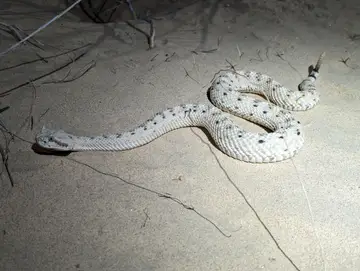
The sidewinder is a small, venomous desert rattlesnake with horn-like scales above its eyes, a rattle on its tail and a sideways way of moving that leaves J-shaped tracks in sand. Arizona Game and Fish says it can deliver potent venom and should be left alone. It lives in the low deserts of western and southwestern Arizona, California's sandy deserts, southern Nevada and Utah's Washington County. Arizona Game and Fish Department
On this page
Is the sidewinder rattlesnake dangerous?
Arizona Game and Fish Department: capable of delivering potent venom; if encountered it should be left alone. Arizona Game and Fish Department
“This rattlesnake is capable of delivering potent venom. If encountered it should be left alone.”
Bites and stings: It uses venom through long, hollow fangs to kill prey. Arizona Game and Fish says a large share of envenomations happen when a snake is handled or abused. UC IPM warns a rattlesnake can still inject venom by reflex for an hour or more after death.
If someone is bitten or stung, call 911 or Poison Help at 1-800-222-1222.
How to identify a sidewinder rattlesnake
A photo or description can narrow it down, but cannot confirm what an animal is or that it is safe. Look from a distance and do not handle wild animals.
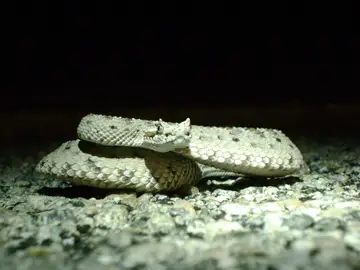
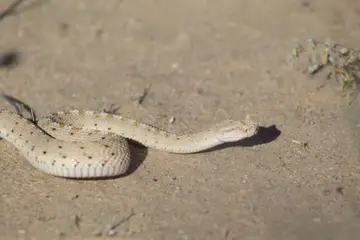
Size: Small: up to 25 in excluding the rattle (Arizona); typically 1.5 ft or less but can reach 3 ft (Death Valley NPS); 17-33 in (Nevada). Arizona Game and Fish Department
Colors: tan, pinkish-tan, cream or light gray, often matching the soil or sand. Pattern: brown or gray-brown blotches on the back with chalky-white between them; dark stripe back from the eye; black rings at the tail tip.
Key features
- Enlarged, upturned, horn-like scales above the eyes Arizona Game and Fish Department
- Rattle on the tail, though rattles can break off (UC IPM) Arizona Game and Fish Department
- Broad, triangular head and slender neck Arizona Game and Fish Department
- Sideways locomotion that leaves parallel J-shaped tracks Arizona Game and Fish Department
Animals mistaken for the sidewinder rattlesnake
Sidewinder Rattlesnake or Gopher snake?
Sidewinder Rattlesnake
Gopher snake Pituophis catenifer
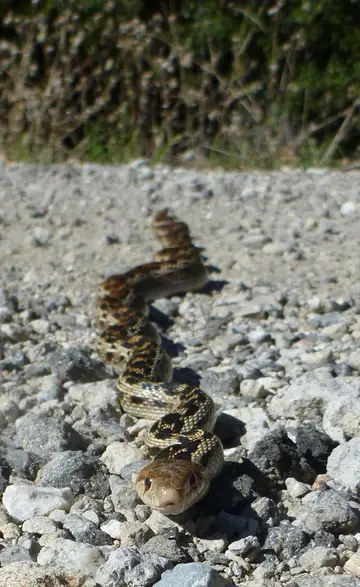

UC IPM's general rattlesnake comparison, not specific to the sidewinder: rattlesnakes have a rattle and a distinctive triangular head; gopher snakes do not have a rattle. A gopher snake can change its posture to mimic the triangular head, so head shape alone does not separate them. UC IPM also warns that rattles can shorten or break off completely, so the lack of a rattle does not mean a snake is not a rattlesnake. University of California Statewide IPM Program
UC IPM calls the gopher snake harmless.
Where the sidewinder rattlesnake lives
- Native or listed
- Nonnative or not established
- No official record in our data
- 1–9
- 10–99
- 100–999
- 1,000+
On our state guides
State boundaries: U.S. Census Bureau, cartographic boundary file cb_2024_us_state_20m.
When it is active
Arizona: nocturnal and dusk-active in hot summer months; daytime and dusk-active in spring. Death Valley: most active at dawn and dusk, also at night in warmer periods. Nevada: primarily nocturnal, active at dusk and sometimes by day in early spring, and may stop activity in mid-summer heat. Arizona Game and Fish Department
US open-licence records peak in April to June and September.
Habitat and habits
Habitat: Sandy desert: creosote and mesquite flats, sand dunes and sandy washes, from below sea level to about 6,000 ft in California and Death Valley; up to about 2,800 ft in Arizona. National Park Service
Behavior: Moves sideways across sand and often rests partly buried, sometimes with only the head and back showing. Death Valley NPS says burying itself gives it a hiding place.
Diet: Lizards, small mammals such as pocket mice and kangaroo rats, and sometimes birds and other snakes.
Young: Bears live young. Arizona: mating in spring, up to 20 young born in July or August. Nevada: 4 to 11 young with no parental care. Death Valley: average of 8 to 10.
Legal status and reporting
Federal: USFWS ECOS status field reads 'Species of Concern', with no listing date. US Fish and Wildlife Service
Protection: Nevada lists it as a Priority Species with state status 'Unprotected'. Utah requires a certificate of registration to collect, possess or harvest rattlesnakes. Other states: not confirmed. Nevada Department of Wildlife
Questions about the sidewinder rattlesnake
Sidewinder rattlesnake
A small venomous rattlesnake of the southwestern deserts, named for its sideways movement. It has horn-like scales above the eyes and leaves J-shaped tracks. Official sources place it in Arizona, California, Nevada and Utah, and Arizona Game and Fish says to leave it alone.
Sources
- Online Field Guide species account: Sidewinder (Crotalus cerastes). Arizona Game and Fish Department. 2023; checked November 3, 2026.
Quoted passages (9)
“This rattlesnake is capable of delivering potent venom. If encountered it should be left alone.”
“A small (up to 628 mm or 25″ in total length excluding rattle)”
“The scales above the eyes (supraoculars) are enlarged, upturned, pointed, and horn-like.”
“On the end of the tail is a rattle”
“The neck is slender and the head is broad and triangular.”
“This method of locomotion leaves distinctive parallel J-shaped tracks”
“In sandy areas this snake often coils partially buried in the sand, sometimes with only the head and dorsum exposed.”
“Nocturnal and crepuscular during the hot summer months, it shelters in underground burrows during the day. It is diurnal and crepuscular during spring”
“Mating takes place in spring and a litter of up to 20 young is born in July or August.”
- Sidewinder - Death Valley National Park. National Park Service. updated January 17, 2021; checked November 3, 2026.
Quoted passages (1)
“Habitat: sandy flats in creosote and mesquite deserts, occasionally rocky slopes; below sea level to about 6,000 ft.”
- Pest Notes: Rattlesnakes. University of California Statewide IPM Program (UC ANR, Cooperative Extension). 2014-12; checked November 3, 2026.
Quoted passages (1)
“Rattlesnakes have a rattle in addition to a distinctive triangular head whereas harmless gopher snakes do not have a rattle.”
- Sidewinder. Nevada Department of Wildlife. undated page; checked November 3, 2026.
Quoted passages (2)
“The Sidewinder preys mainly on lizards, pocket mice, kangaroo rats, and other small mammals.”
“Priority Species Unprotected”
- BISON-M Species Booklet 030161: Sidewinder Rattlesnake. New Mexico Department of Wildlife (BISON-M). updated August 9, 2023; checked November 3, 2026.
- ECOS species report query for the four taxa. U.S. Fish and Wildlife Service. live query result 2026-11-03; checked November 3, 2026.
Quoted passages (1)
“Species of Concern”
- Rattlesnake. California Department of Fish and Wildlife. undated page; checked November 3, 2026.
- Species tables for Utah's reptiles and amphibians. Utah Division of Wildlife Resources (DWR). page "Last updated: April 22, 2026"; checked November 3, 2026.
- GBIF.org occurrence records, human observations licensed CC0 1.0 or CC BY 4.0 only, accessed November 3, 2026. The datasets behind these counts are listed on our Sources page.
- State boundaries: U.S. Census Bureau, cartographic boundary file cb_2024_us_state_20m.