Sonoran Desert toad
Incilius alvarius · also called Colorado River toad · Last checked November 3, 2026.
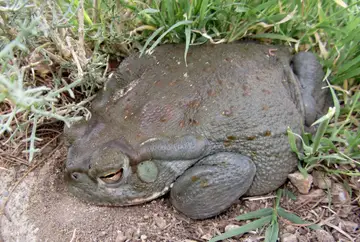
The Sonoran Desert toad, also called the Colorado River toad, is the largest native toad in the US, growing to 7.5 inches or more, with olive-green to brown skin and large glands behind the eyes. It is dangerous: the National Park Service says its toxins are deadly to pets and harmful to humans, and Arizona Game and Fish says they are strong enough to kill a dog. It lives in southern Arizona and Hidalgo County, New Mexico, where it is state-listed as threatened. California lists it as possibly extirpated. Most are seen at night during the summer monsoon. National Park Service
On this page
Is the sonoran desert toad dangerous?
NPS: its toxins are deadly to pets and harmful to humans. National Park Service
“These toxins are deadly to pets and harmful to humans.”
No official source we use states whether this animal is venomous. That does not mean it is harmless: do not handle it.
If someone is bitten or stung, call 911 or Poison Help at 1-800-222-1222.
How to identify a sonoran desert toad
A photo or description can narrow it down, but cannot confirm what an animal is or that it is safe. Look from a distance and do not handle wild animals.
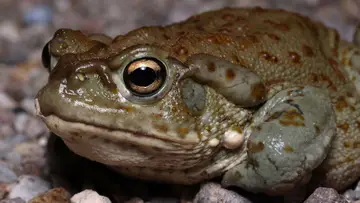

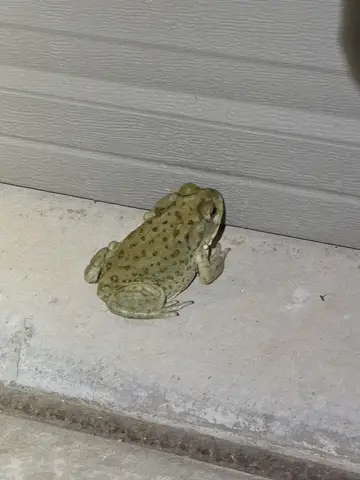
Size: Up to 7.5 inches or more (AZGFD); NPS Saguaro gives 4 to 7.5 inches. Arizona Game and Fish Department
Colors: Typically olive-green to brown, relatively smooth skin; muddy green-gray with some cream around the mouth and belly. Pattern: A prominent white wart near the mouth; large warts on the hind legs.
Key features
- Cranial crests on the head and long glands behind the head and on the hind legs Arizona Game and Fish Department
- Amber eye, with a large oval parotoid gland and round eardrum behind it National Park Service
- Call is a short, low toot; AZGFD compares it to a ferry boat whistle National Park Service
Young
Small dark, orange-tipped spots on the back. Larger tadpoles are gray or brown and grow to about 2.25 inches.
Animals mistaken for the sonoran desert toad
Sonoran Desert toad or American bullfrog?
Sonoran Desert toad
American bullfrog Lithobates catesbeianus
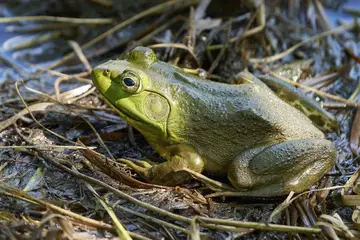

NPS says it is sometimes mistaken for a bullfrog because of its size and smooth skin. The prominent parotoid glands mark it as a true toad. National Park Service
Where the sonoran desert toad lives
- Native or listed
- Nonnative or not established
- No official record in our data
- 1–9
- 10–99
- 100–999
- 1,000+
On our state guides
State boundaries: U.S. Census Bureau, cartographic boundary file cb_2024_us_state_20m.
When it is active
Mostly at night during the monsoon season, sometimes emerging a month or more before the rains near permanent water. Outside the summer activity period it stays in rodent burrows or other underground retreats. Arizona Game and Fish Department
US open-licence records peak in July to August.
Habitat and habits
Habitat: Sonoran desertscrub, semi-desert grassland, oak and occasionally pine-oak woodland, up to about 5,800 feet. In the west it is increasingly tied to permanent water such as major rivers or farm edges; elsewhere it may be many miles from water, especially during the summer monsoons. Arizona Game and Fish Department
Behavior: Shelters in burrows and cool caves from daytime heat and forages at night. When disturbed, the glands secrete toxins; in New Mexico accounts, a molested toad takes a butting pose with the glands aimed at the intruder.
Diet: Almost anything that moves and fits in its mouth, including insects, centipedes, spiders, lizards, mice and other amphibians.
Young: Usually breeds on one night within 2 or 3 days of rainfall over one inch, in cattle tanks, reservoirs, backwaters and ponds. Females lay long strings of up to 8,000 eggs. Tadpoles typically change into toads in a month or less.
Legal status and reporting
Federal: USFWS ECOS lists it under the older name Bufo alvarius as a 'Species of Concern' (not an ESA listing). ECOS has no entry under Incilius alvarius. US Fish and Wildlife Service
Protection: New Mexico: state-listed Threatened. California: CDFW Species of Special Concern. BISON-M
Questions about the sonoran desert toad
Sonoran desert toad
The largest native toad in the US, also called the Colorado River toad, found in southern Arizona and Hidalgo County, New Mexico, and possibly extirpated in California. NPS says its toxins are deadly to pets and harmful to humans. If someone is exposed and has a reaction, call 911 or Poison Help at 1-800-222-1222. If a dog has eaten one or shows unusual symptoms, Arizona's poison center says to take it to a veterinarian.
Sources
- Amphibians and Fish (Organ Pipe Cactus National Monument). National Park Service. updated October 4, 2023; checked November 3, 2026.
Quoted passages (4)
“These toxins are deadly to pets and harmful to humans.”
“The bright amber eye is in front of the large oval parotoid gland and the circular eardrum, or tympanum.”
“The call is a short, low pitched ‘toot’.”
“This toad takes refuge in burrows and cool caves to escape intense daytime heat, coming out at night to forage”
- Online Field Guide species account: Sonoran Desert Toad (Incilius alvarius). Arizona Game and Fish Department. 2023; checked November 3, 2026.
Quoted passages (7)
“Arizona’s largest toad, Sonoran Desert toads grow to 7.5 inches or more in length.”
“…they can be identified as toads by the crests on the head (cranial crests), and prominent, elongated glands on both sides of the back of the head (parotoid glands) and on the hind legs”
“Young toads have small dark, orange-tipped spots on the back. Larger tadpoles are gray or brown with a rounded tail tip, and grow to about 2.25 inches.”
“This toad is found in Sonoran Desertscrub, semi-desert grasslands, oak, and occasionally pine-oak woodlands to about 5,800 feet. … To the west, the species becomes increasingly tied to permanent water, such as major rivers or the edges of agriculture. Elsewhere it may be found many miles from water, particularly during the summer monsoons.”
“Sonoran Desert toads eat just about anything that moves and will fit into their mouths, including insects, centipedes, spiders, lizards, mice, and other amphibians.”
“Most Sonoran Desert toads are found at night during the monsoon season, but they may emerge a month or more before the summer rains begin, particularly in areas of permanent water. Outside of the summer activity period, Sonoran Desert toads remain in rodent burrows or other underground retreats.”
“Breeding usually occurs on one night within 2 or 3 days of a rainfall event of greater than one inch. … They breed in permanent or temporary waters such as cattle tanks, reservoirs, backwaters, and ponds. … Females deposit long stringers of up to 8,000 eggs in shallow water. Tadpoles typically metamorphose in a month or less.”
- BISON-M Species Booklet 020095: Sonoran Desert Toad. New Mexico Department of Wildlife (BISON-M). updated July 7, 2021; checked November 3, 2026.
Quoted passages (1)
“State NM: Threatened”
- Special Animals List, California Natural Diversity Database. California Department of Fish and Wildlife. October 2026; checked November 3, 2026.
- USFWS ECOS species report export, scientific-name queries. U.S. Fish and Wildlife Service. live query 2026-11-03; checked November 3, 2026.
- Amphibians (Tonto National Monument). National Park Service. updated December 26, 2020; checked November 3, 2026.
Quoted passages (1)
“Colorado River Toads are sometimes mistaken for bullfrogs due to their large size and relatively smooth skin. Prominent bumps below their eyes, called parotoid glands, are characteristic of true toads.”
- Pets & Poison. Arizona Poison and Drug Information Center. undated page; checked November 3, 2026.
- GBIF.org occurrence records, human observations licensed CC0 1.0 or CC BY 4.0 only, accessed November 3, 2026. The datasets behind these counts are listed on our Sources page.
- State boundaries: U.S. Census Bureau, cartographic boundary file cb_2024_us_state_20m.