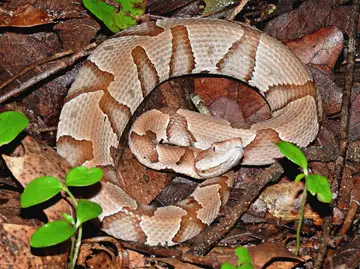
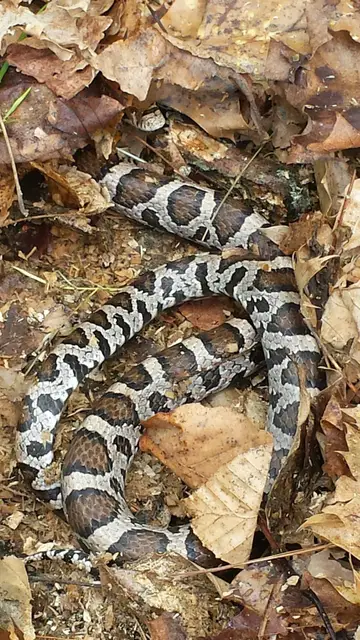
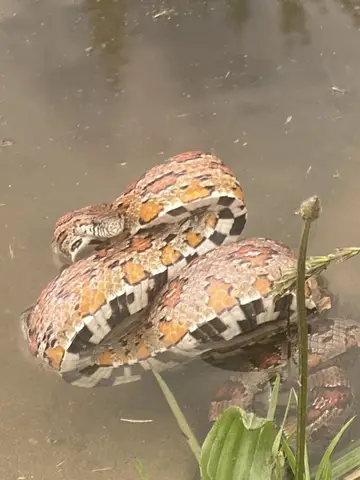
DNR Snakes page: the copperhead is found only in the southern half of the state; the DNR FAQ says copperheads are the only somewhat common venomous snake, in the forested hills of southern and west-central Indiana. DNR State Parks calls it Indiana's most common venomous snake.
Indiana Department of Natural Resources, Division of Fish & Wildlife: “Copperhead - Only found in southern half of the state.” Source
Yes. Indiana DNR: four of Indiana's 32 snake species are venomous: timber rattlesnake, eastern massasauga, copperhead and cottonmouth. Only the copperhead is somewhat common; the other three are rare and state endangered. Indiana Department of Natural Resources, Division of Fish & Wildlife
Are there water moccasins (cottonmouths) in Indiana?
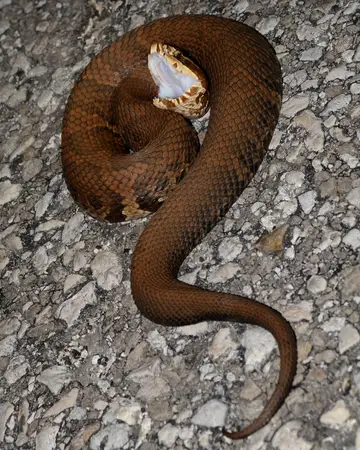
Rarely. DNR: the cottonmouth is state endangered and found only in one small area of southwestern Indiana. The common watersnake is often called "water moccasin" in Indiana and is non-venomous. (A 2017 DNR State Parks brochure said the cottonmouth was most likely extirpated.) Indiana Department of Natural Resources, Division of Fish & Wildlife
Venom: “Yes. Among Indiana's 32 species of snakes, four are venomous: the timber rattlesnake, eastern massasauga, copperhead, and cottonmouth (also known as the "water moccasin").” (Indiana Department of Natural Resources, Division of Fish & Wildlife)
Habitat: This nocturnal reptile lives in dry, rocky areas, but can be found in old outbuildings and barns. (Indiana Department of Natural Resources, Division of State Parks)
Also venomous. Juvenile cottonmouths have many dark spots and speckles inside their dark crossbands (copperhead bands have none or at most one). The Florida Museum says adult Florida cottonmouths are typically uniformly dark, but SCDNR says cottonmouth color ranges from dark brown and black to olive drab and yellow-tan, so a pale snake is not ruled out. The copperhead's eye is not obscured by the dark facial band typical of the cottonmouth. Cottonmouths are almost always associated with wetlands.
Photo: U.S. Fish and Wildlife Service - Midwest Region · Public domain · Wikimedia Commons
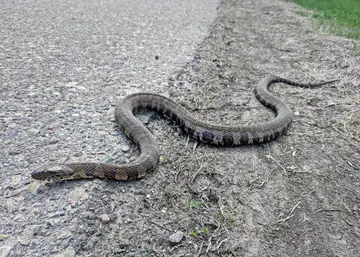
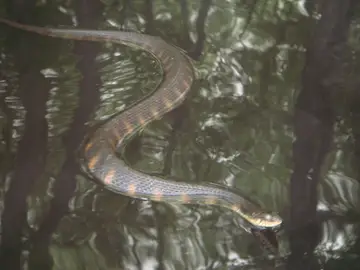
Northern water snake
Its dark bands form a 'reverse hourglass': wider across the back and narrower on the sides (the copperhead's are narrow on the back, wide on the sides). Older water snakes can look solid dark.
Florida Museum, for Florida: crossbands (in the Southern Watersnake, on juveniles) are darker, narrower and much more numerous than a copperhead's; pupils are round; dark vertical lines on the sides of the face near the mouth, which copperheads lack. Large adults are typically uniformly dark brown or black.
Milk snake blotches are outlined in black and widest across the middle of the back; belly is a black-and-white checkerboard (copperhead belly is mottled white to gray).
Snakes. Indiana Department of Natural Resources, Division of Fish & Wildlife. dateModified 2026-03-09; checked November 3, 2026.Quoted passages (3)
“Copperhead - Only found in southern half of the state.”
“Eastern Massasauga Rattlesnake - Federally Threatened - Northern third of Indiana. Timber Rattlesnake - State Endangered - South central Indiana.”
“Cottonmouth - State Endangered - Only found in one small area in southwestern Indiana.”
Reptiles of Indiana List. Indiana Department of Natural Resources, Division of Fish & Wildlife. page states "Revised September 2021"; checked November 3, 2026.
Amphibians and Reptiles FAQs. Indiana Department of Natural Resources, Division of Fish & Wildlife. dateModified 2026-03-09; checked November 3, 2026.Quoted passages (2)
“Yes. Among Indiana's 32 species of snakes, four are venomous: the timber rattlesnake, eastern massasauga, copperhead, and cottonmouth (also known as the "water moccasin").”
“Yes. Among Indiana's 32 species of snakes, four are venomous: the timber rattlesnake, eastern massasauga, copperhead, and cottonmouth (also known as the "water moccasin"). Only copperheads can be considered somewhat common and can be found in the forested hills of southern and west-central Indiana. The remaining three are rare and listed as state endangered species.”
Common Snakes of Indiana State Parks (brochure). Indiana Department of Natural Resources, Division of State Parks (Interpretive Services). brochure dated 9/2017; checked November 3, 2026.Quoted passages (1)
“The Northern copperhead is Indiana's most common venomous snake. … The bite of this snake is extremely painful but rarely life threatening.”