Indiana has 4 venomous snakes named by official sources: Copperhead, Cottonmouth, Eastern Massasauga and Timber Rattlesnake. Each one is labelled venomous by Indiana Department of Natural Resources, Division of Fish & Wildlife.
The 4 venomous snakes of Indiana
Recognize them from a distance; a photo cannot confirm that a snake is safe. Identifying animals safely.
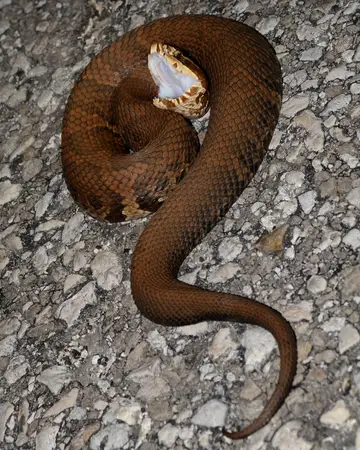
Venom: “Yes. Among Indiana's 32 species of snakes, four are venomous: the timber rattlesnake, eastern massasauga, copperhead, and cottonmouth (also known as the "water moccasin").” (Indiana Department of Natural Resources, Division of Fish & Wildlife)
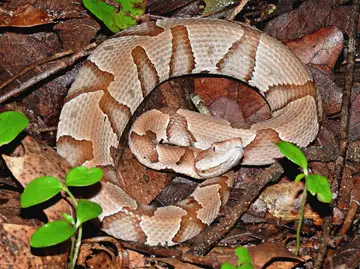
Habitat: This nocturnal reptile lives in dry, rocky areas, but can be found in old outbuildings and barns. (Indiana Department of Natural Resources, Division of State Parks)
Venom: “Yes. Among Indiana's 32 species of snakes, four are venomous: the timber rattlesnake, eastern massasauga, copperhead, and cottonmouth (also known as the "water moccasin").” (Indiana Department of Natural Resources, Division of Fish & Wildlife)
Venom: “Yes. Among Indiana's 32 species of snakes, four are venomous: the timber rattlesnake, eastern massasauga, copperhead, and cottonmouth (also known as the "water moccasin").” (Indiana Department of Natural Resources, Division of Fish & Wildlife)
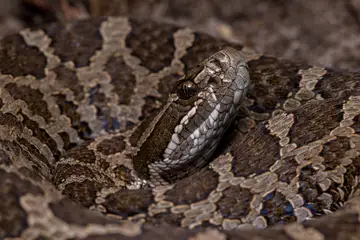
Habitat: Eastern massasaugas tend to inhabit wetland areas but may also use drier habitats. They have been found to occur in marshy grasslands, lake edges, fens, dry prairie and woodland, and forested swampland. (Indiana Department of Natural Resources, Division of Fish & Wildlife)
Venom: “Yes. Among Indiana's 32 species of snakes, four are venomous: the timber rattlesnake, eastern massasauga, copperhead, and cottonmouth (also known as the "water moccasin").” (Indiana Department of Natural Resources, Division of Fish & Wildlife)
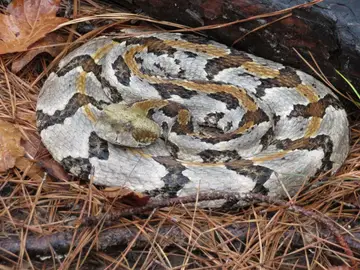
Habitat: Indiana's largest venomous snake lives on dry forested hillsides and hibernates in dens. (Indiana Department of Natural Resources, Division of State Parks)
See all 36 snakes, venomous and not, on Indiana snakes. Indiana Department of Natural Resources, Division of Fish & Wildlife gives Indiana 32 snake species in all; that page lists the 36 that official sources name one by one.
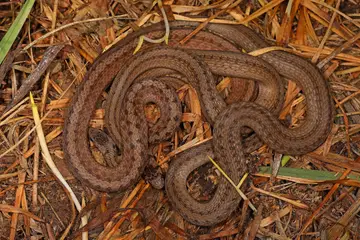
Copperheads have bold hourglass-shaped bands, and young copperheads under about 12 inches have bright yellow tail tips. Brown snakes have small spots, not hourglass bands.
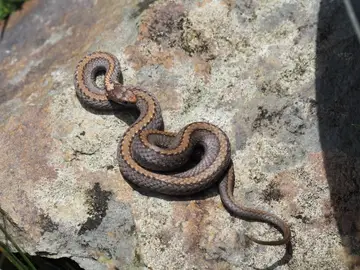
Brown Snake (Dekay's Brownsnake) or Red-bellied Snake?
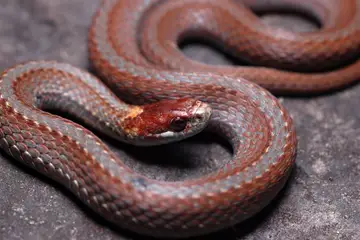
Missouri: red-bellied snakes are sometimes mistaken for young copperheads. Copperheads are stout-bodied with hourglass-shaped markings on the back, vertical pupils, a sensory pit between each nostril and eye and, sometimes, especially in young copperheads, a yellow tail tip.
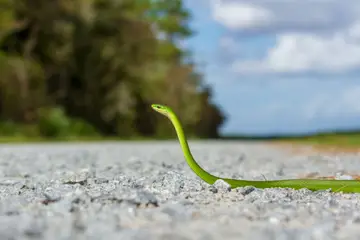
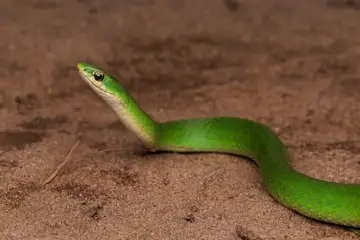
The smooth green snake has smooth scales, is generally smaller and rarely climbs. Missouri: the scales of a rough greensnake feel rough, and the smooth greensnake is a grassland species. SREL: the smooth green snake replaces this species in the Appalachian Mountains and the Northeast. Indiana Department of Natural Resources, Division of State Parks
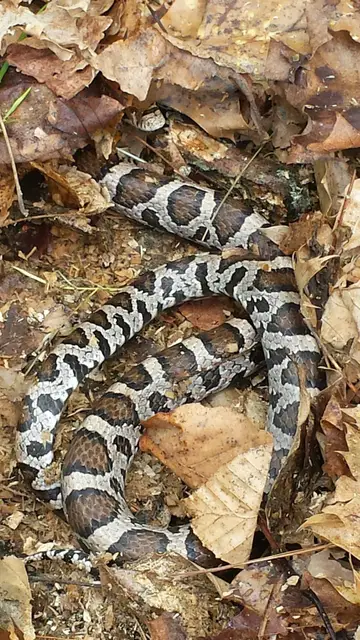
The copperhead's head is coppery with no marks; the milksnake's head is light with brownish marks (Pennsylvania). Tennessee: copperhead has a copper-colored, unmarked head and triangular shapes on the side of the body. Pennsylvania says the eastern milksnake is the snake most often killed by mistake for a copperhead. Belly colour is not used here: Pennsylvania's own pages describe the copperhead belly two different ways (uniform cream in one account, mottled white to gray in another).
Photos show typical adults; individuals vary. Never get close to compare.
When venomous snakes are active in Indiana
Records of snakes in Indiana peak in April to June and August. They show when people record snakes, not how many there are (about month bars).
JanFebMarAprMayJunJulAugSepOctNovDec
703 records of snakes in Indiana by month (GBIF, CC0 and CC BY records).
Call 911 or Poison Help at 1-800-222-1222 right away. Poison Help connects you to your local poison center, any time of day.
Official advice from Indiana Department of Natural Resources, Division of State Parks and Indiana Department of Natural Resources, Division of Fish & Wildlife:
Invasive species: report online via EDDMapS or the GLEDN app; terrestrial invasives 1-866-NO-EXOTIC (1-866-663-9684), [email protected]; aquatic invasives [email protected]. Nuisance wildlife: DNR does not remove wildlife; hire a licensed wildlife control operator; DNR Customer Service 317-232-4200 or [email protected]. Mammal sightings (armadillo, mountain lion, etc.): DNR Report a Mammal form. Gecko / wall lizard sightings: [email protected]. Indiana Department of Natural Resources
Venom labels come only from official sources and link to them; "Not stated" never means harmless. How labels work.
Sources
Reptiles of Indiana List. Indiana Department of Natural Resources, Division of Fish & Wildlife. page states "Revised September 2021"; checked November 3, 2026.
Amphibians and Reptiles FAQs. Indiana Department of Natural Resources, Division of Fish & Wildlife. dateModified 2026-03-09; checked November 3, 2026.Quoted passages (2)
“Yes. Among Indiana's 32 species of snakes, four are venomous: the timber rattlesnake, eastern massasauga, copperhead, and cottonmouth (also known as the "water moccasin").”
“Yes. Among Indiana's 32 species of snakes, four are venomous: the timber rattlesnake, eastern massasauga, copperhead, and cottonmouth (also known as the "water moccasin"). Only copperheads can be considered somewhat common and can be found in the forested hills of southern and west-central Indiana. The remaining three are rare and listed as state endangered species.”
Common Gartersnake. Indiana Department of Natural Resources, Division of Fish & Wildlife. dateModified 2026-03-09; checked November 3, 2026.
Common Watersnake. Indiana Department of Natural Resources, Division of Fish & Wildlife. dateModified 2026-03-09; checked November 3, 2026.
Eastern Hog-nosed Snake. Indiana Department of Natural Resources, Division of Fish & Wildlife. dateModified 2026-03-09; checked November 3, 2026.
Common Snakes of Indiana State Parks (brochure). Indiana Department of Natural Resources, Division of State Parks (Interpretive Services). brochure dated 9/2017; checked November 3, 2026.Quoted passages (5)
“The Northern copperhead is Indiana's most common venomous snake. … The bite of this snake is extremely painful but rarely life threatening.”
“The timber rattlesnake is endangered in Indiana. Indiana's largest venomous snake lives on dry forested hillsides and hibernates in dens.”
“If you think the snake was venomous, or if you are unsure, call or have a friend call 911 and contact property staff.”
“Avoid bites by watching snakes in their natural habitat instead of picking them up. Look closely before stepping when hiking trails or fishing along lake edges.”
“The smooth green snake has smooth scales. It rarely climbs and is generally smaller than the rough green snake.”
Snakes. Indiana Department of Natural Resources, Division of Fish & Wildlife. dateModified 2026-03-09; checked November 3, 2026.Quoted passages (4)
“If you leave a snake alone, it will leave you alone. When a snake bites a person, it does so in self-defense.”
“They tend to be more active during the day in spring and fall, and more active early morning and evening during the heat of summer. … Snakes hibernate from late fall through early spring.”
“Eastern Massasauga Rattlesnake - Federally Threatened - Northern third of Indiana. Timber Rattlesnake - State Endangered - South central Indiana.”
“Cottonmouth - State Endangered - Only found in one small area in southwestern Indiana.”
Eastern Massasauga Rattlesnake. Indiana Department of Natural Resources, Division of Fish & Wildlife. dateModified 2026-03-09; checked November 3, 2026.Quoted passages (1)
“Nevertheless, caution should be taken when encountering a massasauga as their venom can be lethal to humans.”
Invasive Species. Indiana Department of Natural Resources. dateModified 2026-09-08; checked November 3, 2026.Quoted passages (1)