States Wildlife

Are there armadillos in North Carolina?

Last checked November 3, 2026 against official sources.

On this page
  1. The answer
  2. More official answers
  3. Which ones
  4. Where in the US
  5. Sources

Yes.

Nine-banded armadillos reached NC in the late 2000s; NCWRC lists confirmed observations across the state and asks the public to report sightings.

N.C. Wildlife Resources Commission: “…reaching North Carolina in the late 2000s, primarily from natural dispersal from adjacent states.” Source

How we answer questions

On North Carolina's official list

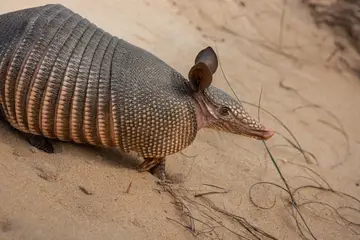
Nine Banded Armadillo
Photo: MartinKlippel · CC BY-SA 4.0 · Wikimedia Commons · resized

Nine Banded Armadillo

Dasypus novemcinctus

Nonnative

Danger to people
“To reduce exposure to diseases, the Commission recommends that gloves be worn when in direct contact with any wild animal, including armadillos.” N.C. Wildlife Resources Commission
Size
Cat-sized: 15-17 in long not counting the tail, 8-17 lb (FWC); 24-32 in including a 9.5-14.5 in tail (UGA).
How to recognize it
  • Bony skin plates that form a shell, which make it easy to identify
  • Long scaly tail, deer-like ears, long pig-like snout
  • Tail encased in 12 bony rings; no canine or incisor teeth

Full Nine Banded Armadillo guide

All mammals in the state: North Carolina mammals.

Where the nine-banded armadillo lives in the US

Texas: on the state's official listKentucky: on the state's official listGeorgia: on the state's official list (nonnative)Missouri: on the state's official listVirginia: on the state's official list (nonnative)Tennessee: on the state's official listLouisiana: on the state's official listFlorida: on the state's official list (nonnative)Illinois: on the state's official list (nonnative)Iowa: on the state's official listNebraska: on the state's official listArkansas: on the state's official listMississippi: on the state's official listNorth Carolina: on the state's official list (nonnative)Oklahoma: on the state's official listIndiana: on the state's official listSouth Carolina: on the state's official listNew Mexico: on an official sourceAlabama: on the state's official listKansas: on the state's official list
Official presence. 20 states where a state list or official source names it. Gray means no official record in our data, not that it is absent.
  • Native or listed
  • Nonnative or not established
  • No official record in our data
Texas: 6 recordsTennessee: 4 recordsLouisiana: 2 recordsNew York: 1 recordFlorida: 6 recordsArkansas: 2 recordsMississippi: 1 recordSouth Carolina: 2 recordsKansas: 3 records
Observation records. Open-licence records on GBIF in 9 states. Records are sightings people shared, not confirmation that a population lives there.
  • 1–9
  • 10–99
  • 100–999
  • 1,000+

Nine-banded armadillo: identification, range and danger

When mammals are seen in North Carolina

6,357 records (GBIF, CC0 and CC BY).

Other questions about North Carolina

Sources

  1. Armadillo, Nine-Banded (NCWRC species page). N.C. Wildlife Resources Commission. undated page; checked November 3, 2026.
    Quoted passages (3)
    “…reaching North Carolina in the late 2000s, primarily from natural dispersal from adjacent states.”
    “The Nine-banded Armadillo is a unique mammal, with its armor-like skin and long, scaly tail. … It has deer-like ears and and has been nicknamed ‘Armored pig’ for its long, pig-like snout”
    “To reduce exposure to diseases, the Commission recommends that gloves be worn when in direct contact with any wild animal, including armadillos.”
  2. 2025 SWAP Appendix 3 Table 3-6 MAMMALS SGCN and Priority Species List (2025 WAP Revision Taxa Team Evaluations). N.C. Wildlife Resources Commission. 2025 NC SWAP; checked November 3, 2026.
  3. Coyote (NCWRC species page). N.C. Wildlife Resources Commission. undated page; checked November 3, 2026.
    Quoted passages (1)
    “Abundance: Common throughout state”
  4. Black Bear (NCWRC species page). N.C. Wildlife Resources Commission. undated page; checked November 3, 2026.
    Quoted passages (1)
    “Common in coastal and mountain regions of the state; uncommon in the Piedmont region”
  5. Eastern Cougar (NCWRC species page). N.C. Wildlife Resources Commission. undated page; checked November 3, 2026.
  6. GBIF.org occurrence records, human observations licensed CC0 1.0 or CC BY 4.0 only, accessed November 3, 2026. The datasets behind these counts are listed on our Sources page.