Yes. Nine-banded armadillos reached NC in the late 2000s; NCWRC lists confirmed observations across the state and asks the public to report sightings. N.C. Wildlife Resources Commission
Yes. The black bear is the only bear species in NC; common in coastal and mountain regions, uncommon in the Piedmont. N.C. Wildlife Resources Commission
“Once a coyote becomes habituated, it loses its natural wariness of people and may become bold or aggressive.” N.C. Wildlife Resources Commission
Size
About 3.5 to 4 feet long including the tail and roughly 2 feet tall at the shoulder; weight varies by region: Arizona 20 to 30 lb, Florida average about 28 lb, Georgia 25 to 45 lb
How to recognize it
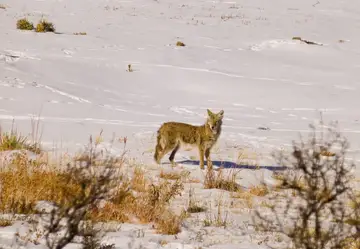
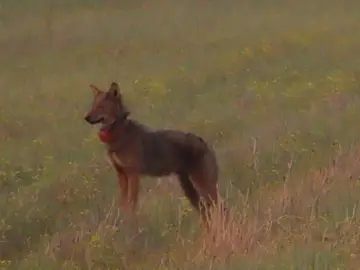
Large pointed ears, long narrow nose, bushy black-tipped tail
Like a slender medium-sized dog, much smaller than a wolf
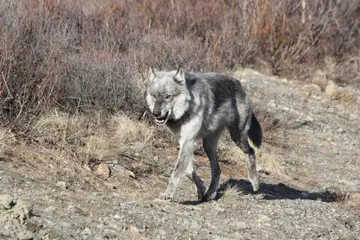
NCWRC table: red wolf 4 to 5 ft long nose to tail, 40 to 80 lb, wide head, broad muzzle, large feet, ears proportionally smaller than the head; coyote no more than 3 ft, slimmer, 20 to 30 lb on the Albemarle Peninsula, narrow head, long pointed muzzle, smaller feet, ears proportionally larger. NCWRC warns that color and size overlap, so the two can be hard to tell apart in the field. (AZGFD gives coyote length as 3.5 to 4 ft including the tail, so length alone is not reliable.)
NY DEC: gray wolves are much larger (females typically 50-100 lb, males 70-145 lb, 5-6 ft nose to tail, 27-33 in at the shoulder); eastern coyotes rarely exceed 50 lb and generally stand under 2 ft at the shoulder. Wolves have small rounded ears and a short blocky snout; coyotes have larger, more pointed ears (can look rounded in winter coat) and a long, narrow, pointed snout. Coyote tracks are typically 3 x 2 in, wolf tracks about 5 x 4 in. NY DEC says most wolf reports in New York were coyotes, dogs or wolf-dog hybrids.