Banana spider
Trichonephila clavipes · also called Golden silk orb weaver, Golden silk spider and Golden silk orbweaver · Last checked November 3, 2026.
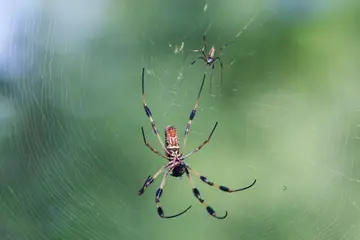
In the US, "banana spider" usually means the golden silk orb weaver (Trichonephila clavipes). It is a large spider with a bright yellow to orange abdomen, tufts of hair on its legs, and big golden webs. UF/IFAS says it occurs throughout Florida and across the Gulf States, north to North Carolina. Extension services in Alabama, Mississippi and South Carolina also report it. Clemson Extension says it is not harmful to humans. It rarely bites, and then only if handled; UF/IFAS says the bite is much less severe than a bee sting. UF/IFAS also lists "banana spider" as a name for the pantropical huntsman spider, which is a different animal, and CDC uses "banana" spiders for Phoneutria, wandering spiders of Brazil and other parts of South America, whose venom is dangerous: these statements do not apply to them. UF/IFAS Extension
On this page
Is the banana spider dangerous?
For the golden silk orb weaver, Clemson Extension: not harmful to humans and docile; would run rather than bite. A bite is similar to a bee sting and is not known to require medical attention the way widow or recluse bites can. Clemson Cooperative Extension, Home & Garden Information Center
“The four spider species listed above are not harmful to humans.”
Bites and stings: Bites only if held or pinched (UF/IFAS) or roughly handled (MSU). The bite causes localized pain and slight redness that fades quickly; UF/IFAS says it is much less severe than a bee sting.
If someone is bitten or stung, call 911 or Poison Help at 1-800-222-1222.
How to identify a banana spider
A photo or description can narrow it down, but cannot confirm what an animal is or that it is safe. Look from a distance and do not handle wild animals.
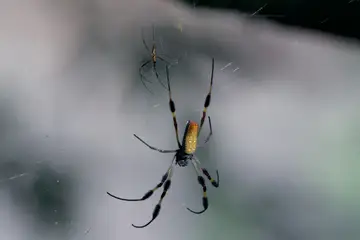
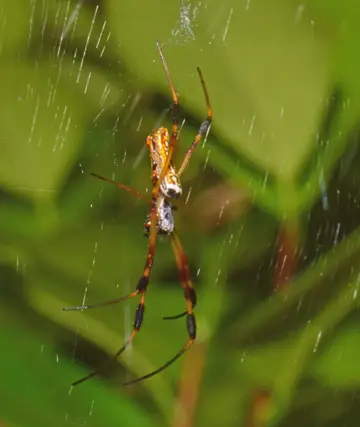
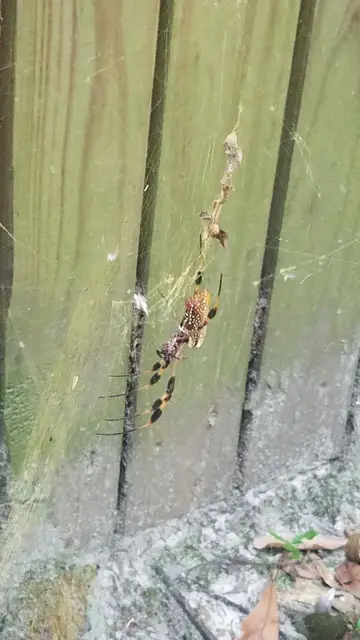
Size: Female body 24 to 40 mm (about 1 to 1.6 in) (UF/IFAS); Clemson gives an average female body length of 1½ to 2 inches. Males are much smaller: UF/IFAS says about 6 mm on average, Clemson says a little less than 1 inch in total, MSU says about 1/10th as big as females. UF/IFAS Extension
Colors: yellow, orange, tan, silver and brown. Pattern: silvery white spots on abdomen; banded legs; hair tufts on legs.
Key features
- Hairy "bottlebrush" tufts on some leg segments, which tell it apart from other big yellow orb weavers, including the Joro spider. Clemson Cooperative Extension, Home & Garden Information Center
- White cephalothorax (head and leg section). Clemson Cooperative Extension, Home & Garden Information Center
- Abdomen yellow-orange with two rows of silvery white spots; legs yellow-orange with brown bands and black tufts near the joints of the 1st, 2nd and 4th pairs. University of Georgia Cooperative Extension
- Large, finely meshed golden web, often 1 to 2 meters (about 3 to 6.5 feet) across, with the hub near the top. UF/IFAS Extension
Young
Spiderlings look very different from adults: they resemble other native orb weavers, with legs dark green to yellowish and a mottled white, yellow and black abdomen, and their webs lack the golden color of adult females.
Animals mistaken for the banana spider
Banana spider or Joro spider?
Banana spider
Joro spider Trichonephila clavata
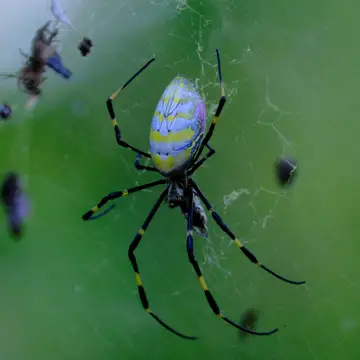
Female golden silk orb weavers have dense black leg tufts and no red markings. Joro spiders have horizontal silver stripes (UGA: blue bands) on the abdomen, a red or reddish pink patch on the underside, and no such leg tufts. Mississippi State University Extension Service
MSU Extension says neither species is to be feared for its bite.
Banana spider or Yellow garden spider?
Banana spider
Yellow garden spider Argiope aurantia
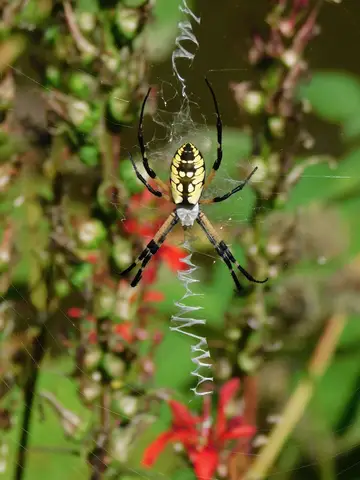
Garden orb weavers (Argiope) have a different abdominal color pattern and no tufts of hair on the legs. UF/IFAS Extension
Clemson Extension counts the yellow garden spider among the big yellow spiders it says are not harmful to humans.
Banana spider or Pantropical huntsman spider (also called banana spider)?
Banana spider
Pantropical huntsman spider (also called banana spider) Heteropoda venatoria
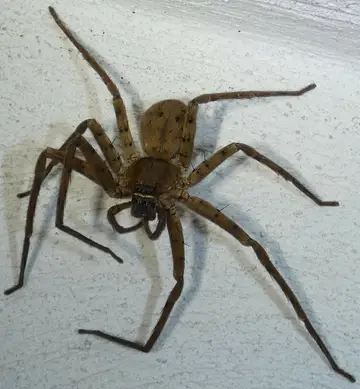
Not an orb weaver: a large, flat, brown spider that does not use a web to catch prey, with distinct black spots on its legs. UF/IFAS Extension
UF/IFAS: not a dangerous spider, but it can give a locally painful bite if handled or trapped.
Where the banana spider lives
- Native or listed
- Nonnative or not established
- No official record in our data
- 1–9
- 10–99
- 100–999
- 1,000+
On our state guides
State boundaries: U.S. Census Bureau, cartographic boundary file cb_2024_us_state_20m.
When it is active
Large webs are most noticed in late summer and fall. Adult males are present July to September; most females mature in August. UF/IFAS Extension
US open-licence records peak in June to September.
Habitat and habits
Habitat: Webs in open woods or at edges of dense forest, usually attached to trees and low shrubs, sometimes in treetops or between utility wires. UF/IFAS Extension
Behavior: Rarely bites unless roughly handled. Its webs are semipermanent, not destroyed and rebuilt periodically; large portions may be repaired. Spiderlings spread by ballooning; spiders and egg sacs can also travel on equipment, vehicles or plants.
Diet: Small to medium flying insects, including flies, bees, wasps, small moths and butterflies.
Young: One generation per year in temperate North America. Mature females make at least two egg sacs 2.5 to 3 cm across late in the fall, each with several hundred eggs.
Questions about the banana spider
Banana spider bite
Golden silk orb weavers (the usual US banana spider) bite only if held or pinched. UF/IFAS says the bite causes localized pain and slight redness that quickly go away, and is much less severe than a bee sting. Clemson Extension says a bite is similar to a bee sting and is not known to need medical attention the way widow or recluse bites can. CDC also uses the name for Phoneutria of South America, whose bites are dangerous. If you are worried about any bite, call 911 or Poison Help at 1-800-222-1222.
Banana spider venomous
For the golden silk orb weaver: UF/IFAS says most spiders are venomous, Mississippi State University Extension says its bites are not seriously venomous, and Clemson Extension says it is not harmful to humans. The name is also used by CDC for Phoneutria of Brazil and other parts of South America, which are dangerous.
Banana spider size
Females are large: 24 to 40 mm (about 1 to 1.6 inches) long in the body according to UF/IFAS; Clemson gives an average of 1½ to 2 inches. Males are much smaller: UF/IFAS says about 6 mm on average, and Clemson says a little less than 1 inch in total.
Banana spider web
The web is large and finely meshed, often 1 to 2 meters (3 to 6.5 feet) across, with golden silk. It is usually strung in open woods or at forest edges between trees and shrubs. UF/IFAS says it is semipermanent: it is not destroyed and rebuilt periodically, and large portions may be repaired.
Banana spider florida
Yes. UF/IFAS says the golden silk orb weaver, which Floridians commonly call the banana spider, occurs throughout Florida.
Banana spider south carolina
Yes. Clemson Extension says the golden silk spider, also called the banana spider, is the most common golden orb weaver in South Carolina and was first documented in Charleston in 1863.
Are there banana spiders in alabama?
Yes. Alabama Cooperative Extension says the golden silk orbweaver is well established in Alabama.
Sources
- EENY229 Golden Silk Spider, Trichonephila clavipes (Linnaeus) (Weems & Edwards). UF/IFAS Extension (EDIS). undated page; checked November 3, 2026.
Quoted passages (6)
“Females range from 24 mm to 40 mm in length.”
“The finely meshed, large web of Trichonephila clavipes (often 1 to 2 meters in diameter) is placed to best exploit insect flight paths”
“Typically, the webs are made in open woods or edges of dense forest, usually attached to trees and low shrubs, although they may be in the tops of trees or between the wires of utility lines”
“Prey consists of a wide variety of small to medium-sized flying insects, including flies, bees, wasps, and small moths and butterflies”
“It is particularly despised by hikers and hunters, as during late summer and fall the large golden webs of this species make a sticky trap for the unwary.”
“Trichonephila clavipes in temperate North America has one generation per year under field conditions.”
- HGIC 2503 Big Yellow Spiders in South Carolina. Clemson Cooperative Extension, Home & Garden Information Center. Originally published 08/21; checked November 3, 2026.
Quoted passages (4)
“The four spider species listed above are not harmful to humans.”
“Golden silk orbweavers have a hairy ‘bottlebrush’ appearance on some of their leg segments, which allows you to distinguish them from other big, yellow orbweavers, including the Joro spider.”
“Golden silk orbweavers have a trademark white cephalothorax (the body part with the head and where the legs attach), which is used by the spider for heat regulation during hot days.”
“Spiderlings look very different from adults.”
- Golden Silk Spider, Bug's Eye View Vol. 3, No. 31 (Blake Layton). Mississippi State University Extension Service. 2017 (Bug's Eye View Vol. 3, No. 31; checked November 3, 2026.
- ENY2080 An Introduction to Some Common and Charismatic Florida Spiders (Powell & Taylor). UF/IFAS Extension (EDIS). Original publication date February 2023; checked November 3, 2026.
Quoted passages (1)
“The abdominal color patterns of Argiope spp.”
- Joro Spiders: What You Need to Know. Alabama Cooperative Extension System. published 2022-03-11; checked November 3, 2026.
- EENY-160 Pantropical Huntsman Spider, Heteropoda venatoria (Linnaeus) (Arachnida: Araneae: Sparassidae). UF/IFAS Extension (EDIS), author G. B. Edwards (FDACS Division of Plant Industry). undated page; checked November 3, 2026.
Quoted passages (1)
“Heteropoda venatoria is a large brown spider with a flattened body structure and very little dorsal pattern.”
- Poisonings, Envenomations, and Toxic Exposures During Travel (CDC Yellow Book). Centers for Disease Control and Prevention. archived copy, captured October 27, 2026; checked November 3, 2026.
- Golden Silk Spider or Joro Spider?, Bug's Eye View Vol. 8, No. 18. Mississippi State University Extension Service. 2022 (Bug's Eye View Vol. 8, No. 18; checked November 3, 2026.
Quoted passages (2)
“Both can bite, but rarely do so unless roughly handled, and bites are not seriously venomous.”
“Female golden silk spiders have dense tufts of black hairs on their legs.”
- Circular 1273 Joro Spider (Trichonephila clavata). University of Georgia Cooperative Extension. Circular 1273, October 2022; checked November 3, 2026.
Quoted passages (1)
“Abdomen is yellow-orange with two rows of silvery white spots Legs are yellow-orange with brown bands; 1st, 2nd, and 4th pairs of legs have black tufts of hair near joints”
- GBIF.org occurrence records, human observations licensed CC0 1.0 or CC BY 4.0 only, accessed November 3, 2026. The datasets behind these counts are listed on our Sources page.
- State boundaries: U.S. Census Bureau, cartographic boundary file cb_2024_us_state_20m.