Saddleback caterpillar (saddleback caterpillar moth)
Acharia stimulea · also called saddleback caterpillar moth and slug caterpillar · Last checked November 3, 2026.
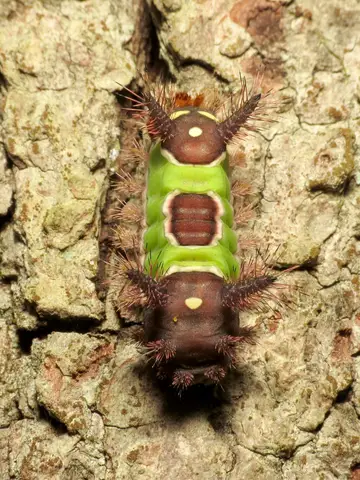
The saddleback caterpillar is the larva of a small brown moth in the slug caterpillar family. It is short and squat, about 3/4 to 1 inch long, brown at both ends with a bright green patch in the middle and a brown, white-edged 'saddle' on its back, and four large fleshy horns. Spines on those horns and along its sides carry venom. UF/IFAS calls it a medically significant species and one of the most important stinging caterpillars in North America; LSU AgCenter says many experts consider it the most dangerous caterpillar on the continent. Stings happen when someone touches or brushes against it; UF/IFAS says a disturbed caterpillar may arch its back to bring its spiny horns into contact. It is native to the eastern United States, from Florida north to New York and Massachusetts and west to Texas, Indiana and Kansas, and feeds on a very wide range of trees, shrubs, garden plants and crops. UF/IFAS Extension (EDIS), Entomology and Nematology Department
On this page
Is the saddleback caterpillar dangerous?
UF/IFAS: best known as a medically significant species; its large spines and potent venom rank it among the most important stinging caterpillars in North America, with only flannel moth (puss caterpillar) larvae considered more dangerous. UF/IFAS Extension (EDIS), Entomology and Nematology Department
“Acharia stimulea is best known as a medically significant species. The large spines and potent hemolytic venom rank it as one of the most important North American species of urticating caterpillars, with larvae from the moth family Megalopygidae being the only lepidopterans considered more dangerous”
Bites and stings: Official sources describe stings from its spines, not bites. The hollow spines break off and stay embedded in whatever touches them; NC State says they do little harm except to the occasional person who accidentally brushes against one.
If someone is bitten or stung, call 911 or Poison Help at 1-800-222-1222.
How to identify a saddleback caterpillar
A photo or description can narrow it down, but cannot confirm what an animal is or that it is safe. Look from a distance and do not handle wild animals.
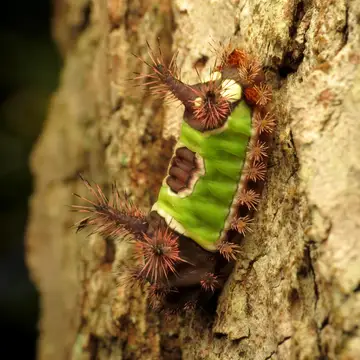
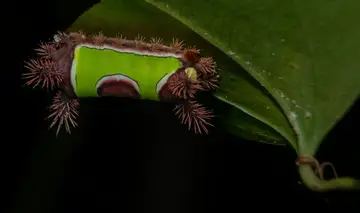
Size: About 3/4 inch (up to 0.8 inch, 20 mm) when full grown; UGA says about 1 inch. UF/IFAS Extension (EDIS), Entomology and Nematology Department
Colors: Dark brown at the front and back ends, bright green over the middle of the back; brown saddle-shaped spot in the middle of the green back. Pattern: Green patch bordered in white, outlining a saddle shape; LSU describes a chartreuse-and-white 'blanket' with a reddish brown oval saddle; cream spots at the rear end that look like a face.
Key features
- Short, slug-like body; legs hidden underneath; glides like a slug UF/IFAS Extension (EDIS), Entomology and Nematology Department
- Four large fleshy horns, a pair at each end, plus smaller knobs along the sides, all bearing stinging spines; LSU says it looks like it has two heads Virginia Tech
Young
Newly hatched larvae are tiny and almost transparent. Early stages lack the bright colors but already have the stout body and fleshy knobs. UF/IFAS says larvae acquire stinging spines as early as the second stage (about 0.2 to 0.3 inch); NC State says newly hatched caterpillars already display yellow, spine-covered knobs.
Animals mistaken for the saddleback caterpillar
Saddleback caterpillar (saddleback caterpillar moth) or Puss caterpillar (southern flannel moth)?
Saddleback caterpillar (saddleback caterpillar moth)
Puss caterpillar (southern flannel moth) Megalopyge opercularis
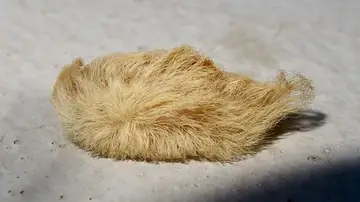
UGA: the puss caterpillar is densely covered with hair (pale yellow, gray or reddish brown); the saddleback has a brown slug-like body with a green middle and a white-bordered brown saddle. University of Georgia Cooperative Extension
Also venomous; UF/IFAS ranks flannel moth larvae as the only caterpillars more dangerous than the saddleback.
Saddleback caterpillar (saddleback caterpillar moth) or Spiny oak slug?
Saddleback caterpillar (saddleback caterpillar moth)
Spiny oak slug Euclea delphinii
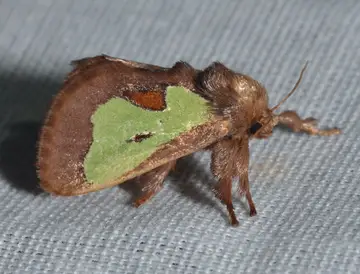

VCE: varies from yellow-green to brown to pink, usually with a darker central stripe down the back; smaller spine-bearing knobs run in two rows down the back and along the lower sides. Virginia Tech
Also a stinging slug caterpillar: VCE says its knobs bear poison spines.
Saddleback caterpillar (saddleback caterpillar moth) or Hag moth caterpillar (monkey slug)?
Saddleback caterpillar (saddleback caterpillar moth)
Hag moth caterpillar (monkey slug) Phobetron pithecium
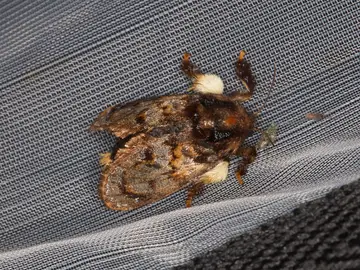

UGA: brownish, with six pairs of curly projections, and easily mistaken for leaf debris. University of Georgia Cooperative Extension
Also stings: UGA says long black stinging hairs grow among the brown hairs.
Where the saddleback caterpillar lives
- Native or listed
- Nonnative or not established
- No official record in our data
- 1–9
- 10–99
- 100–999
- 1,000+
On our state guides
State boundaries: U.S. Census Bureau, cartographic boundary file cb_2024_us_state_20m.
When it is active
Caterpillars feed for about four to five months before pupating and overwinter as pupae in temperate areas. Adult moths fly in June and July in the far Northeast, and earlier (closer to February and March) in warm areas such as Texas and Florida; males fly at twilight and females at night. UF/IFAS Extension (EDIS), Entomology and Nematology Department
US open-licence records peak in July to September.
Habitat and habits
Habitat: On the leaves of a very wide range of trees, shrubs and crops; reported from more than 40 plant families. Common hosts include oak, maple, apple, corn, beans, blueberry, palms and ornamental plants. NC State Extension
Behavior: Clings tightly to leaves with sucker-like prolegs; if disturbed it may arch its back to bring its spiny horns into contact with the attacker.
Diet: Leaves of many plants, especially deciduous trees; young larvae feed together on one leaf and eat 'windows' between the veins, while full-grown larvae eat whole leaves.
Young: Females lay clusters of 30 to 50 flat, overlapping eggs on the upper side of leaves; eggs hatch after about ten days. One brood per year.
Legal status and reporting
Federal: No Acharia species appears in the USFWS ECOS species database (query 2026-11-03 returned 0 rows). ECOS
Report: For help identifying or managing it, NC State Extension says to contact your local Cooperative Extension center. For a sting, call 911 or Poison Help at 1-800-222-1222. NC State Extension
Questions about the saddleback caterpillar
Saddleback caterpillar sting
Its spines carry venom (UF/IFAS). A sting causes immediate intense burning pain; NC State says the pain can spread to nearby lymph nodes and swelling and redness can last over a week, and some people are sensitive enough to need medical treatment. UF/IFAS says severe body-wide reactions are possible. Call 911 or Poison Help at 1-800-222-1222.
Saddleback caterpillar sting what to do
Call 911 or Poison Help at 1-800-222-1222. Texas A&M AgriLife says contact with the eyes or an allergic reaction to a caterpillar sting warrants immediate medical attention, and NC State says some people need professional medical treatment.
Saddleback caterpillar sting treatment
This site does not give treatment advice. Call 911 or Poison Help at 1-800-222-1222. NC State Extension says some people are very sensitive to these stings and may require professional medical treatment.
Saddleback caterpillar bite
Official sources describe stings, not bites. Its hollow venomous spines break off and stay in the skin when someone touches or brushes against it (UF/IFAS, NC State). Call 911 or Poison Help at 1-800-222-1222.
Saddleback caterpillar moth poisonous
The danger is the caterpillar's venomous spines. Virginia Cooperative Extension says adult moths of stinging caterpillars are not known to cause skin reactions. UF/IFAS warns that the cocoons of this genus can contain stinging spines woven into the silk.
Saddleback caterpillar butterfly
It does not become a butterfly. It is the larva of a moth, the saddleback caterpillar moth (Acharia stimulea), a slug moth in the family Limacodidae.
Saddleback caterpillar turns into what
A small, stout, furry-looking moth: glossy dark brown with black shading and a few white dots on the forewings, with a wingspan of about 1 to 1.7 inches. It spins a hard silk cocoon first, and in temperate areas spends the winter as a pupa.
Saddleback caterpillar range
UF/IFAS says it is native to the eastern United States, from Florida north to New York and Massachusetts and west to Texas, Indiana and Kansas.
Saddleback caterpillar location
Look on the leaves of trees, shrubs, garden plants and crops: it has been reported on more than 40 plant families, including oak, maple, apple, corn, blueberry, citrus and ornamentals. Its range covers the eastern United States from Florida to New York and Massachusetts and west to Texas, Indiana and Kansas.
Sources
- EENY-522 Saddleback Caterpillar Acharia stimulea (Clemens) (Insecta: Lepidoptera: Limacodidae). UF/IFAS Extension (EDIS), Entomology and Nematology Department. Original March 2012; checked November 3, 2026.
Quoted passages (8)
“Acharia stimulea is best known as a medically significant species. The large spines and potent hemolytic venom rank it as one of the most important North American species of urticating caterpillars, with larvae from the moth family Megalopygidae being the only lepidopterans considered more dangerous”
“…during last instar the larvae can be as large as 20 mm (0.8 in) with a 7 mm (0.28 in) width”
“The caterpillars have a truncated, slug-like body form that is not typical of other Lepidoptera families. The prolegs are concealed under the ventral surface of the body. … This locomotive complex gives the family its designation as slug caterpillars because of their gliding movement pattern”
“Early instars lack defined aposematic coloration, but still have the stout body design and fleshy tubercles shown by later instars. … they acquire urticating spines on the fleshy tubercles of the body as early as the second instar”
“Acharia stimulea is polyphagous, especially on deciduous trees … Hatchlings will feed gregariously on a single leaf until advancement to the next growth stage. … feed on plant tissue between leaf veins while avoiding the leaf veins themselves; this creates visual dark patches (or ‘windows’) … The last instars feed on the entire leaf”
“Sometimes, if disturbed, larvae will arch their back inward in an attempt to create contact with all anterior and posterior horns”
“Larvae need approximately four to five months to feed and develop before pupating … Caterpillars in temperate areas will overwinter as pupae … Adults emerge for mating flights in June and July in far northeastern states … which translates into expected emergences closer to February and March in warmer climate zones as in Texas and Florida. Males fly first in the twilight hours of warm nights, with females following during the night hours”
“Clutches are laid on the upperside of host plant leaves in irregular clusters of thirty to fifty eggs. … After ten days, the minute larva will chew itself free from the egg … Adults have a single brood”
- 2 nuisance caterpillars are out in greater numbers this year. LSU AgCenter (news release; Tim Schowalter, LSU AgCenter entomologist). June 1, 2012; checked November 3, 2026.
- Saddleback Caterpillar. NC State Extension (N.C. Cooperative Extension, NC State University). Publication date: Jan. 27, 2017; checked November 3, 2026.
Quoted passages (2)
“They have been reported feeding on more than 40 plant families and numerous species within those families.”
“For assistance with a specific problem, contact your local Cooperative Extension Center.”
- Stinging and Biting Pests (Circular 782). University of Georgia Cooperative Extension. October 26, 2022; checked November 3, 2026.
Quoted passages (2)
“Puss caterpillars may be pale yellow, gray or reddish brown, about 1 in. long and densely covered with hairs. … has a brown sluglike body with a green mid-section. In the middle of the green mid-section there is a distinctive brown saddle mark with a white border.”
“The hag moth caterpillar is a strange-looking brownish caterpillar with six pairs of curly projections … These caterpillars are solitary and can easily be mistaken for leaf debris.”
- Stinging Caterpillars: Slug Caterpillars and Flannel Moths (ENTO-347NP / ENTO-75NP). Virginia Cooperative Extension (Virginia Tech). Revised February 7, 2020; checked November 3, 2026.
Quoted passages (2)
“There is a pair of large, fleshy tubercules at the anterior and posterior ends. … All of the tubercules possess formidable stinging spines.”
“This caterpillar varies in color from yellow-green to brown to pink, usually with a darker central stripe down the back … Additional smaller tubercules, all bearing poison spines, run in two rows down the back and along the lower sides.”
- USFWS ECOS species report export (JSON), scientific-name query. U.S. Fish and Wildlife Service (ECOS). live query 2026-11-03; checked November 3, 2026.
- Start looking out for stinging caterpillars (AgriLife Today). Texas A&M AgriLife (AgriLife Today, quoting AgriLife Extension specialists). 2025-05-29 (published; checked November 3, 2026.
- GBIF.org occurrence records, human observations licensed CC0 1.0 or CC BY 4.0 only, accessed November 3, 2026. The datasets behind these counts are listed on our Sources page.
- State boundaries: U.S. Census Bureau, cartographic boundary file cb_2024_us_state_20m.