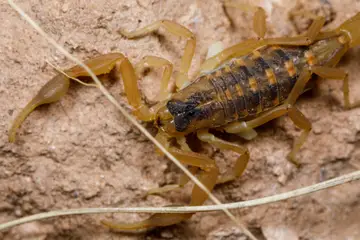
“The stings from Texas scorpions produce only moderate reactions in most people because the poison has little effect on the nervous system. … As with any arthropod venom, allergic reactions are …” Texas A&M AgriLife Extension Service
Size
Usually about 2.5 inches. Sources range from 1 to 1.5 inches on average (Missouri Department of Conservation) to up to 3.5 inches (Oklahoma State).
How to recognize it
Slender pincers and a long, slender tail. The tail is longer on males than females.
Tail ends in a stinger, usually carried up and over the body.
Venom: “On the end of the tail is a bulb-like poison gland or stinger. … The stings from Texas scorpions produce only moderate reactions in most people because the poison has little effect on the nervous system.” (Texas A&M AgriLife Extension Service)
Habitat: Indoors or outdoors in a wide variety of habitats (Extension) (Texas A&M AgriLife Extension Service)
“Texas has 18 species, but only one, the striped bark scorpion, occurs throughout the state.”
“On the end of the tail is a bulb-like poison gland or stinger. … The stings from Texas scorpions produce only moderate reactions in most people because the poison has little effect on the nervous system.”
“This species can be identified easily by its slender pedipalps (pincer-bearing arms) and long, slender tail.”
“The stings from Texas scorpions produce only moderate reactions in most people because the poison has little effect on the nervous system. … As with any arthropod venom, allergic reactions are possible.”
“Adults are about 2½ inches long.”
“Scorpions are nocturnal, hiding during the day and becoming active at night.”