On this page The answer More official answers Which ones Where in the US Lookalikes Official advice Sources Yes.
TPWD: the only breeding population is in the Trans-Pecos and Val Verde and Crockett counties, but a bear can show up almost anywhere.
Texas Parks and Wildlife Department: “Currently, the only population of Black Bears in Texas is in the Trans-Pecos and Val Verde and Crockett counties.” Source
How we answer questions
Are there mountain lions in Texas? Yes. TPWD: Trans-Pecos, South Texas brushlands and parts of the Hill Country. Attacks on people are rare: TPWD reports four in Texas since 1980, all in remote West Texas. Texas Parks and Wildlife Department
Are there armadillos in Texas? Yes. TPWD fact sheet on the nine-banded armadillo. Texas Parks and Wildlife Department
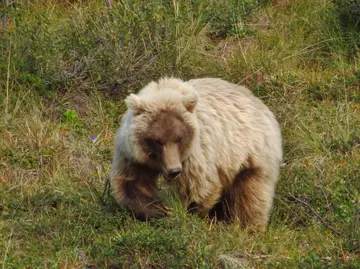
The 2 on Texas's list Photo: Annika Lindqvist · CC BY 4.0 · iNaturalist Ursus arctos
Size USFWS: in the lower 48, adult males average 400-600 lb and adult females 250-350 lb. NPS: about 3-5 feet at the shoulder; brown bears overall range from 200 to 1,000 lb. How to recognize it Distinct shoulder hump, dish-shaped face and long claws Claws about 4 inches long and slightly curved Full grizzly or brown bear guide
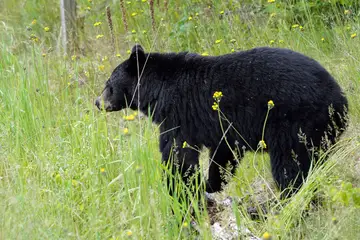
Photo: U.S. Fish and Wildlife Service - Midwest Region · Public domain · Wikimedia Commons Ursus americanus
Danger to people “Although generally harmless, Black Bears can injure humans when provoked and should be treated with caution” Texas Parks and Wildlife Department Size Smokies: males average about 6 ft long, 3 ft at the shoulder and 250 lb in summer; females usually just over 100 lb. Missouri: 46 to 78 inches long, 86 to 600 lb. How to recognize it Straight facial profile, rounded erect ears, very short tail Short curved claws for climbing Where in Texas Currently, the only population of Black Bears in Texas is in the Trans-Pecos and Val Verde and Crockett counties. Natural Science Research Laboratory, Museum of Texas Tech University Conservation The Black Bear is on the state threatened species list. (TPWD tx-tpwd-fs-blackbear)
J F M A M J J A S O N D
42 records by month. Full American black bear guide
All mammals in the state: Texas mammals .
Where the American black bear lives in the US Texas: on the state's official list California: on the state's official list Kentucky: on the state's official list Georgia: on the state's official list Wisconsin: on the state's official list Oregon: on an official source Missouri: on the state's official list Virginia: on the state's official list Tennessee: on the state's official list Louisiana: on an official source New York: on the state's official list Idaho: on the state's official list Florida: on an official source Montana: on the state's official list Minnesota: on the state's official list Maryland: on the state's official list Iowa: on the state's official list Ohio: on the state's official list Nebraska: on the state's official list Washington: on the state's official list South Dakota: on the state's official list Arkansas: on the state's official list Mississippi: on the state's official list Colorado: on the state's official list North Carolina: on the state's official list Utah: on the state's official list Oklahoma: on the state's official list Wyoming: on the state's official list West Virginia: on the state's official list Indiana: on the state's official list Massachusetts: on the state's official list Nevada: on the state's official list North Dakota: on the state's official list Pennsylvania: on the state's official list South Carolina: on the state's official list Maine: on the state's official list Rhode Island: on the state's official list Connecticut: on the state's official list Alaska: on the state's official list New Mexico: on an official source Alabama: on the state's official list Kansas: on the state's official list Vermont: on the state's official list New Jersey: on the state's official list New Hampshire: on the state's official list Arizona: on the state's official list Official presence. 46 states where a state list or official source names it. Gray means no official record in our data, not that it is absent.
Texas: 42 records California: 855 records Kentucky: 6 records Georgia: 22 records Wisconsin: 50 records Oregon: 91 records Missouri: 1 record Virginia: 161 records Tennessee: 241 records Louisiana: 5 records New York: 854 records Idaho: 26 records Florida: 93 records Montana: 136 records Minnesota: 65 records Maryland: 25 records Ohio: 5 records Nebraska: 1 record Washington: 177 records South Dakota: 1 record Arkansas: 6 records Mississippi: 1 record Colorado: 178 records North Carolina: 268 records Utah: 21 records Oklahoma: 1 record Wyoming: 242 records West Virginia: 22 records Massachusetts: 54 records Nevada: 16 records Pennsylvania: 105 records South Carolina: 6 records Maine: 14 records Rhode Island: 2 records Connecticut: 78 records Michigan: 26 records Alaska: 223 records New Mexico: 78 records Alabama: 3 records Vermont: 529 records New Jersey: 24 records New Hampshire: 160 records Arizona: 86 records Observation records. Open-licence records on GBIF in 43 states. Records are sightings people shared, not confirmation that a population lives there.
American Black Bear: identification, range and danger
What else it could be Photo: Annika Lindqvist · CC BY 4.0 · iNaturalist Grizzlies have longer front claws, humped shoulders and a more concave face. Color does not settle it: brown bears can be black to blonde.
When mammals are seen in Texas
Jan Feb Mar Apr May Jun Jul Aug Sep Oct Nov Dec
29,642 records (GBIF, CC0 and CC BY). What official sources advise Other questions about Texas Sources TPWD Wildlife Fact Sheet: Black Bear (Ursus americanus) . Texas Parks and Wildlife Department. undated page; checked November 3, 2026. Quoted passages (2) “Currently, the only population of Black Bears in Texas is in the Trans-Pecos and Val Verde and Crockett counties.” “Although generally harmless, Black Bears can injure humans when provoked and should be treated with caution” The Mammals of Texas, Online Edition: Order Carnivora . Natural Science Research Laboratory, Museum of Texas Tech University. Feb 9, 2026; checked November 3, 2026. TPWD Wildlife Fact Sheet: Mountain Lion (Puma concolor) . Texas Parks and Wildlife Department. undated page; checked November 3, 2026. Quoted passages (1) “In Texas, the Mountain Lion is found throughout the Trans-Pecos, as well as the brushlands of south Texas and portions of the Hill Country.” TPWD Wildlife Fact Sheet: Nine-banded Armadillo (Dasypus novemcinctus) . Texas Parks and Wildlife Department. undated page; checked November 3, 2026. Quoted passages (1) “Originally native to South America, the armadillo now ranges as far north as Texas, Oklahoma, Kansas and Louisiana.” GBIF.org occurrence records, human observations licensed CC0 1.0 or CC BY 4.0 only, accessed November 3, 2026. The datasets behind these counts are listed on our Sources page.