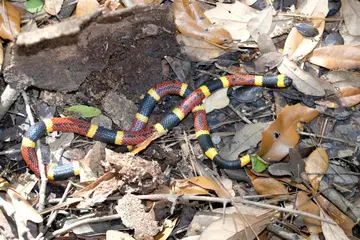
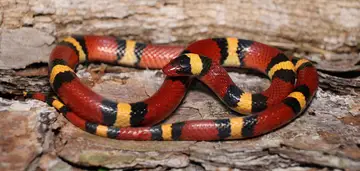
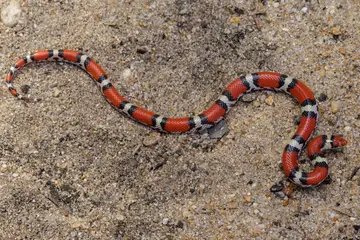
TPWD: the Texas coral snake is the state's only elapid and is found in the southeastern half of Texas.
Texas Parks and Wildlife Department: “The brightly colored Texas coral snake is the state's only member of the Elapidae family, which includes the cobras of Asia and Africa. … Coral snakes are found in the southeastern half of Texas in woodlands, canyons and coastal plains.” Source
Yes. TPWD Junior Naturalists and AgriLife Extension give eight species: two Sistrurus and six Crotalus (Extension counts 10 subspecies). TPWD hunter education says 10 species. The western diamondback is the most common and widespread venomous snake in Texas. Texas Parks and Wildlife Department
Official presence. 10 states where a state list or official source names it. Gray means no official record in our data, not that it is absent.
Native or listed
Nonnative or not established
No official record in our data
Observation records. Open-licence records on GBIF for all US coral snakes (genera Micrurus and Micruroides) in 7 states. Records are sightings people shared, not confirmation that a population lives there.
“The brightly colored Texas coral snake is the state's only member of the Elapidae family, which includes the cobras of Asia and Africa. … Coral snakes are found in the southeastern half of Texas in woodlands, canyons and coastal plains.”
“The coral snake is slender with a small indistinctive head and round pupils, and is usually is 2-1/2 feet or shorter.”
Herps of Texas: Snakes of Texas. Herps of Texas, Biodiversity Collections, Dept. of Integrative Biology, The University of Texas at Austin. 2020-07-23 (archive capture date; checked November 3, 2026.
“Coral snakes, which are venomous, do not have cat’s-eye pupils.”
“There are 10 species of rattlesnakes in Texas. … This is the most common and widespread venomous snake in Texas, found in all but the easternmost part of the state.”
“Also known as 'water moccasins', only one recognized subspecies is found in Texas; Western cottonmouth (A.p. leucostoma).”