Are there brown recluse spiders in Wisconsin?
Last checked November 3, 2026 against official sources.
On this page
Not established.
Wisconsin is outside the brown recluse's native range (UW Insect Diagnostic Lab). UW-Extension calls the brown recluse very rare in the upper Midwest. CDC/NIOSH lists it as venomous.
UW-Madison Insect Diagnostic Lab (Division of Extension / Department of Entomology), P.J. Liesch: “While we’re outside the native range of the dreaded, but horribly misunderstood brown recluse spider (Loxosceles reclusa), Wisconsin is actually home to a native black widow species—the northern black widow (Latrodectus variolus).” Source
More official answers for Wisconsin
Are there black widow spiders in Wisconsin?
Yes, but rare. The northern black widow is native but rare, documented in fewer than 10 counties, mostly east-central counties near Lake Michigan (Door County most). UW-Madison Insect Diagnostic Lab (Division of Extension / Department of Entomology), P.J. Liesch
Are there scorpions in Wisconsin?
No. Scorpions are not native; a few arrive as hitchhikers, usually the striped bark scorpion, whose venom UW calls mild and not medically dangerous though stings are painful. UW-Madison Insect Diagnostic Lab (Division of Extension / Department of Entomology), P.J. Liesch
Where the brown recluse spider lives in the US
- Native or listed
- Nonnative or not established
- No official record in our data
- 1–9
- 10–99
- 100–999
- 1,000+
Where official sources do confirm it
Official sources confirm the brown recluse spider in 17 states: Alabama, Arkansas, Georgia, Illinois, Indiana, Iowa, Kansas, Kentucky, Louisiana, Mississippi, Missouri, Nebraska, Ohio, Oklahoma, Tennessee, Texas and Virginia. Illinois and Iowa border Wisconsin.
- Iowa: “Brown recluse spiders are established in sixteen states: Alabama, Arkansas, Georgia, Illinois, Indiana, Iowa, Kansas, Kentucky, Louisiana, Mississippi, Missouri, Nebraska, Ohio, Oklahoma, Tennessee, and Texas.” Penn State Extension
- Illinois: “Brown recluse spiders are established in sixteen states: Alabama, Arkansas, Georgia, Illinois, Indiana, Iowa, Kansas, Kentucky, Louisiana, Mississippi, Missouri, Nebraska, Ohio, Oklahoma, Tennessee, and Texas.” Penn State Extension
What else it could be
Wolf spiders
UC IPM lists wolf spiders among the brown spiders often mistaken for recluses. They have 8 eyes, so they can be ruled out quickly.
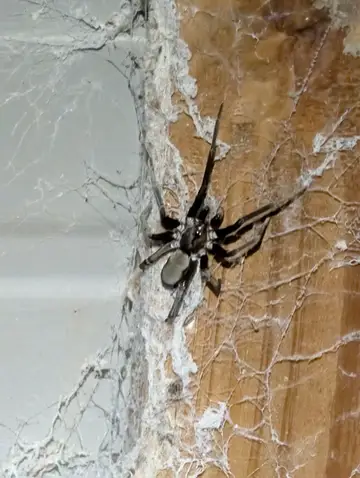
Photo: Sam Taylor · CC BY 4.0 · iNaturalist Southern house spider (male)
UF/IFAS says males are often mistaken for brown recluses. The brown recluse has six eyes in three separate pairs, while the southern house spider has eight eyes bunched together at the front.
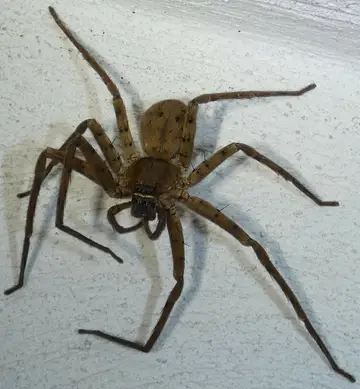
Photo: kcthetc1 · CC0 1.0 · iNaturalist Huntsman spider
UF/IFAS says its carapace pattern is reversed: a light central mark on a dark background. Adults are also much larger than a brown recluse.
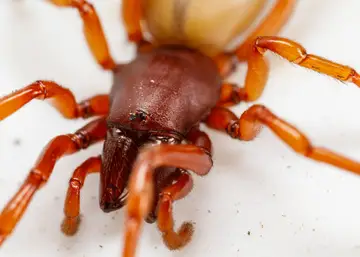
Photo: Meghan Cassidy · CC BY-SA 4.0 · iNaturalist · resized Woodlouse spider
Ohio DNR says it is sometimes confused with the recluse, perhaps because it also has six eyes; recluses are much smaller, dull brown and have tiny fangs. UC IPM says the woodlouse spider's six eyes are in two groups of three (a recluse has three pairs) and it has no body markings.
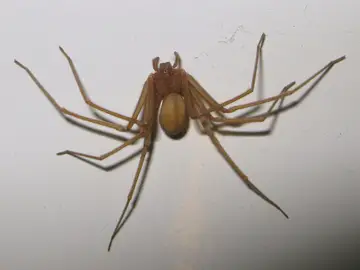
Photo: jacilluch · CC BY-SA 2.0 · Wikimedia Commons · resized Mediterranean recluse
Alabama Extension says the Mediterranean and Chilean recluses closely resemble the brown recluse and are difficult to tell apart from it; it has the same six eyes in three pairs. UC IPM says telling recluse species apart needs a high-magnification microscope and a spider expert. It is not native; Alabama Extension says it has been found in only a few small, isolated locations, and Ohio DNR reports it from buildings in several Ohio cities.

When spiders are seen in Wisconsin
If you see one in Wisconsin
Keep your distance and do not try to catch or handle it. Rattlesnake sightings: call DNR 1-888-WDNRINFO (1-888-936-7463), or use the DNR Rare Species Observation Form / DNR Wildlife Switchboard ([email protected], 608-267-0866). Threatening wolves or wolf depredation: USDA-Wildlife Services (north 1-800-228-1368, south 1-800-433-0663). Spongy moth outside quarantined counties: 1-800-642-MOTH (6684). Other invasive species: DNR Report invasive species page. Feral pig sightings: DNR reporting form or USDA Wildlife Services (north 800-228-1368, south 800-433-0663). Wisconsin Department of Natural Resources, Bureau of Endangered Resources
Other questions about Wisconsin
Sources
- Black Widows: The Hermits of Door County. UW-Madison Insect Diagnostic Lab (Division of Extension / Department of Entomology), P.J. Liesch. May 22, 2018; checked November 3, 2026.
Quoted passages (2)
“While we’re outside the native range of the dreaded, but horribly misunderstood brown recluse spider (Loxosceles reclusa), Wisconsin is actually home to a native black widow species—the northern black widow (Latrodectus variolus).”
“In Wisconsin, these spiders are rare and have been documented in fewer than 10 counties.”
- Scorpion Hitchhikers in Wisconsin. UW-Madison Insect Diagnostic Lab (Division of Extension / Department of Entomology), P.J. Liesch. August 29, 2024; checked November 3, 2026.
Quoted passages (1)
“While scorpions are common in southern parts of the US, they aren’t native to Wisconsin or the Upper Midwest.”
- Amphibian and Reptile Frequently Asked Questions #4 - Snakes, PUB-ER-670. Wisconsin Department of Natural Resources, Bureau of Endangered Resources (Kapfer 2011). 2011; checked November 3, 2026.
Quoted passages (1)
“If you have a confirmed rattlesnake sighting, you can report it by calling: 1-888-WDNRINFO (1-888-936-7463).”
- GBIF.org occurrence records, human observations licensed CC0 1.0 or CC BY 4.0 only, accessed November 3, 2026. The datasets behind these counts are listed on our Sources page.