Are there alligators in Florida?
Last checked November 3, 2026 against official sources.
Yes.
Alligators live in Florida marshes, swamps, rivers and lakes and are found in all 67 counties; serious injuries are rare.
FWC: “Alligators have inhabited Florida's marshes, swamps, rivers and lakes for many centuries, and are found in all 67 counties.” Source
More official answers for Florida
Are there crocodiles in Florida?
Yes. American crocodiles live mainly in south Florida and the Keys in brackish and saltwater areas; the Florida population is federally threatened. FWC
Where the American alligator lives in the US
- Native or listed
- Nonnative or not established
- No official record in our data
- 1–9
- 10–99
- 100–999
- 1,000+
What else it could be
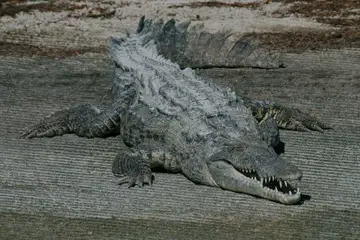
Photo: Dennis Vollmar · CC BY 4.0 · iNaturalist American crocodile
Crocodile: lighter grayish-green skin, narrow tapered triangular snout, fourth lower tooth visible with the mouth closed, and mostly coastal brackish or salt water in south Florida. Alligator: darker, broad rounded snout, mostly fresh water.
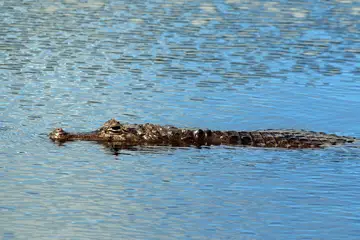
Photo: Charles J. Sharp · CC BY-SA 4.0 · Wikimedia Commons · resized Spectacled caiman
USGS: the common (spectacled) caiman's snout is not as broad and round as the American alligator's, and unlike the alligator it has a unique bony ridge in front of and between the eyes.

What official sources advise
- Never feed an alligator, keep your distance, swim only in designated areas in daylight, keep pets leashed and away from water. FWC
- If you are concerned about an alligator or crocodile, call the FWC Nuisance Alligator Hotline 866-FWC-GATOR (866-392-4286). FWC
- Alligator courtship begins in early April; mating in May or June; nesting late June/early July; hatching mid-August to early September. FWC
Other questions about Florida
Sources
- Living with Alligators. Florida Fish and Wildlife Conservation Commission (FWC). archived copy, captured October 25, 2026; checked November 3, 2026. Archived copy.
Quoted passages (3)
“Alligators have inhabited Florida's marshes, swamps, rivers and lakes for many centuries, and are found in all 67 counties.”
“Remember, never feed an alligator and keep your distance if you see one. Swim only in designated swimming areas during daylight hours. And keep pets on a leash and away from the water.”
“…if you are concerned about an alligator, call FWC’s toll-free Nuisance Alligator Hotline at 866-392-4286.”
- Alligator Facts. Florida Fish and Wildlife Conservation Commission (FWC). archived copy, captured September 1, 2026; checked November 3, 2026. Archived copy.
Quoted passages (1)
“Courtship begins in early April, and mating occurs in May or June.”
- American Crocodile. Florida Fish and Wildlife Conservation Commission (FWC). archived copy, captured September 5, 2026; checked November 3, 2026. Archived copy.
Quoted passages (1)
“American crocodiles live in coastal areas throughout the Caribbean and occur at the northern end of their range in south Florida and the Keys.”