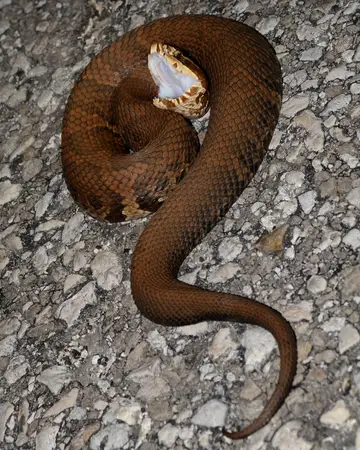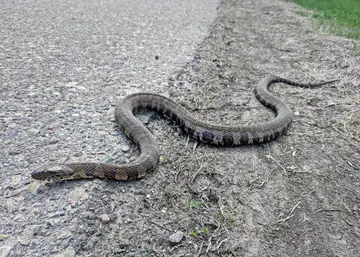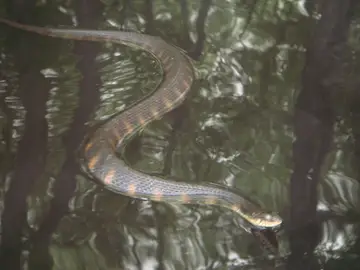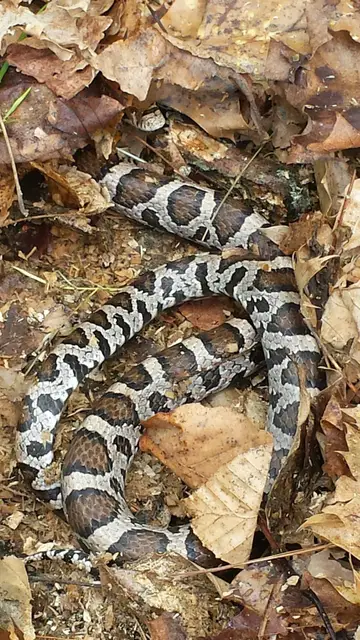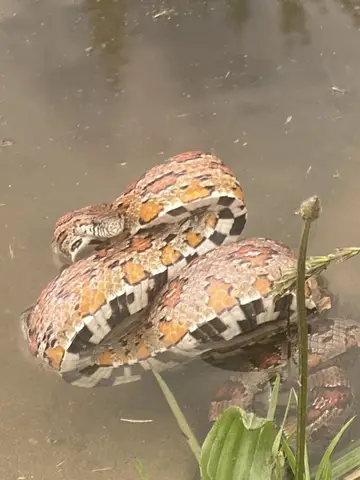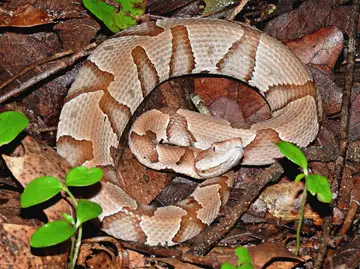
Eastern Copperhead
Agkistrodon contortrix
- Danger to people
- “Copperhead bites are extremely painful but rarely life-threatening for healthy adults and for most large or medium-sized pets.” Florida Museum of Natural History
- Size
- Adults usually about 2 to 3 feet (24-36 in); record about 53 inches.
- How to recognize it
- Vertical (cat-like) pupils and a heat-sensing pit between eye and nostril
- Heavy-bodied; keeled scales
- Head shape alone is not a reliable way to identify copperheads
- Where in Florida
- In Florida, copperheads occur only in the Panhandle, primarily in the western tip and along the Apalachicola River and its tributaries … Florida Museum of Natural History
What the sources say
Venom: “Only six of Florida's 44 snake species are venomous: the eastern coral snake, the southern copperhead, the cottonmouth, the eastern diamondback rattlesnake, the timber rattlesnake, and the dusky pygmy rattlesnake.” (FWC)
Range: In Florida, copperheads occur only in the Panhandle, primarily in the western tip and along the Apalachicola River and its tributaries. The herpetology collection at the Florida Museum contains verified records from Calhoun, Escambia, Gadsden, Jackson, Liberty, Okaloosa, and Santa Rosa counties. The range may extend to other nearby areas, but there are no confirmed records from other Florida counties.
Habitat: The Eastern Copperhead's preferred habitats in Florida are upland pine and hardwood forests with abundant leaf litter and in forests adjacent to low, wet areas boarding swamps, stream beds, river bottoms, and damp ravines. Large logs and piles of debris and rocks are often used as shelters. This species is occasionally found in suburban neighborhoods where development encroaches into favorable habitats. (Florida Museum of Natural History)