States Wildlife

Are there coyotes in Florida?

Last checked November 3, 2026 against official sources.

On this page
  1. The answer
  2. More official answers
  3. Which ones
  4. Where in the US
  5. Lookalikes
  6. Official advice
  7. Sources

Yes.

Coyotes have been documented in all 67 Florida counties.

FWC: “Coyotes are found throughout Florida, having been documented in all 67 Florida counties.” Source

How we answer questions

On Florida's official list

Coyote
Photo: Gaurav Vaidya from Chapel Hill, USA · CC BY 2.0 · Wikimedia Commons

Coyote

Where in Florida
Coyotes are found throughout Florida, having been documented in all 67 Florida counties. FWC
What the sources say

Habitat: This medium-sized canine, a close relative of the domestic dog, is extremely adaptable and can be found in rural, suburban and urban landscapes. (FWC)

All mammals in the state: Florida mammals.

Where the coyote lives in the US

Texas: on the state's official listCalifornia: on the state's official listKentucky: on the state's official listGeorgia: on the state's official list (nonnative)Wisconsin: on the state's official listMissouri: on the state's official listVirginia: on the state's official list (nonnative)Tennessee: on the state's official listLouisiana: on the state's official listNew York: on the state's official listIdaho: on the state's official listFlorida: on an official sourceIllinois: on the state's official listMontana: on the state's official listMinnesota: on the state's official listMaryland: on the state's official listIowa: on the state's official listOhio: on the state's official listNebraska: on the state's official listWashington: on the state's official listSouth Dakota: on the state's official listArkansas: on the state's official listMississippi: on the state's official listColorado: on the state's official listNorth Carolina: on the state's official list (nonnative)Oklahoma: on the state's official listWyoming: on the state's official listWest Virginia: on the state's official listIndiana: on the state's official listMassachusetts: on the state's official listNevada: on the state's official listNorth Dakota: on the state's official listPennsylvania: on the state's official listSouth Carolina: on an official sourceMaine: on the state's official listRhode Island: on the state's official listConnecticut: on the state's official listAlaska: on the state's official listDelaware: on the state's official listNew Mexico: on the state's official listAlabama: on the state's official listKansas: on the state's official listVermont: on the state's official listNew Jersey: on the state's official listNew Hampshire: on the state's official listArizona: on the state's official list
Official presence. 46 states where a state list or official source names it. Gray means no official record in our data, not that it is absent.
  • Native or listed
  • Nonnative or not established
  • No official record in our data
Texas: 1,376 recordsCalifornia: 3,793 recordsKentucky: 52 recordsGeorgia: 46 recordsWisconsin: 105 recordsOregon: 176 recordsMissouri: 97 recordsVirginia: 69 recordsTennessee: 74 recordsLouisiana: 62 recordsNew York: 1,146 recordsIdaho: 182 recordsFlorida: 100 recordsIllinois: 163 recordsMontana: 33 recordsMinnesota: 84 recordsMaryland: 48 recordsIowa: 5 recordsOhio: 231 recordsNebraska: 294 recordsWashington: 221 recordsSouth Dakota: 35 recordsArkansas: 45 recordsMississippi: 33 recordsColorado: 271 recordsNorth Carolina: 108 recordsUtah: 69 recordsOklahoma: 41 recordsWyoming: 294 recordsWest Virginia: 14 recordsIndiana: 52 recordsMassachusetts: 202 recordsNevada: 74 recordsNorth Dakota: 15 recordsPennsylvania: 45 recordsSouth Carolina: 10 recordsMaine: 46 recordsRhode Island: 16 recordsConnecticut: 91 recordsMichigan: 54 recordsAlaska: 91 recordsNew Mexico: 159 recordsAlabama: 45 recordsKansas: 21 recordsVermont: 202 recordsNew Jersey: 13 recordsNew Hampshire: 322 recordsArizona: 459 records
Observation records. Open-licence records on GBIF in 48 states. Records are sightings people shared, not confirmation that a population lives there.
  • 1–9
  • 10–99
  • 100–999
  • 1,000+

Coyote: identification, range and danger

What else it could be

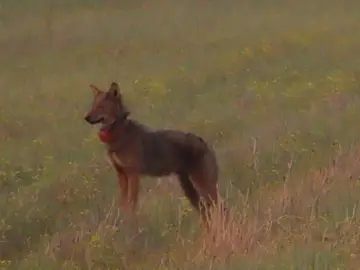
  • Red wolf
    Photo: Katie Gipson · CC BY 4.0 · iNaturalist

    Red wolf

    NCWRC table: red wolf 4 to 5 ft long nose to tail, 40 to 80 lb, wide head, broad muzzle, large feet, ears proportionally smaller than the head; coyote no more than 3 ft, slimmer, 20 to 30 lb on the Albemarle Peninsula, narrow head, long pointed muzzle, smaller feet, ears proportionally larger. NCWRC warns that color and size overlap, so the two can be hard to tell apart in the field. (AZGFD gives coyote length as 3.5 to 4 ft including the tail, so length alone is not reliable.)

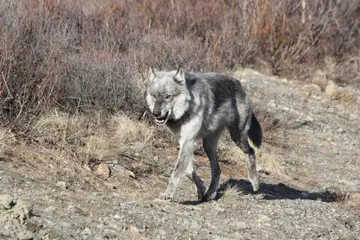
  • Gray wolf
    Photo: Robbie Hannawacker · CC0 1.0 · iNaturalist

    Gray wolf

    NY DEC: gray wolves are much larger (females typically 50-100 lb, males 70-145 lb, 5-6 ft nose to tail, 27-33 in at the shoulder); eastern coyotes rarely exceed 50 lb and generally stand under 2 ft at the shoulder. Wolves have small rounded ears and a short blocky snout; coyotes have larger, more pointed ears (can look rounded in winter coat) and a long, narrow, pointed snout. Coyote tracks are typically 3 x 2 in, wolf tracks about 5 x 4 in. NY DEC says most wolf reports in New York were coyotes, dogs or wolf-dog hybrids.

When mammals are seen in Florida

9,452 records (GBIF, CC0 and CC BY).

What official sources advise

  • Coyotes rarely pose a threat to people; scare them away by yelling, waving arms and making noise. FWC

Other questions about Florida

Sources

  1. Living with Coyotes. Florida Fish and Wildlife Conservation Commission (FWC). archived copy, captured September 15, 2026; checked November 3, 2026. Archived copy.
    Quoted passages (2)
    “Coyotes are found throughout Florida, having been documented in all 67 Florida counties.”
    “Coyotes are not large animals and rarely pose a threat to people, especially adults.”
  2. Terrestrial Mammals (FWRI research). Florida Fish and Wildlife Conservation Commission (FWC). archived copy, captured January 15, 2026; checked November 3, 2026. Archived copy.
    Quoted passages (1)
    “…the subspecies currently lives in seven separated subpopulations throughout Florida”
  3. GBIF.org occurrence records, human observations licensed CC0 1.0 or CC BY 4.0 only, accessed November 3, 2026. The datasets behind these counts are listed on our Sources page.