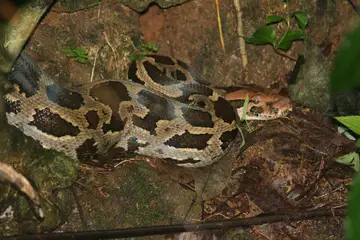
Burmese pythons are established in the southern Florida peninsula.
Florida Museum of Natural History: “However, they are currently known to be established only in the southern Florida peninsula from Lake Okeechobee south to Key Largo and Florida Bay.” Source
“However, larger Burmese Pythons have large, sharp teeth, and their bites can cause severe lacerations.” Florida Museum of Natural History
Where in Florida
Burmese Pythons are a non-native species from southern and southeastern Asia that have been established in Florida since the 1980s … Florida Museum of Natural History
Conservation
Regulated Species (restrictions on collection or possession)
What the sources say
Venom: “Non-venomous. Burmese Pythons may bite to defend themselves. Small individuals are not generally dangerous to people or pets.” (Florida Museum of Natural History)
Range: Burmese Pythons are a non-native species from southern and southeastern Asia that have been established in Florida since the 1980s. They have been introduced in numerous areas in Florida. However, they are currently known to be established only in the southern Florida peninsula from Lake Okeechobee south to Key Largo and Florida Bay. The Everglades National Park remains a stronghold for this species.
Habitat: In Florida, Burmese Pythons have been found in and around undeveloped seasonally flooded wetlands (e.g., the Florida Everglades), tree islands, hardwood hammocks, prairies, mangrove salt marshes, melaleuca and Brazilian pepper stands, agricultural areas, man-made canals and lakes, and housing developments. (Florida Museum of Natural History)
“However, larger African Rock Pythons have large, sharp teeth, and their bites can cause severe lacerations.” Florida Museum of Natural History
Where in Florida
African Rock Pythons are a non-native species from sub-Saharan Africa that have likely been established in Florida since the early 2000s … Florida Museum of Natural History
Conservation
Regulated Species (restrictions on collection or possession)
What the sources say
Venom: “Non-venomous African Rock Pythons typically bite to defend themselves. Small individuals are not generally dangerous to people or pets.” (Florida Museum of Natural History)
Range: African Rock Pythons are a non-native species from sub-Saharan Africa that have likely been established in Florida since the early 2000s. They have been found in Sarasota and Miami-Dade counties. However, they are currently known to be established only in a small localized area on the southeastern side of US 41 (Tamiami Trail) and SR 997 (Krome Avenue) in Miami, Miami-Dade County.
Habitat: In Florida, African Rock Pythons have been found in and around sawgrass prairies, melaleuca stands, agricultural areas, man-made canals and lakes, and housing developments. (Florida Museum of Natural History)
USGS: the Northern African python's back pattern is less vivid/defined and its belly scales are patterned black and white, while the Burmese python's belly scales are white. Florida Museum: Northern African rock pythons have two mostly continuous, irregular dark blotches down the back bordered by black and white. Caution: Florida Museum also says the Burmese belly has dark spots along the sides, so belly colour alone is not a clean test.
“Non-venomous African Rock Pythons typically bite to defend themselves. Small individuals are not generally dangerous to people or pets.”
“However, larger African Rock Pythons have large, sharp teeth, and their bites can cause severe lacerations.”
Living with Snakes. Florida Fish and Wildlife Conservation Commission (FWC). archived copy, captured June 16, 2026; checked November 3, 2026.Archived copy. Quoted passages (1)
“Only six of Florida's 44 snake species are venomous: the eastern coral snake, the southern copperhead, the cottonmouth, the eastern diamondback rattlesnake, the timber rattlesnake, and the dusky pygmy rattlesnake.”