States Wildlife

Are there cottonmouths (water moccasins) in Illinois?

Last checked November 3, 2026 against official sources.

On this page
  1. The answer
  2. More official answers
  3. Which ones
  4. Where in the US
  5. Lookalikes
  6. Sources

Yes.

IDNR: cottonmouths live in swamps and wet bottomlands in southern Illinois, south of Route 13.

IDNR: “Cottonmouths live in swamps and wet bottomlands in southern Illinois, south of Route 13.” Source

How we answer questions

  • Are there rattlesnakes in Illinois?

    Yes. IDNR lists the timber rattlesnake (state threatened) and eastern massasauga (state endangered, federally threatened) among the four venomous snakes. IDNR

On Illinois's official list

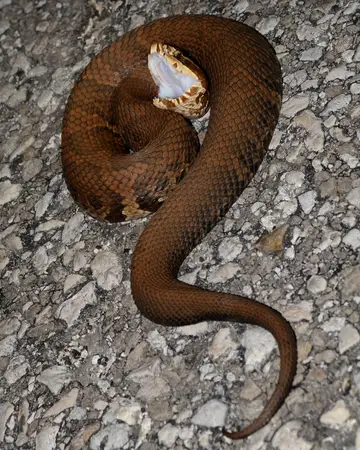
Northern Cottonmouth
Photo: Geoff Gallice from Gainesville · CC BY 2.0 · Wikimedia Commons

Northern Cottonmouth

Agkistrodon piscivorus

Venomous per IDNR

Danger to people
“While venomous snakes are not aggressive and tend to bite people only when stepped on, picked up, or cornered, their bite is a serious matter.” IDNR
Size
Typically 30 to 48 inches (about 3 to 4 feet); recorded up to 75 inches.
How to recognize it
  • Heat-sensing pit between nostril and eye; no rattle
  • Head much wider than the neck, with a dark bar from the eye to the jaw; vertical (cat-eye) pupils
  • Gapes to show the white lining of its mouth when threatened
Where in Illinois
Cottonmouths live in swamps and wet bottomlands in southern Illinois, south of Route 13. IDNR
251 records by month.
What the sources say

Venom: “Four species of Ililnois snakes, the eastern copperhead (Agkistrodon contortrix), the northern cottonmouth (Agkistrodon piscivorus), the timber rattlesnake (Crotalus horridus) and the eastern massasauga (Sistrurus catenatus) are venomous.” (IDNR)

Habitat: Cypress-tupelo swamps, sloughs, and oxbow lakes of extreme southern counties. (Illinois Natural History Survey (INHS), Prairie Research Institute, University of Illinois Urbana-Champaign)

Full Northern Cottonmouth guide

All snakes in the state: Illinois snakes.

Where the cottonmouth lives in the US

Texas: on the state's official listKentucky: on the state's official listGeorgia: on the state's official listMissouri: on the state's official listVirginia: on the state's official listTennessee: on the state's official listLouisiana: on the state's official listFlorida: on an official sourceIllinois: on the state's official listArkansas: on the state's official listMississippi: on the state's official listNorth Carolina: on the state's official listOklahoma: on the state's official listIndiana: on the state's official listSouth Carolina: on the state's official listAlabama: on the state's official listKansas: on the state's official list
Official presence. 17 states where a state list or official source names it. Gray means no official record in our data, not that it is absent.
  • Native or listed
  • Nonnative or not established
  • No official record in our data
Texas: 534 recordsKentucky: 10 recordsGeorgia: 46 recordsMissouri: 65 recordsVirginia: 45 recordsTennessee: 127 recordsLouisiana: 218 recordsFlorida: 16 recordsIllinois: 251 recordsArkansas: 80 recordsMississippi: 88 recordsNorth Carolina: 105 recordsOklahoma: 19 recordsSouth Carolina: 60 recordsAlabama: 90 records
Observation records. Open-licence records on GBIF in 15 states. Records are sightings people shared, not confirmation that a population lives there.
  • 1–9
  • 10–99
  • 100–999
  • 1,000+

Cottonmouth: identification, range and danger

What else it could be

  • Watersnakes

    Seen from directly above, a watersnake's eyes are visible but a cottonmouth's are not. Watersnakes have round pupils and no facial pit, and they usually have thin dark vertical lines on the lips.

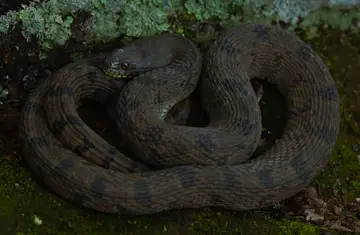
  • Diamond-backed Watersnake
    Photo: Peter Paplanus from St. Louis, Missouri · CC BY 2.0 · Wikimedia Commons

    Diamond-backed Watersnake

    Alabama DCNR says this snake is often confused with the cottonmouth. TWRA: the diamond-backed watersnake is lighter, with a chain-like pattern; watersnakes in general lack the cottonmouth's facial pits (see the watersnake entry above).

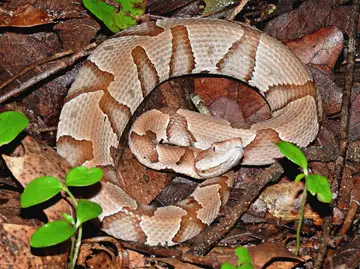
  • Copperhead
    Photo: USFWSmidwest · Public domain · Wikimedia Commons

    Copperhead

    On young cottonmouths the dark crossbands have many dark spots and speckles; copperhead bands have none or one. Adult copperheads keep the banded pattern, while adult cottonmouths are usually plain and dark. A cottonmouth's eye is hidden in a dark facial band; a copperhead's is not.

When snakes are seen in Illinois

1,529 records (GBIF, CC0 and CC BY).

Other questions about Illinois

Sources

  1. Wild About Illinois Snakes! (species gallery by family). Illinois Department of Natural Resources (IDNR). undated page; checked November 3, 2026.
    Quoted passages (3)
    “Cottonmouths live in swamps and wet bottomlands in southern Illinois, south of Route 13.”
    “Four species of Ililnois snakes, the eastern copperhead (Agkistrodon contortrix), the northern cottonmouth (Agkistrodon piscivorus), the timber rattlesnake (Crotalus horridus) and the eastern massasauga (Sistrurus catenatus) are venomous.”
    “While venomous snakes are not aggressive and tend to bite people only when stepped on, picked up, or cornered, their bite is a serious matter.”
  2. Northern Cottonmouth (Field Guide to Amphibians and Reptiles of Illinois). Illinois Natural History Survey (INHS), Prairie Research Institute, University of Illinois Urbana-Champaign. undated page; checked November 3, 2026.
  3. GBIF.org occurrence records, human observations licensed CC0 1.0 or CC BY 4.0 only, accessed November 3, 2026. The datasets behind these counts are listed on our Sources page.