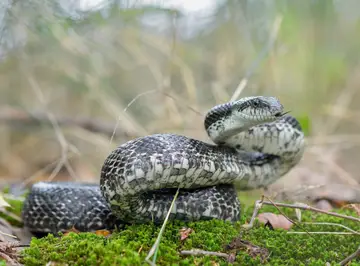
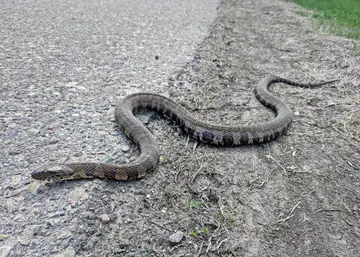
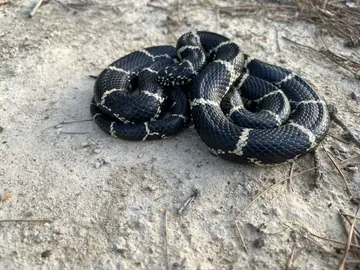
Illinois has 4 venomous snakes named by official sources: Eastern Copperhead, Northern Cottonmouth, Timber Rattlesnake and Eastern Massasauga. Each one is labelled venomous by IDNR.
The 4 venomous snakes of Illinois
Recognize them from a distance; a photo cannot confirm that a snake is safe. Identifying animals safely.
“While venomous snakes are not aggressive and tend to bite people only when stepped on, picked up, or cornered, their bite is a serious matter.” IDNR
Size
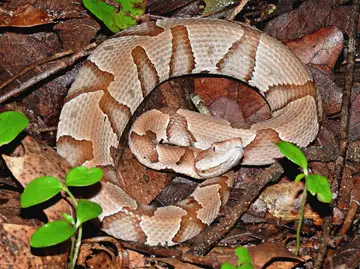
Adults usually about 2 to 3 feet (24-36 in); record about 53 inches.
How to recognize it
Vertical (cat-like) pupils and a heat-sensing pit between eye and nostril
Heavy-bodied; keeled scales
Head shape alone is not a reliable way to identify copperheads
Where in Illinois
Copperheads occur in the southern one-third of Illinois, south of Route 16 and in the lower Illinois River valley … IDNR
JFMAMJJASOND
31 records by month.What the sources say
Venom: “Four species of Ililnois snakes, the eastern copperhead (Agkistrodon contortrix), the northern cottonmouth (Agkistrodon piscivorus), the timber rattlesnake (Crotalus horridus) and the eastern massasauga (Sistrurus catenatus) are venomous.” (IDNR)
Range: Copperheads occur in the southern one-third of Illinois, south of Route 16 and in the lower Illinois River valley. They prefer upland forests or river bluffs with limestone or sandstone outcroppings.
Habitat: Wooded, rocky hillsides and forest edges, sometimes in meadows and fields during summer. (Illinois Natural History Survey (INHS), Prairie Research Institute, University of Illinois Urbana-Champaign)
Venom: “Four species of Ililnois snakes, the eastern copperhead (Agkistrodon contortrix), the northern cottonmouth (Agkistrodon piscivorus), the timber rattlesnake (Crotalus horridus) and the eastern massasauga (Sistrurus catenatus) are venomous.” (IDNR)
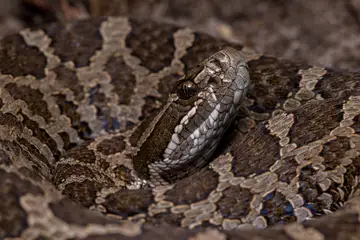
Range: Massasaugas live in scattered locations within the counties of Madison, Clinton, Piatt, Knox, Warren, Will, Cook and Lake. Their habitats are prairie wetlands and river floodplains.
Habitat: Old fields, floodplain forests, marshlands, and bogs. (Illinois Natural History Survey (INHS), Prairie Research Institute, University of Illinois Urbana-Champaign)
“While venomous snakes are not aggressive and tend to bite people only when stepped on, picked up, or cornered, their bite is a serious matter.” IDNR
Size
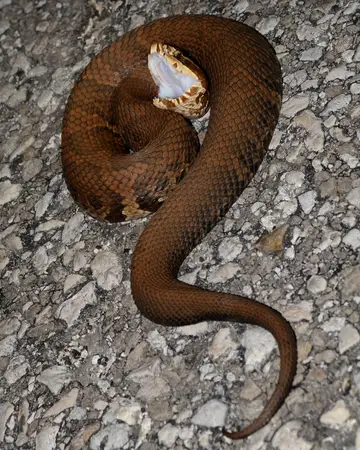
Typically 30 to 48 inches (about 3 to 4 feet); recorded up to 75 inches.
How to recognize it
Heat-sensing pit between nostril and eye; no rattle
Head much wider than the neck, with a dark bar from the eye to the jaw; vertical (cat-eye) pupils
Gapes to show the white lining of its mouth when threatened
Where in Illinois
Cottonmouths live in swamps and wet bottomlands in southern Illinois, south of Route 13. IDNR
JFMAMJJASOND
251 records by month.What the sources say
Venom: “Four species of Ililnois snakes, the eastern copperhead (Agkistrodon contortrix), the northern cottonmouth (Agkistrodon piscivorus), the timber rattlesnake (Crotalus horridus) and the eastern massasauga (Sistrurus catenatus) are venomous.” (IDNR)
Habitat: Cypress-tupelo swamps, sloughs, and oxbow lakes of extreme southern counties. (Illinois Natural History Survey (INHS), Prairie Research Institute, University of Illinois Urbana-Champaign)
“While venomous snakes are not aggressive and tend to bite people only when stepped on, picked up, or cornered, their bite is a serious matter.” IDNR
Size
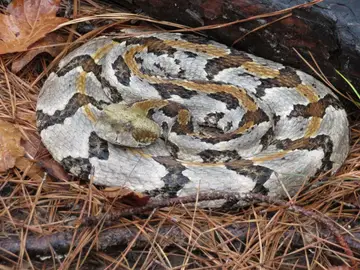
Most adults 36 to 60 inches (3 to 5 feet); record 74.5 inches.
How to recognize it
Black tail ending in a rattle
Heat-sensing pit between nostril and eye
Large, thick head distinct from the neck; cat-like vertical pupil
Where in Illinois
Timber rattlesnakes may be found in the southern one-fourth of the state (south of Interstate 64), in the lower Illinois River valley, in the Mississippi River valley … IDNR
Venom: “Four species of Ililnois snakes, the eastern copperhead (Agkistrodon contortrix), the northern cottonmouth (Agkistrodon piscivorus), the timber rattlesnake (Crotalus horridus) and the eastern massasauga (Sistrurus catenatus) are venomous.” (IDNR)
Range: Timber rattlesnakes may be found in the southern one-fourth of the state (south of Interstate 64), in the lower Illinois River valley, in the Mississippi River valley and in a few other locations. These snakes prefer heavy timber with rock outcrops and bluffs.
Habitat: Heavy forest along rocky outcrops and bluffs. (Illinois Natural History Survey (INHS), Prairie Research Institute, University of Illinois Urbana-Champaign)
See all 40 snakes, venomous and not, on Illinois snakes. IDNR gives Illinois 39 snake species in all; that page lists the 40 that official sources name one by one.
Snakes people confuse
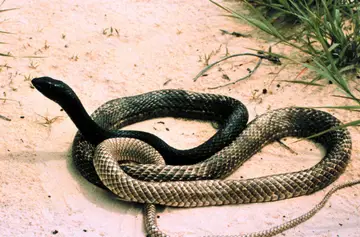
Black Racer or Cottonmouth?
Photo: Everglades NPS from Homestead, Florida, United States · Public domain · Wikimedia Commons
NPS says black racers can resemble the venomous water moccasin and advises leaving alone any snake you cannot identify. It gives no safe field mark, and none is offered here.
Black Racer or Timber rattlesnake?
Photo: Everglades NPS from Homestead, Florida, United States · Public domain · Wikimedia Commons
Report mountain lion, black bear, gray wolf, feral swine, armadillo (north-central/northern counties) and nutria sightings to IDNR through Wildlife Illinois (wildlifeillinois.org/report-sightings/). Report spotted lanternfly with photos to [email protected]. Wildlife Illinois, website authorized by IDNR
“Family: Colubridae - … All of the colubrid snakes in Illinois lay eggs and are harmless to humans.”
“Four species of Ililnois snakes, the eastern copperhead (Agkistrodon contortrix), the northern cottonmouth (Agkistrodon piscivorus), the timber rattlesnake (Crotalus horridus) and the eastern massasauga (Sistrurus catenatus) are venomous.”
“While venomous snakes are not aggressive and tend to bite people only when stepped on, picked up, or cornered, their bite is a serious matter.”
“Family: Dipsadidae - The members of this family are generally small snakes that have teeth in the back of the jaw that are used to transfer venom into their prey. They lay eggs and are harmless to humans.”
“Family: Natricidae - … They are harmless to humans.”
“These snakes should be avoided and precautions taken (wear leather boots, do not reach under rocks or logs, do not step over rocks or logs, look around before you sit) if you are entering an area possibly inhabited by venomous snakes.”
“Illinois snake species hibernate during the cold winter months, becoming active in spring as temperatures and day length increase. … They are generally active during the day, but they can become nocturnal when summer temperatures rise.”
“The timber rattlesnake, Crotalus horridus, has dorsal blotches that are usually uniform in width across the back (not wider at the edges, or ‘bow tie’ shaped as in the Eastern Massasauga) and very narrow, sometimes approaching a chevron.”
“The fox snake, Pantherophis vulpinus, has rounder dorsal blotches (again, not ‘bow tie’ shaped) and only one row of smaller blotches on each side.”
“Of the 40 snakes in Illinois, only four venomous snakes are native to the state:”
“IPC is here to help. Calls to our helpline, 1-800-222-1222, are free and confidential. … Call 911 if someone is unconscious or is having difficulty breathing.”
“Do not attempt to move a snake, even if you think it’s dead.”
“Key Characters: Tail scales patterned like a braided whip; back scales smooth; anal plate divided. Similar Species: North American Racer, Gray Ratsnake.”
“If you have recently seen a mountain lion, black bear, or gray wolf in Illinois, please report the sighting below to the Illinois Department of Natural Resources.”