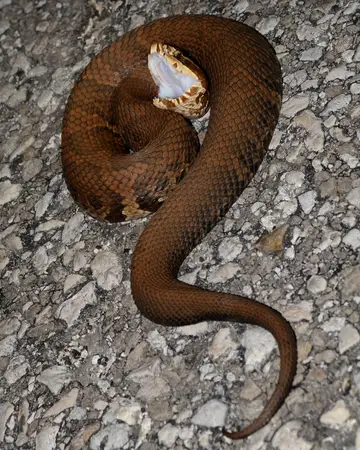
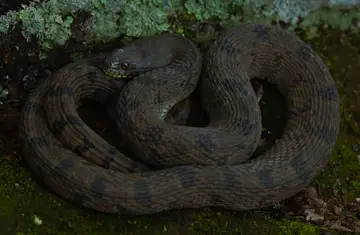
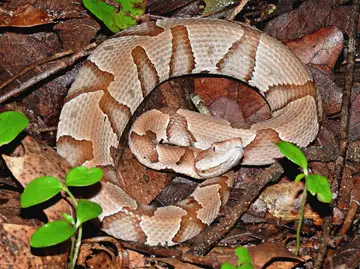
KHA: the only credible Kansas records are from the Spring River drainage in extreme southeastern Kansas. GPNC warns that watersnakes are often mistaken for cottonmouths.
Kansas Herpetofaunal Atlas (Travis W. Taggart), Sternberg Museum of Natural History, Fort Hays State University: “The only credible records of this species in Kansas are from the Spring River drainage in extreme southeastern Kansas.” Source
Venom: “DANGEROUSLY VENOMOUS (a threat to life or limb)” (Kansas Herpetofaunal Atlas (Travis W. Taggart), Sternberg Museum of Natural History, Fort Hays State University)
Range: The only credible records of this species in Kansas are from the Spring River drainage in extreme southeastern Kansas. The Spring River roughly defines the boundary of the Ozark Plateau in Kansas.
Seen from directly above, a watersnake's eyes are visible but a cottonmouth's are not. Watersnakes have round pupils and no facial pit, and they usually have thin dark vertical lines on the lips.
Alabama DCNR says this snake is often confused with the cottonmouth. TWRA: the diamond-backed watersnake is lighter, with a chain-like pattern; watersnakes in general lack the cottonmouth's facial pits (see the watersnake entry above).
On young cottonmouths the dark crossbands have many dark spots and speckles; copperhead bands have none or one. Adult copperheads keep the banded pattern, while adult cottonmouths are usually plain and dark. A cottonmouth's eye is hidden in a dark facial band; a copperhead's is not.
When snakes are seen in Kansas
JanFebMarAprMayJunJulAugSepOctNovDec
1,419 records (GBIF, CC0 and CC BY).
If you see one in Kansas
Keep your distance and do not try to catch or handle it. Report mountain lion, bear or wolf sightings and threatened, endangered, SINC or rare species to KDWP (Wildlife Sightings page; Pratt Operations Office, 512 SE 25th Avenue, Pratt, KS 67124, 620-672-5911). Nuisance wildlife: KDWP lists Nuisance Wildlife Damage Control permit holders. Kansas Department of Wildlife and Parks
KHA species account: Northern Cottonmouth. Kansas Herpetofaunal Atlas (Travis W. Taggart), Sternberg Museum of Natural History, Fort Hays State University. updated February 19, 2026; checked November 3, 2026.Quoted passages (2)
“The only credible records of this species in Kansas are from the Spring River drainage in extreme southeastern Kansas.”
A Pocket Guide to Kansas Snakes, Sixth Edition (Collins, Collins & Taggart). Great Plains Nature Center (cooperative project of the U.S. Fish and Wildlife Service, Kansas Department of Wildlife and Parks and City of Wichita); published by the Friends of the Great Plains Nature Center. Sixth Edition; checked November 3, 2026.Quoted passages (1)
“For example, watersnakes are frequently mistaken for Northern Cottonmouths.”
KHA species account: Western Diamond-backed Rattlesnake. Kansas Herpetofaunal Atlas (Travis W. Taggart), Sternberg Museum of Natural History, Fort Hays State University. updated February 19, 2026; checked November 3, 2026.Quoted passages (1)
“The only known extant 'population' of these large serpents was introduced in the vicinity of Kanopolis State Park in Ellsworth County, where they have been found regularly since 1993.”
Wildlife Sightings (KDWP). Kansas Department of Wildlife and Parks. undated page; checked November 3, 2026.Quoted passages (1)
“If you observe a threatened or endangered species, a species in need of conservation, or a rare species in a new location, please report it to KDWP.”