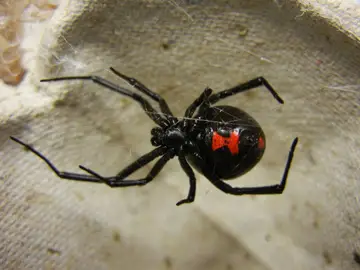
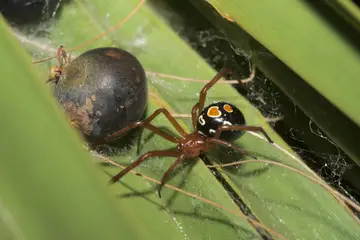
DEC's brochure calls the black widow venomous and extremely rare in New York.
NYSDEC, text by Cornell University Department of Entomology, reprinted from New York State Conservationist: “The venomous black widow spider with its shiny, black abdomen and red hour-glass design is a cobweb spider, but is extremely rare in New York.” Source
Venom: “The venomous black widow spider with its shiny, black abdomen and red hour-glass design is a cobweb spider, but is extremely rare in New York.” (NYSDEC, text by Cornell University Department of Entomology, reprinted from New York State Conservationist)
Official presence. 15 states where a state list or official source names it. Gray means no official record in our data, not that it is absent.
Native or listed
Nonnative or not established
No official record in our data
Observation records. Open-licence records on GBIF for the three US black widows (Latrodectus mactans, L. variolus and L. hesperus) in 44 states. Records are sightings people shared, not confirmation that a population lives there.
Chocolate brown and never has red on the belly; slightly smaller than a mature western black widow (about 3/8 in body length); egg sac looks like a cotton ball with indistinct margins. Caution: UC IPM says a black widow's hourglass can be almost imperceptible or, rarely, completely absent, so a lack of red alone does not rule out a black widow.
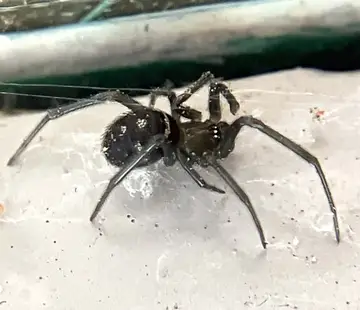
No red hourglass and not pure black; looks purplish-brown in bright light, and larger ones have a light T-shaped mark on the abdomen. Caution: a black widow's hourglass can rarely be almost or completely absent (UC IPM), so a lack of red alone does not rule out a black widow.
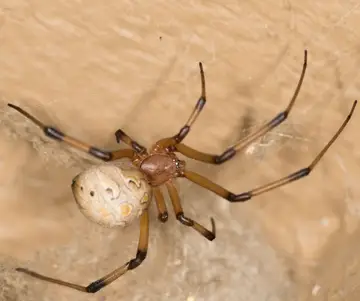
Usually a mottled mix of tan, brown and gray, with a lengthwise stripe and diagonal side stripes; colour varies from almost white to almost black, and very dark ones are flat black rather than shiny black. Mature females are smaller than mature female western black widows (about 3/8 in body length). The egg sac is covered in silk bumps, like a very large pollen grain; UC IPM calls the egg sac a much surer way to confirm a brown widow. Caution: brown widows also have a red hourglass on the underside (UF/IFAS), and a mature brown widow looks very similar to an immature western black widow (UC IPM).
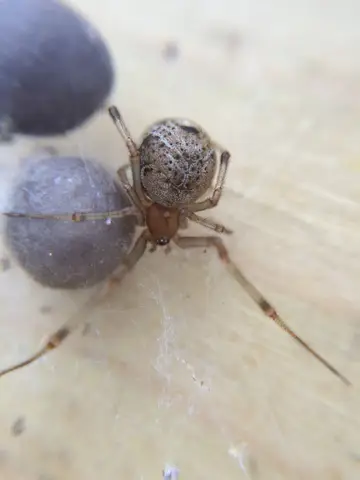
Penn State Extension: the female common house spider is 5 to 6 mm long with a yellowish-brown carapace and a dirty-white to brown abdomen with gray chevrons; its legs are yellow with darker rings at the end of each segment.
Common spiders brochure (11 species and groups). NYSDEC, text by Cornell University Department of Entomology, reprinted from New York State Conservationist. June 2007; checked November 3, 2026.Quoted passages (2)
“The venomous black widow spider with its shiny, black abdomen and red hour-glass design is a cobweb spider, but is extremely rare in New York.”
“In New York, bites attributed to brown recluse spiders are almost certainly from yellow sac spiders.”
Spider FAQs One Two Three. New York State Integrated Pest Management, Cornell University. March 10, 2016; checked November 3, 2026.Quoted passages (1)
“Only one species that could make us really sick lives in the Northeast: the black widow spider, and it’s rare in New York.”
Timber Rattlesnake. NYSDEC. archived copy, captured October 15, 2026; checked November 3, 2026.Quoted passages (1)
“To report sighting, or ask questions, contact your Regional Wildlife Office”