On this page The answer More official answers Which ones Where in the US Lookalikes Official advice Sources Yes.
DEC says the eastern coyote is firmly established.
NYSDEC: “The Eastern coyote is firmly established in New York.” Source
How we answer questions
Are there bears in New York? Yes. DEC estimates a minimum of 6,000-8,000 black bears in areas open to hunting, with 50-60% in the Adirondack region. NYSDEC
No. DEC lists the eastern cougar's New York status as extirpated. The checklist puts cougar under rarely encountered species. NYSDEC
Are there moose in New York? Yes. DEC biologists estimated roughly 600-700 moose in the Adirondack Region as of 2018. NYSDEC
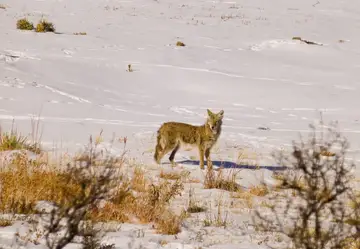
On New York's official list Photo: Gaurav Vaidya from Chapel Hill, USA · CC BY 2.0 · Wikimedia Commons Canis latrans
Size About 3.5 to 4 feet long including the tail and roughly 2 feet tall at the shoulder; weight varies by region: Arizona 20 to 30 lb, Florida average about 28 lb, Georgia 25 to 45 lb How to recognize it Large pointed ears, long narrow nose, bushy black-tipped tail Like a slender medium-sized dog, much smaller than a wolf Paw track about 2 inches long (Florida)
J F M A M J J A S O N D
1,146 records by month. Full Coyote guide
All mammals in the state: New York mammals .
Where the coyote lives in the US Texas: on the state's official list California: on the state's official list Kentucky: on the state's official list Georgia: on the state's official list (nonnative) Wisconsin: on the state's official list Missouri: on the state's official list Virginia: on the state's official list (nonnative) Tennessee: on the state's official list Louisiana: on the state's official list New York: on the state's official list Idaho: on the state's official list Florida: on an official source Illinois: on the state's official list Montana: on the state's official list Minnesota: on the state's official list Maryland: on the state's official list Iowa: on the state's official list Ohio: on the state's official list Nebraska: on the state's official list Washington: on the state's official list South Dakota: on the state's official list Arkansas: on the state's official list Mississippi: on the state's official list Colorado: on the state's official list North Carolina: on the state's official list (nonnative) Oklahoma: on the state's official list Wyoming: on the state's official list West Virginia: on the state's official list Indiana: on the state's official list Massachusetts: on the state's official list Nevada: on the state's official list North Dakota: on the state's official list Pennsylvania: on the state's official list South Carolina: on an official source Maine: on the state's official list Rhode Island: on the state's official list Connecticut: on the state's official list Alaska: on the state's official list Delaware: on the state's official list New Mexico: on the state's official list Alabama: on the state's official list Kansas: on the state's official list Vermont: on the state's official list New Jersey: on the state's official list New Hampshire: on the state's official list Arizona: on the state's official list Official presence. 46 states where a state list or official source names it. Gray means no official record in our data, not that it is absent.
Texas: 1,376 records California: 3,793 records Kentucky: 52 records Georgia: 46 records Wisconsin: 105 records Oregon: 176 records Missouri: 97 records Virginia: 69 records Tennessee: 74 records Louisiana: 62 records New York: 1,146 records Idaho: 182 records Florida: 100 records Illinois: 163 records Montana: 33 records Minnesota: 84 records Maryland: 48 records Iowa: 5 records Ohio: 231 records Nebraska: 294 records Washington: 221 records South Dakota: 35 records Arkansas: 45 records Mississippi: 33 records Colorado: 271 records North Carolina: 108 records Utah: 69 records Oklahoma: 41 records Wyoming: 294 records West Virginia: 14 records Indiana: 52 records Massachusetts: 202 records Nevada: 74 records North Dakota: 15 records Pennsylvania: 45 records South Carolina: 10 records Maine: 46 records Rhode Island: 16 records Connecticut: 91 records Michigan: 54 records Alaska: 91 records New Mexico: 159 records Alabama: 45 records Kansas: 21 records Vermont: 202 records New Jersey: 13 records New Hampshire: 322 records Arizona: 459 records Observation records. Open-licence records on GBIF in 48 states. Records are sightings people shared, not confirmation that a population lives there.
Coyote: identification, range and danger
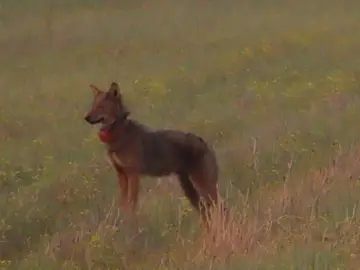
What else it could be Photo: Katie Gipson · CC BY 4.0 · iNaturalist NCWRC table: red wolf 4 to 5 ft long nose to tail, 40 to 80 lb, wide head, broad muzzle, large feet, ears proportionally smaller than the head; coyote no more than 3 ft, slimmer, 20 to 30 lb on the Albemarle Peninsula, narrow head, long pointed muzzle, smaller feet, ears proportionally larger. NCWRC warns that color and size overlap, so the two can be hard to tell apart in the field. (AZGFD gives coyote length as 3.5 to 4 ft including the tail, so length alone is not reliable.)
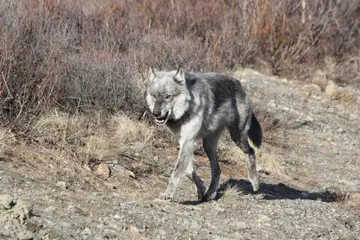
Photo: Robbie Hannawacker · CC0 1.0 · iNaturalist NY DEC: gray wolves are much larger (females typically 50-100 lb, males 70-145 lb, 5-6 ft nose to tail, 27-33 in at the shoulder); eastern coyotes rarely exceed 50 lb and generally stand under 2 ft at the shoulder. Wolves have small rounded ears and a short blocky snout; coyotes have larger, more pointed ears (can look rounded in winter coat) and a long, narrow, pointed snout. Coyote tracks are typically 3 x 2 in, wolf tracks about 5 x 4 in. NY DEC says most wolf reports in New York were coyotes, dogs or wolf-dog hybrids.
When mammals are seen in New York
Jan Feb Mar Apr May Jun Jul Aug Sep Oct Nov Dec
25,019 records (GBIF, CC0 and CC BY). What official sources advise Do not approach a coyote or let children or pets approach one. NYSDEC Other questions about New York Sources Coyote Conflicts . NYSDEC. archived copy, captured August 31, 2026; checked November 3, 2026. Quoted passages (2) “The Eastern coyote is firmly established in New York.” “Do not approach a coyote or let children or pets approach a coyote.” Checklist of Amphibians, Reptiles, Birds and Mammals of New York State, Including Their Legal Status (Tenth revision, February 2019) . NYSDEC Division of Fish and Wildlife. February 2019; checked November 3, 2026. Black Bear . NYSDEC. archived copy, captured July 11, 2026; checked November 3, 2026. Quoted passages (1) “Currently estimated at a minimum of 6,000-8,000 bears in areas open to hunting” Eastern Cougar . NYSDEC. archived copy, captured June 11, 2026; checked November 3, 2026. Moose . NYSDEC. archived copy, captured June 16, 2026; checked November 3, 2026. Quoted passages (1) “DEC biologists estimated that there are roughly 600-700 moose in the Adirondack Region as of 2018” GBIF.org occurrence records, human observations licensed CC0 1.0 or CC BY 4.0 only, accessed November 3, 2026. The datasets behind these counts are listed on our Sources page.