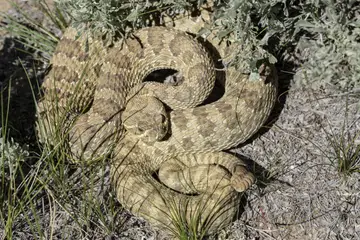
Usually about 3 to 4 feet; Montana gives 15 to 60 inches and NPS says up to 5 feet. Arizona gives a maximum of 28 to 64 inches (excluding rattle) depending on subspecies; in Colorado it is rarely over 39 inches.
How to recognize it
Rattle (or a button in newborns) at the tail tip
Head much broader than the neck, many small scales on top of the head, heat-sensing pit between eye and nostril
Vertical (cat-like) pupils
Where in North Dakota
They are primarily found in southwestern North Dakota, but have been observed in counties bordering the Missouri River on the east. North Dakota Game and Fish Department
What the sources say
Venom: “These are North Dakota’s only venomous snakes.” (North Dakota Game and Fish Department)
Habitat: Rattlesnakes are found in grasslands and sagebrush areas, as wells as high rocky ledges of buttes. (North Dakota Game and Fish Department)
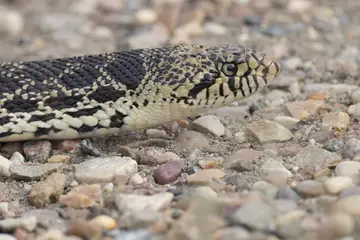
The bullsnake has no rattle, an oval or rounded head and large round pupils; the prairie rattlesnake has a triangular head, slit pupils and a rattle. Bullsnakes are often mistaken for rattlesnakes: when threatened they may coil, flatten the head, hiss and vibrate the tail in dry leaves to sound like a rattle, so do not judge by behavior or by head shape alone.
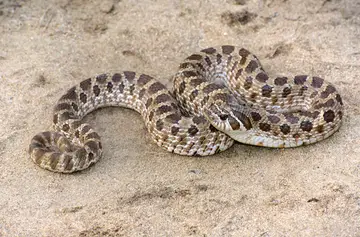
The Montana Field Guide names the western hog-nosed snake as a lookalike and says that in Montana no other snake has rattles: a hognose has no rattle.
Photos show typical adults; individuals vary. Never get close to compare.
When venomous snakes are active in North Dakota
Records of snakes in North Dakota peak in May to July. They show when people record snakes, not how many there are (about month bars).
JanFebMarAprMayJunJulAugSepOctNovDec
63 records of snakes in North Dakota by month (GBIF, CC0 and CC BY records).
Prairie rattlesnakes hunt by day in early spring and late fall, shelter from summer heat and ambush prey in the evening; they hibernate together in winter. North Dakota Game and Fish Department
North Dakota Game and Fish Department: 701-328-6300 (general), Report All Poachers 701-328-9921, online observation and ANS report forms (gf.nd.gov/ans/report). Report any amphibian or reptile not in the NDGF guide (including released pets or bullfrogs) to NDGF. Unusual ticks: submit a picture to ND HHS via its tickborne page. North Dakota Game and Fish Department