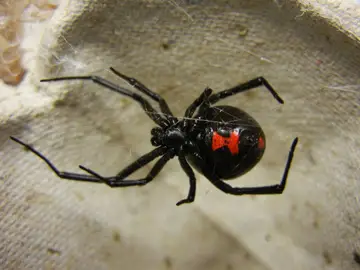
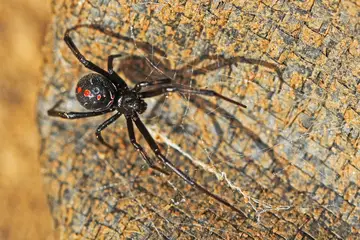
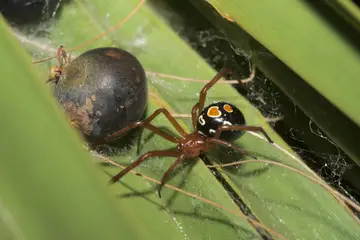
Penn State Extension says the southern black widow is found in Pennsylvania and the northern black widow is probably present too. Both are rarely encountered.
Penn State Extension: “The southern black widow, L. mactans, is found in Pennsylvania. It is probable that the northern black widow, L. variolus, is also present.” Source
Rarely. Penn State says Pennsylvania is outside the brown recluse native range. Any found are inside buildings, brought in by people, and extremely rare. Penn State Extension
“Two of the more medically important types are the black widow spiders, and the brown recluse spider and its relatives. These two types of spiders are rarely encountered in Pennsylvania.” Penn State Extension
What the sources say
Venom: “Black widow venom is principally neurotoxic, so at first a bite is almost painless.” (Penn State Extension)
Habitat: Black widows can be found under stones, in stumps or woodpiles, in vacant rodent holes, in the dark corners of barns and garages, and in outdoor privies and other undisturbed cavities. (Penn State Extension)
Official presence. 15 states where a state list or official source names it. Gray means no official record in our data, not that it is absent.
Native or listed
Nonnative or not established
No official record in our data
Observation records. Open-licence records on GBIF for the three US black widows (Latrodectus mactans, L. variolus and L. hesperus) in 44 states. Records are sightings people shared, not confirmation that a population lives there.
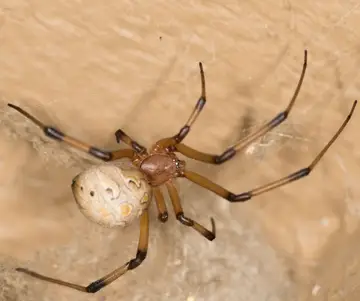
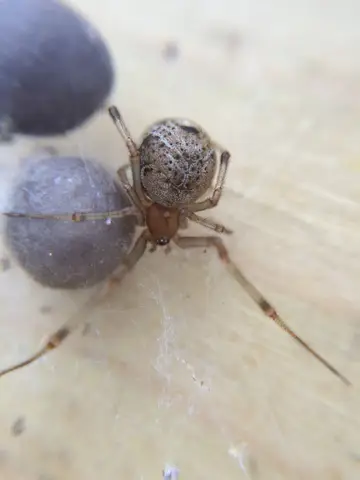
Chocolate brown and never has red on the belly; slightly smaller than a mature western black widow (about 3/8 in body length); egg sac looks like a cotton ball with indistinct margins. Caution: UC IPM says a black widow's hourglass can be almost imperceptible or, rarely, completely absent, so a lack of red alone does not rule out a black widow.
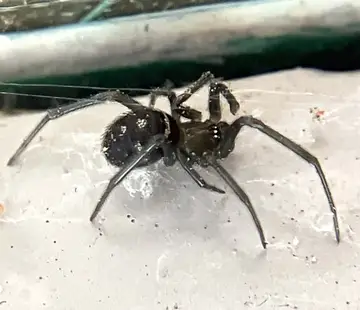
No red hourglass and not pure black; looks purplish-brown in bright light, and larger ones have a light T-shaped mark on the abdomen. Caution: a black widow's hourglass can rarely be almost or completely absent (UC IPM), so a lack of red alone does not rule out a black widow.
Usually a mottled mix of tan, brown and gray, with a lengthwise stripe and diagonal side stripes; colour varies from almost white to almost black, and very dark ones are flat black rather than shiny black. Mature females are smaller than mature female western black widows (about 3/8 in body length). The egg sac is covered in silk bumps, like a very large pollen grain; UC IPM calls the egg sac a much surer way to confirm a brown widow. Caution: brown widows also have a red hourglass on the underside (UF/IFAS), and a mature brown widow looks very similar to an immature western black widow (UC IPM).
Penn State Extension: the female common house spider is 5 to 6 mm long with a yellowish-brown carapace and a dirty-white to brown abdomen with gray chevrons; its legs are yellow with darker rings at the end of each segment.
“Two of the more medically important types are the black widow spiders, and the brown recluse spider and its relatives. These two types of spiders are rarely encountered in Pennsylvania.”
False Black Widow Spider. Penn State Extension. updated September 8, 2025; checked November 3, 2026.
Wildlife Notes: Black Bear. Pennsylvania Game Commission. Revised 02/2021; checked November 3, 2026.Quoted passages (1)
“Bears enter hibernation late in the fall, with pregnant females being the first to enter dens, typically during mid to late November. Males den several weeks later.”
Blacklegged Tick (Ixodes scapularis). Pennsylvania Department of Environmental Protection, Vector Management. undated page; checked November 3, 2026.Quoted passages (1)
“However, the greatest risk of being bitten is spring, summer, and fall from a nymph or adult female. … Most Lyme transmission occurs in June and July due to the activity and small size of the nymphs.”
Brown Recluse Spiders. Penn State Extension. updated September 8, 2025; checked November 3, 2026.Quoted passages (1)
“Outside their native range (which includes Pennsylvania), brown recluse are restricted to buildings and are almost exclusively brought in by humans (such as when someone moves from an area where brown recluse are native). They are therefore extremely rare and localized.”