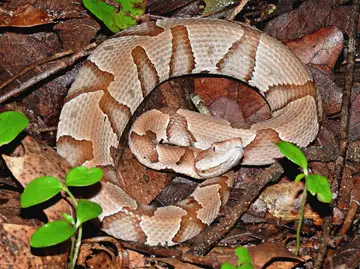
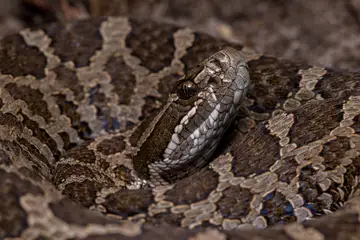
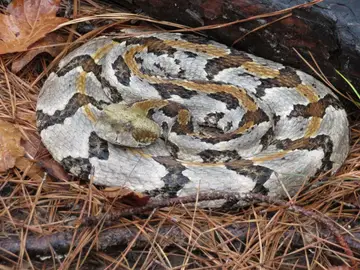
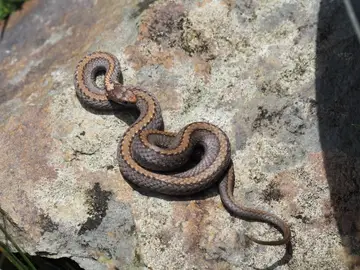
Pennsylvania has 3 venomous snakes named by official sources: Eastern Copperhead, Timber Rattlesnake and Eastern Massasauga. Each one is labelled venomous by Pennsylvania Fish and Boat Commission.
The 3 venomous snakes of Pennsylvania
Recognize them from a distance; a photo cannot confirm that a snake is safe. Identifying animals safely.
“If the strike hits its intended victim, poison may be injected through two hollow fangs connected to glands located on each side and toward the rear of the head. … The venom is a hemotoxin, but with …” Pennsylvania Fish and Boat Commission
Size
Adults usually about 2 to 3 feet (24-36 in); record about 53 inches.
How to recognize it
Vertical (cat-like) pupils and a heat-sensing pit between eye and nostril
Heavy-bodied; keeled scales
Head shape alone is not a reliable way to identify copperheads
Conservation
PA status S = Species of Special Concern (PFBC)
What the sources say
Venom: “One of only three venomous snakes common to Pennsylvania, the eastern copperhead is a close cousin of the cottonmouth or water moccasin found in more southerly aquatic environments.” (Pennsylvania Fish and Boat Commission)
Usually 18 to 30 inches long (New York DEC: 18 to 40 inches, average 27.5). The western massasauga in Arizona reaches only about 22 inches.
How to recognize it
A segmented rattle (a single button in newborns) and vertical, catlike pupils. In Michigan it is the only snake with both.
Nine large plates on top of the head (the timber rattlesnake has many small scales there)
A heat-sensing pit on each side of the head between the eye and nostril; the head is flat and much wider than the neck
Conservation
PA status E = Endangered Species (PFBC)
What the sources say
Venom: “The eastern massasauga is a rattlesnake. It is the smallest of Pennsylvania's three venomous snakes, but the one with the biggest problem.” (Pennsylvania Fish and Boat Commission)
Habitat: A resident of swampy areas, much of its habitat has been drained or dried up. (Pennsylvania Fish and Boat Commission)
“Contrary to popular belief, the timber rattlesnake does not always sound its familiar alarm before striking …” Pennsylvania Fish and Boat Commission
Size
Most adults 36 to 60 inches (3 to 5 feet); record 74.5 inches.
How to recognize it
Black tail ending in a rattle
Heat-sensing pit between nostril and eye
Large, thick head distinct from the neck; cat-like vertical pupil
Conservation
PA status S = Species of Special Concern (PFBC)
JFMAMJJASOND
144 records by month.What the sources say
Venom: “Though not the largest snake found in Pennsylvania, the timber rattlesnake has the distinction of being the largest of our three venomous species.” (Pennsylvania Fish and Boat Commission)
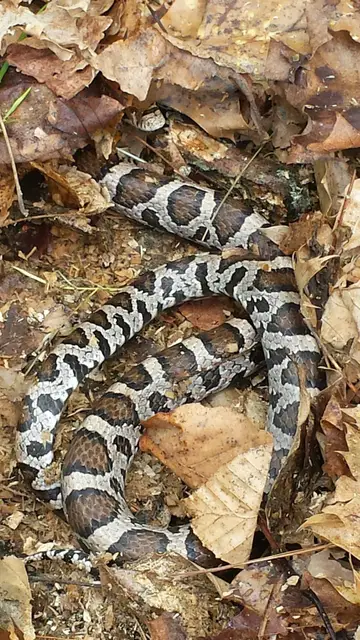
The copperhead's head is coppery with no marks; the milksnake's head is light with brownish marks (Pennsylvania). Tennessee: copperhead has a copper-colored, unmarked head and triangular shapes on the side of the body. Pennsylvania says the eastern milksnake is the snake most often killed by mistake for a copperhead. Belly colour is not used here: Pennsylvania's own pages describe the copperhead belly two different ways (uniform cream in one account, mottled white to gray in another).
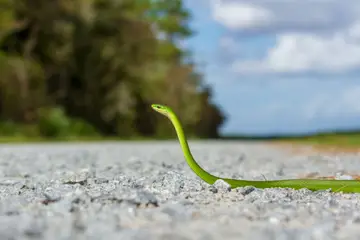
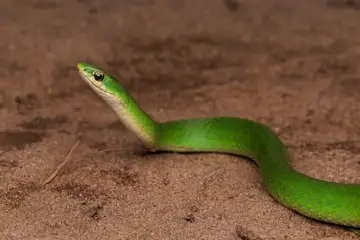
The smooth green snake has smooth scales, is generally smaller and rarely climbs. Missouri: the scales of a rough greensnake feel rough, and the smooth greensnake is a grassland species. SREL: the smooth green snake replaces this species in the Appalachian Mountains and the Northeast.
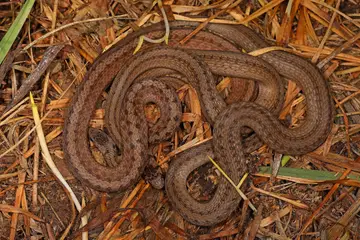
Copperheads have bold hourglass-shaped bands, and young copperheads under about 12 inches have bright yellow tail tips. Brown snakes have small spots, not hourglass bands.
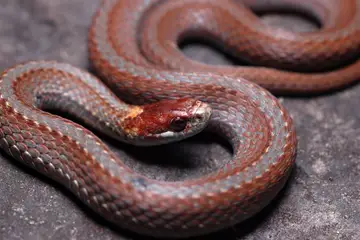
Brown Snake (Dekay's Brownsnake) or Red-bellied Snake?
Missouri: red-bellied snakes are sometimes mistaken for young copperheads. Copperheads are stout-bodied with hourglass-shaped markings on the back, vertical pupils, a sensory pit between each nostril and eye and, sometimes, especially in young copperheads, a yellow tail tip.
Snakebite: call 911 immediately if the person loses consciousness, has chest pain, trouble breathing or throat/tongue swelling; otherwise call Poison Help at 1-800-222-1222 (Pittsburgh Poison Center at UPMC). Pittsburgh Poison Center at UPMC
How to report
Feral swine: report to the Game Commission at 1-833-PGC-WILD (or 1-833-PGC-HUNT). Spotted lanternfly: report online or call 1-888-4BADFLY (PA Dept. of Agriculture). Venomous snake removal: call a local PFBC Waterways Conservation Officer. Nuisance wildlife: PGC region office; USDA-APHIS Wildlife Services 866-487-3297. Pennsylvania Game Commission
“Pennsylvania is home to a diverse population of amphibians and reptiles, including 22 species of salamanders, 21 snakes, 18 frogs and toads, 13 turtles and four lizards.”
Reptiles and Amphibians FAQs. Pennsylvania Fish and Boat Commission. undated page; checked November 3, 2026.Quoted passages (2)
“There are only three venomous snakes native to PA: the Eastern Copperhead, Timber Rattlesnake and Eastern Massasauga.”
“Water Moccasins or Cottonmouths are not native to PA. They are found primarily in the southern states. Their range only goes as far north as southern Virginia.”
Snakes (species accounts). Pennsylvania Fish and Boat Commission. undated page; checked November 3, 2026.Quoted passages (14)
“Although usually quick to flee, the black racer can become a fierce fighter when cornered or somehow made to feel trapped. Left to itself, it is harmless.”
“This relatively small snake is harmless, although it can emit a pungent, unpleasant-smelling musk that may help repel an attacker.”
“Then, inflating the body with air, hissing and striking out, the hog-nosed snake suddenly resembles a fearsome-looking creature, but it is harmless.”
“Often killed by people out of fear, the northern watersnake is not a water moccasin and it is not venomous.”
“One of only three venomous snakes common to Pennsylvania, the eastern copperhead is a close cousin of the cottonmouth or water moccasin found in more southerly aquatic environments.”
“If the strike hits its intended victim, poison may be injected through two hollow fangs connected to glands located on each side and toward the rear of the head. … The venom is a hemotoxin, but with a trace of neurotoxin and as such primarily affects the bloodstream.”
“Though not the largest snake found in Pennsylvania, the timber rattlesnake has the distinction of being the largest of our three venomous species.”
“Contrary to popular belief, the timber rattlesnake does not always sound its familiar alarm before striking. In fact, when striking because of fear or the need to defend itself, more often than not the snake strikes without an audible warning.”
“The eastern massasauga is a rattlesnake. It is the smallest of Pennsylvania's three venomous snakes, but the one with the biggest problem.”
“Nine plates (actually large scales) cover the crown of the head, compared to the timber rattlesnake's numerous small scales.”
“Contrary to popular belief, the timber rattlesnake does not always sound its familiar alarm before striking.”
“Able to tolerate colder temperatures, it leaves the den first in the spring and it's the last to hibernate in the fall.”
“The eastern massasauga is a rattlesnake.”
“Thus, the dark pattern on the milksnake is at its widest across the midline of the back, compared to the narrower dark band on the midline of the copperhead.”
Timber Rattlesnake Conservation. Pennsylvania Fish and Boat Commission. undated page; checked November 3, 2026.Quoted passages (2)
“If you see a snake, of any species, do not kill or attempt to move or capture it. Instead, retreat calmly and allow the animal to continue its course or seek cover.”
“PFBC Waterways Conservation Officers are trained to handle venomous snakes. Call a local officer to have them safely capture the snake and relocate it to a suitable area nearby.”
“If the patient loses consciousness, has chest pain, trouble breathing or a sense of throat/tongue swelling, CALL 911 IMMEDIATELY. … Otherwise, call the regional poison center at 800-222-1222.”
“The copperhead, like so many other reptiles and amphibians, enjoys a day in the sun and often basks on a favorite rock, especially on a warm day in the spring or fall. During the hotter days of summer, the copperhead seeks relief from the piercing rays of the sun and becomes more nocturnal in its habits.”
Feral Swine. Pennsylvania Game Commission. undated page; checked November 3, 2026.Quoted passages (1)
“Any observations of feral swine in the commonwealth should immediately be reported to the Game Commission at 1-833-PGC-WILD or 1-833-PGC-HUNT.”